Mentha Oil Rate: Sambhal Mandi Bhav, MCX and Per Drum Price

Key takeaways
- Today physical spot mentha oil rates across major Uttar Pradesh trading centers (Sambhal, Chandausi, Barabanki) trade in the benchmark range of Rs 940 to Rs 1,010 per kg depending on total L-menthol content (75% to 82%).
- A standard commercial galvanized iron (GI) drum holds exactly 180 kg net weight of crude mentha oil, translating to a per-drum spot value between Rs 1,69,200 and Rs 1,81,800 at prevailing rates.
- On the Multi Commodity Exchange (MCX India), mentha oil trades in contract units of 360 kg (2 drums) with delivery settlement centers centered in Chandausi, Sambhal, and Barabanki.
- India produces over 80% of the world natural mentha oil, with the Terai and Rohilkhand belts of Uttar Pradesh cultivating more than 3.5 lakh hectares of Japanese mint (Mentha arvensis).
- Average farm distillation yield delivers 20 to 25 kg of oil per acre in the first cutting (May-June) and 15 to 20 kg in the second cutting (July), yielding gross farm revenue of Rs 35,000 to Rs 48,000 per acre over a compact 90 to 100 day crop cycle.
- Purity determines final payment: crude oil testing above 78% L-menthol and congealing point above 27 deg C commands a Rs 15 to Rs 30 per kg premium over lower grade or moisture-contaminated lots.
Mentha oil (Japanese mint oil derived from Mentha arvensis) is one of India's most valuable commercial cash crops and essential oil export commodities. India dominates the global essential oil landscape, manufacturing between 75% and 85% of total global natural menthol supplies. Within India, Uttar Pradesh is the undisputed hub, contributing over 80% of total national output from high-intensity cultivation clusters across Sambhal, Chandausi, Barabanki, Sitapur, Rampur, Budaun, and Bareilly.
For commercial mint growers, distillers, and essential oil aggregators, tracking daily mentha oil rates (मेंथा तेल का आज का भाव) is essential for timing distillations and spot physical sales. Unlike regulated grain commodities like paddy and wheat that operate under government Minimum Support Prices (MSP), mentha oil operates under a dynamic free-market mechanism driven by domestic pharmaceutical demand, confectionery consumption, cosmetic manufacturing, and large-scale bulk exports to China, the European Union, and the United States.
Mentha Oil Spot Mandi Rates Today Across Major Trading Hubs
Physical spot transactions take place daily across specialized APMC grain and essential oil mandis in Western and Central Uttar Pradesh. Buyers, known locally as oil arhtiyas and chemical stockists, purchase crude mentha oil in 15 kg tin cans or 180 kg drums directly from farmers who have completed field steam distillation. The table below outlines prevailing physical spot rates, modal prices, and daily trading ranges across major centers:
| Mandi / Trading Hub | State | Min Rate (Rs/kg) | Max Rate (Rs/kg) | Modal Rate (Rs/kg) | 180 kg Drum Value (Rs) | Primary Variety / Grade |
|---|---|---|---|---|---|---|
| Sambhal APMC | Uttar Pradesh | Rs 960 | Rs 1,005 | Rs 985 | Rs 1,77,300 | Shivalik / Kosi (78-81% Menthol) |
| Chandausi APMC | Uttar Pradesh | Rs 965 | Rs 1,010 | Rs 990 | Rs 1,78,200 | CIM-Kranti / Kosi (Premium Export Grade) |
| Barabanki Mandi | Uttar Pradesh | Rs 940 | Rs 980 | Rs 960 | Rs 1,72,800 | Damroo / Shivalik (76-79% Menthol) |
| Viswan (Sitapur) | Uttar Pradesh | Rs 935 | Rs 975 | Rs 955 | Rs 1,71,900 | Local Arvensis (Standard Grade) |
| Rampur APMC | Uttar Pradesh | Rs 950 | Rs 990 | Rs 970 | Rs 1,74,600 | Kosi / CIMAP Saryu (78% Menthol) |
| Budaun Mandi | Uttar Pradesh | Rs 945 | Rs 985 | Rs 965 | Rs 1,73,700 | Shivalik (77-80% Menthol) |
| Bareilly APMC | Uttar Pradesh | Rs 940 | Rs 980 | Rs 960 | Rs 1,72,800 | Mixed Commercial Grade |
| Lakhimpur Kheri | Uttar Pradesh | Rs 930 | Rs 970 | Rs 950 | Rs 1,71,000 | Terai Belt Standard Distillation |
| Aligarh / Hathras | Uttar Pradesh | Rs 945 | Rs 985 | Rs 965 | Rs 1,73,700 | Semi-Refined Crude Mentha |
| Ambala / Yamunanagar | Haryana | Rs 950 | Rs 995 | Rs 975 | Rs 1,75,500 | Regional Processing Grade |
Spot rates fluctuate daily based on spot arrival volumes, warehouse inventory levels, and futures settlement quotes. Producers can monitor live arrivals on our mandi rates live tracker, analyze price seasonality on the mandi price trends portal, compute batch profits with our crop income calculator, and access regional extension services via our Uttar Pradesh farming hub.
MCX Mentha Oil Futures Contract Specifications & Spot Linkage
The Multi Commodity Exchange of India (MCX India) operates the primary electronic derivatives benchmark for mentha oil, while official daily spot prices across major mandis are tracked on Agmarknet. While physical farmers rarely deliver directly onto the exchange warehouse, the MCX futures settlement price serves as the definitive pricing benchmark that local arhtiyas and wholesale processors use to quote daily village and APMC spot buying rates.
Understanding how MCX futures contracts function helps producers anticipate price turns and evaluate whether to sell their oil fresh out of the field distillation tub or warehouse it in drums for post-harvest price recovery.
| Parameter | MCX Contract Specification Detail | Physical Market Significance |
|---|---|---|
| Trading Symbol | MENTHAOIL | Official ticker used on MCX terminals and market tickers. |
| Contract Trading Unit | 360 kg | Equivalent to exactly 2 standard galvanized commercial export drums. |
| Quotation / Base Unit | Rs per kg | Matches local village and APMC per-kilogram quotes. |
| Tick Size (Minimum Fluctuation) | Rs 0.10 per kg | A 10-paise movement equals Rs 36 profit or loss per lot. |
| Daily Price Limits (Circuit Filter) | 4% (+/- 2% initial, with 15-min cooling period) | Limits extreme speculative volatility during harvest arrival months. |
| Delivery Unit & Lot Size | 360 kg (gross container with standard 180 kg net drums) | Minimum physical delivery quantum accepted at accredited warehouses. |
| Delivery Center | Chandausi (Compulsory delivery center in Sambhal district, UP) | The primary regional delivery hub; additional delivery center at Barabanki. |
| Quality Standards on MCX | Total Menthol: Min 70% | Congealing Point: Min 14.5 deg C | Official MCX minimum specifications; premium grades command spot premiums. |
| Trading Hours | Monday to Friday: 9:00 AM to 5:00 PM IST | Physical mandis adjust evening quotes to mirror MCX market closing prices. |
Per Drum, Per Quintal & Per Tin Mentha Oil Conversion Guide
In village-level transactions, mentha oil is rarely weighed in single kilograms alone. Smallholders bring their distilled oil in 15 kg square metal tins (identical to edible ghee/mustard oil tins), whereas mid-sized distillers and commercial traders store and transport mentha oil in heavy-duty galvanized iron (GI) drums. Understanding exact tare weight deductions and unit conversions is essential to ensure you receive fair compensation.
- Standard Export GI Drum Weight: Net mentha oil content is standardized at exactly 180.00 kg. Empty drum tare weight ranges between 15.00 kg and 17.50 kg, yielding a total gross drum weight of approximately 195.00 kg to 197.50 kg.
- Domestic 15 kg Metal Tin: Standard smallholder container holding 15.00 kg net essential oil. Empty tin tare weight is typically 0.85 kg to 1.00 kg.
- Commercial Quintal Metric: 1 Quintal equals exactly 100 kg. When traders quote "Mentha oil per quintal bhav", divide the quoted figure by 100 to get the exact per-kilogram rate.
- Tare Deduction Rule: Never allow buyers to deduct arbitrary tare weight beyond the actual certified empty container tare. Always weigh an empty tin or empty drum on a calibrated electronic scale before filling.
| Rate per Kg (Rs) | 15 kg Tin Value (Rs) | 50 kg Half-Drum Value (Rs) | 1 Quintal / 100 kg Value (Rs) | 1 Drum / 180 kg Net Value (Rs) | 1 MCX Lot / 360 kg Value (Rs) |
|---|---|---|---|---|---|
| Rs 900 | Rs 13,500 | Rs 45,000 | Rs 90,000 | Rs 1,62,000 | Rs 3,24,000 |
| Rs 925 | Rs 13,875 | Rs 46,250 | Rs 92,500 | Rs 1,66,500 | Rs 3,33,000 |
| Rs 950 | Rs 14,250 | Rs 47,500 | Rs 95,000 | Rs 1,71,000 | Rs 3,42,000 |
| Rs 975 | Rs 14,625 | Rs 48,750 | Rs 97,500 | Rs 1,75,500 | Rs 3,51,000 |
| Rs 1,000 | Rs 15,000 | Rs 50,000 | Rs 1,00,000 | Rs 1,80,000 | Rs 3,60,000 |
| Rs 1,025 | Rs 15,375 | Rs 51,250 | Rs 1,02,500 | Rs 1,84,500 | Rs 3,69,000 |
| Rs 1,050 | Rs 15,750 | Rs 52,500 | Rs 1,05,000 | Rs 1,89,000 | Rs 3,78,000 |
| Rs 1,100 | Rs 16,500 | Rs 55,000 | Rs 1,10,000 | Rs 1,98,000 | Rs 3,96,000 |
| Rs 1,150 | Rs 17,250 | Rs 57,500 | Rs 1,15,000 | Rs 2,07,000 | Rs 4,14,000 |
Distillation Yield Economics & Per Acre Profit Calculation
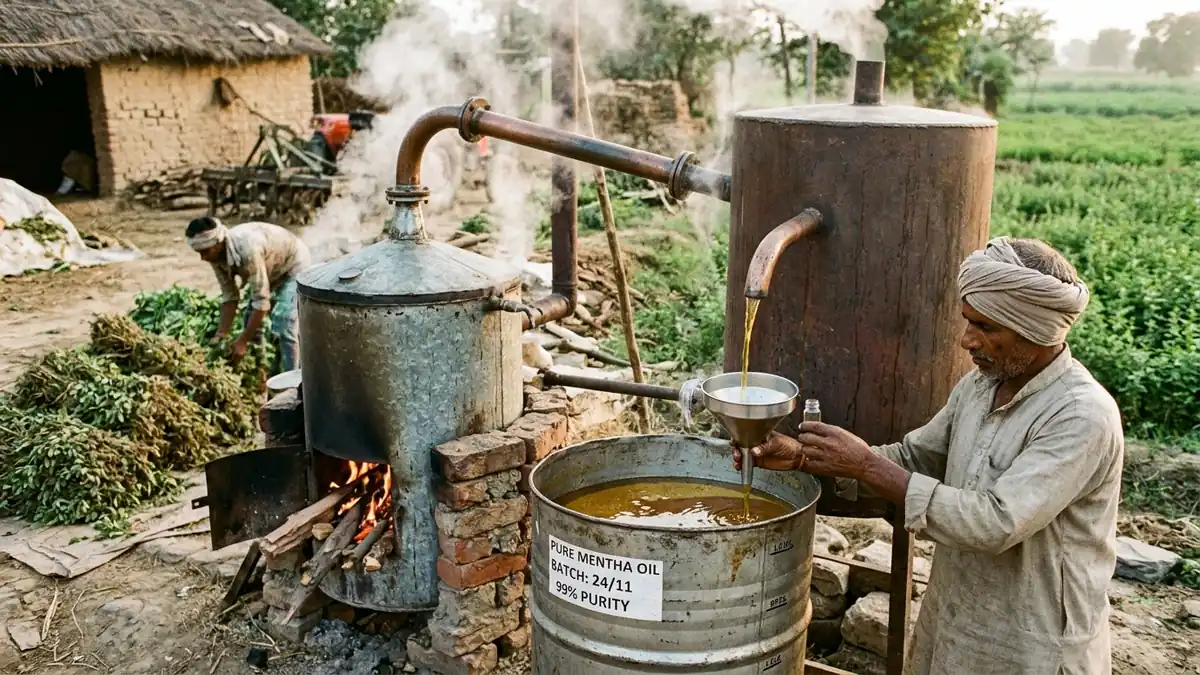
Mentha arvensis is cultivated as a short-duration summer cash crop, predominantly planted during February and March following the harvest of potato, mustard, or early sugarcane. Field distillation converts fresh green foliage into liquid essential oil using direct steam or water-and-steam distillation units (भपका संयंत्र).
Understanding distillation recovery metrics enables farmers to assess their real cost of production and ensure field boiling plants operate at peak thermodynamic efficiency:
- Fresh Biomass Extraction Recovery: Freshly harvested, shade-wilted mentha herb contains between 0.70% and 1.25% essential oil by weight. One tractor trolley carrying approximately 20 to 25 quintals (2,000 to 2,500 kg) of properly wilted herb yields between 18 kg and 26 kg of crude oil.
- First Cutting Yield (May - June): After 90 to 105 days of vegetative growth, the first cutting yields between 100 and 125 quintals of fresh herb per acre, generating 20 to 25 kg of crude mentha oil.
- Second Cutting / Ratoon Yield (July): Allowing the crop to regenerate for 45 to 55 days yields a second cutting of 70 to 90 quintals of herb per acre, generating an additional 15 to 20 kg of crude mentha oil.
- Total Cumulative Yield: High-yielding varieties developed by CSIR-CIMAP (such as CIM-Kranti, Kosi, and CIMAP Saryu) yield a combined 35 to 45 kg of essential oil per acre across two harvest cycles.
- Gross Farm Revenue: At a prevailing median rate of Rs 980 per kg, an output of 40 kg per acre generates Rs 39,200 in gross revenue within approximately 120 to 140 days of total field occupancy.
- Production Costs: Land preparation, suckers/rhizome planting, irrigation (mentha requires 8-12 irrigations during hot summer months), fertilizer (120 kg N, 60 kg P2O5, 40 kg K2O per hectare), and distillation fuel/boiler fees typically total Rs 14,000 to Rs 18,000 per acre, leaving a net farmer profit of Rs 20,000 to Rs 25,000 per acre.
To finance inputs like suckers, high-grade water-soluble fertilizers, and distillation plant operations, farmers can leverage low-interest formal credit through the Kisan Credit Card (KCC) framework, and consult CSIR-CIMAP varietal research bulletins.
Purity Grading & Quality Factors That Dictate Farmer Payouts
Crude mentha oil is not a uniform commodity. Its price is directly tied to the concentration of active chemical constituents, particularly free L-menthol. Before buying large consignments, commercial arhtiyas and chemical laboratories test samples using portable hydrometers, refractometers, or Gas Chromatography (GC) analysis:
| Quality Grade | Total L-Menthol Content (%) | Congealing Point (deg C) | Specific Gravity (at 25 deg C) | Visual Appearance & Odor | Market Pricing Impact |
|---|---|---|---|---|---|
| Grade 1 / Super Premium | Above 78.0% | Above 27.5 deg C | 0.890 to 0.905 | Colorless to pale yellow, crisp mint scent | Full market rate + Rs 15 to Rs 25/kg premium |
| Grade 2 / Standard FAQ | 72.0% to 77.9% | 24.0 to 27.0 deg C | 0.895 to 0.910 | Pale yellow, clean characteristic scent | Standard prevailing APMC modal benchmark rate |
| Grade 3 / Sub-Standard | 68.0% to 71.9% | 20.0 to 23.5 deg C | 0.900 to 0.915 | Yellowish, faint smoky or damp odor | Discounted by Rs 30 to Rs 60/kg |
| DMO (Dementholized Oil) | 30.0% to 45.0% | Below 10.0 deg C | 0.888 to 0.900 | Residual oil after menthol crystallization | Trades at 40% to 50% discount to crude mentha |
| Adulterated / Burnt Lot | Variable / Low | Fails congealing test | Above 0.920 | Dark yellow to brownish, burnt smokiness | Severe rejection or refinery reclamation discount |
Three common farmer mistakes can lead to severe price deductions at the mandi: (1) harvesting foliage immediately after rainfall or over-irrigation when oil concentration drops; (2) over-wilting the herb under direct scorching sunlight, which evaporates high-volatility terpenes; and (3) boiling herb in rusty distillation tubs with burnt bottom residue, which discolors the oil and introduces off-notes.
Key Domestic & Global Market Price Drivers for Mentha Oil
Because mentha oil is an internationally traded industrial raw material rather than a domestic food grain, its price trajectory is determined by macroeconomic forces, industrial consumption cycles, and global currency dynamics:
- International Pharmaceutical & Confectionery Demand: Global demand for natural menthol crystals, mentha oil derivatives, and peppermint flavorings in oral care (toothpaste, mouthwash), cough lozenges, balms (Vicks, Tiger Balm), and confectionery dictates off-take. Strong buying orders from China, Germany, and the United States push Sambhal and Chandausi spot rates upward.
- Competition from Synthetic Menthol: The commercial production of petrochemically synthesized menthol by global chemical conglomerates (notably BASF in Germany and Symrise) caps the ceiling price of natural menthol. Whenever natural mentha oil rises above Rs 1,400 to Rs 1,500 per kg, industrial consumers substitute with cheaper synthetic menthol, forcing natural prices back down.
- Acreage Shifts & Competing Kharif Crops: If mentha oil prices collapse in a given year, farmers in Sambhal and Budaun shift acreage to spring maize, summer pulses (moong/urad), or early sunflower. Lower planting acreage reduces the next season's harvest, triggering supply shortages and cyclical price rallies.
- Monsoon Timing and Distillation Windows: The onset of pre-monsoon showers in Western UP dictates the second cutting harvest. Early heavy rainfall waterlogs fields, washes away foliar oil glands, rots stems, and curtails distillation, abruptly squeezing market arrivals and sparking spot price surges.
- Warehouse Carryover Stocks: Central warehousing facilities in Chandausi, Sambhal, and Barabanki store thousands of drums. High carryover stock at the start of the summer harvesting cycle dampens opening prices, whereas lean warehouse inventories allow farmers to command aggressive opening bids.
GST, Mandi Tax & Legal Compliance for Selling Mentha Oil
Mentha oil transactions involve distinct commercial taxation rules compared to regular exempt farm agricultural produce:
- GST Classification (HSN 3301): Essential oils of mint, including crude mentha oil, attract 12% Goods and Services Tax (GST) when sold by registered dealers, processors, and exporters. When individual farmers sell their own unrefined, farm-distilled crude oil directly in primary agricultural mandis, they are generally treated as unregistered agriculturalists exempt from mandatory GST registration.
- Mandi Cess / User Fee: In Uttar Pradesh APMC mandis, commercial buyers and commission agents pay mandi shulk (market fee) typically ranging from 1% to 1.5% alongside a Vikas Upkar (development cess) of 0.5%.
- Electronic Way Bill (E-Way Bill): Transporting mentha oil consignments valued above Rs 50,000 requires a mandatory GST E-Way Bill generated on the national e-way bill portal. Because a single 180 kg drum of mentha oil exceeds Rs 1,70,000 in value, moving even one drum inter-district requires strict transit documentation to prevent confiscation by commercial tax authorities.
- Storage Safety Guidelines: Mentha oil is a flammable, volatile essential oil classified under industrial chemical transport protocols. Always store drums in shaded, well-ventilated brick warehouses away from direct electrical sparks, heat sources, and open flames.
Direct Selling Tips: How Farmers Can Maximize Realizations
Small and medium farmers frequently lose between Rs 30 and Rs 70 per kg simply due to poor post-harvest handling and selling under distressed conditions during peak June arrivals. Implement these practical harvest strategies to maximize your farm gate return:
- Wilt Herb in the Shade: After field harvesting with a sharp sickle, leave the cut herb in loose windrows under field shade for 2 to 4 hours. Do not allow thick heaps of wet green herb to ferment or heat up, as microbial decomposition burns volatile menthol.
- Use Clean Cooling Water in Condensers: Warm condensation coils fail to condense light essential oil vapors, resulting in oil escape through the condenser vent pipe. Maintain a constant flow of cold tube-well water through the condenser tank.
- Separate Water Completely with Florentine Receiver: Never sell oil containing milky water droplets. Let distilled oil stand in a clean conical separating flask (Florentine vessel) for 2 to 3 hours, then siphon off the heavier bottom water layer. Moisture causes rapid hydrolysis and sour odor.
- Store in Food-Grade Epoxy-Lined or Galvanized Drums: Never store crude mentha oil in unlined black mild steel drums or cheap recycled blue plastic cans. Plastic leaches plasticizers into the oil, rendering it unsellable for export, while bare iron catalytically oxidizes the liquid.
- Form Grower Collectives / FPOs: Individual farmers with 2 to 3 tins have zero bargaining power with local village middlemen. Pooling production through a Farmer Producer Organization (FPO) allows farmers to aggregate 20 to 50 drums and invite competitive spot bids directly from leading exporters in Delhi, Sambhal, and Mumbai.
To insulate against harvest losses, growers can review guidelines on PM Fasal Bima Yojana, calculate premiums with our crop insurance calculator, monitor rain forecasts via our agricultural weather tracker, balance NPK doses using the fertilizer calculator, and verify field soil profiles with soil testing protocols. Varietal research from CSIR-CIMAP Lucknow has raised menthol recovery significantly, while distillers can compute working capital on our KCC loan calculator and apply through the Kisan Credit Card scheme.
Frequently asked questions
- What is today mentha oil rate in Sambhal and Chandausi mandis?
- The indicative mentha oil spot rate in Sambhal and Chandausi APMC mandis (November 2026) was between Rs 960 and Rs 1,010 per kg for FAQ export grade (78% to 81% L-menthol content), with modal transactions settling around Rs 985 per kg. You can check daily physical mandi arrivals on our mandi rates live tracker and the official Agmarknet portal.
- What is the price of one full commercial drum of mentha oil today?
- One commercial galvanized iron export drum contains exactly 180 kg net weight of mentha oil, translating to a current spot market value of Rs 1,72,800 to Rs 1,81,800. To hedge against price volatility, review contract specifications on MCX India and analyze seasonal price cycles with our mandi price trends portal.
- How many kilograms of mentha oil are produced from one acre of land?
- One acre of Japanese mint (Mentha arvensis) yields an average of 35 to 45 kg of crude essential oil across two cuttings: 20 to 25 kg during the first cutting in May-June, and 15 to 20 kg during the second cutting in July. High-yielding varieties developed by CSIR-CIMAP Lucknow maximize oil recovery, and growers can compute working capital via our KCC loan calculator.
- What is the lot size and delivery unit for mentha oil on MCX India?
- On the Multi Commodity Exchange (MCX India), 1 trading lot of mentha oil equals exactly 360 kg (the equivalent of 2 standard commercial export drums), with compulsory physical delivery settlement centered in Chandausi, Uttar Pradesh.
- What is the difference between crude mentha oil and dementholized oil (DMO)?
- Crude mentha oil is the whole essential oil obtained directly from field steam distillation containing 75% to 82% natural menthol, whereas Dementholized Oil (DMO) is the residual liquid left behind after cooling and crystallizing out the solid menthol crystals, containing only 30% to 45% menthol.
- Why does mentha oil freeze or turn solid in winter?
- Pure natural mentha oil naturally congeals and crystallizes at temperatures below 24 deg C to 28 deg C because of its high concentration of pure L-menthol, which has a natural melting point of approximately 42 deg C. Solidification in cool weather is a primary physical indicator of high menthol purity.
- Which variety of mentha yields the highest oil percentage and menthol content?
- High-yielding varieties released by CSIR-CIMAP Lucknow, particularly Kosi, CIM-Kranti, CIMAP Saryu, and Damroo, deliver the highest oil recovery (0.9% to 1.2% on fresh herb weight) and consistently test above 78% to 82% L-menthol content.
- Is GST applicable on farmers selling crude mentha oil at the mandi?
- Individual agricultural farmers selling unrefined crude mentha oil derived from their own field cultivation are classified as exempt agricultural producers. However, registered commercial traders, commission brokers, and essential oil processors are subject to 12% GST under HSN code 3301.
- How should farmers store mentha oil to prevent weight loss and quality deterioration?
- Mentha oil should be stored in airtight, galvanized iron (GI) or epoxy-coated steel drums filled to 95% capacity with zero water content, placed in a cool, dark, well-ventilated godown away from direct sunlight and plastic containers.
- When does mentha oil price usually reach its seasonal peak during the year?
- Mentha oil prices historically reach seasonal lows during peak summer harvesting arrivals in June and July, and rise to seasonal highs between November and February when winter pharmaceutical demand spikes and physical market arrivals dry up.
This article is for general information only and is not financial advice. Loan and scheme eligibility depends on partner and government criteria.