National Certified Seeds, Seed Rate & Germination Testing Portal
Eliminate under-sowing and over-sowing crop losses. Calculate exact seed rates adjusted for 1000-grain test weight, test seed viability with our Rag Doll simulator, master the strict F-I-R chemical slurry protocol, and claim up to 50% Seed Village subsidies.
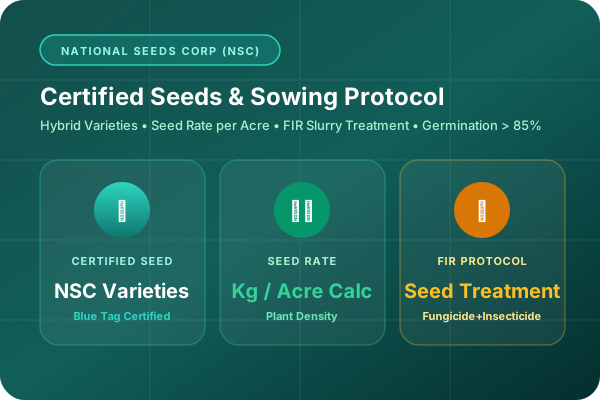
Crop Seed Rate & Plant Population Calculator
Crop Seed Rate & Plant Population Calculator
Calculate precise seed requirements per acre adjusted for 1000-grain test weight, laboratory germination percentage, and field emergence capacity.
Official certification standard for Wheat Certified High-Yield Seeds: 85%
Reflects seedbed moisture, clod fineness, and sowing depth (Default 90% for well-prepared soil).
Effective Seed Rate: 9.4 kg / acre (Standard: 40 kg/acre)
Increase seed rate by 20% if sowing after November 25th to compensate for reduced tillering.
Rag Doll Germination Testing & Compensation Simulator
Interactive Germination Testing & Compensation Engine
Evaluate seed lot viability using the ICAR-recommended Rag Doll or Blotter Paper method. Discover if your seed lot is certified grade or needs seed rate compensation.
Well-developed radical (root) and plumule (shoot) capable of healthy field establishment.
Damaged roots, stunted hypocotyl, albino, or cracked cotyledons (not counted as germinated).
Rotten, infected with fungi, or hard impervious seeds that failed to absorb moisture.
Official Certification Standard for Wheat Certified High-Yield Seeds: 85%
Safe for standard field sowing. Optimal emergence and seedling vigor expected.
How to Conduct the 100-Seed Rag Doll Test at Home
- Sample: Draw 100 seeds randomly from deep inside the seed bag (not just the top).
- Arrange: Moisten a clean jute sack or paper towel. Place seeds in a 10 × 10 grid.
- Roll & Moisten: Roll carefully around a wooden stick, tie ends loosely, and keep in a cool, shady spot for 5 to 7 days, sprinkling water twice daily.
- Count: Unroll and count strong, vigorous seedlings. Seeds with only weak, split roots are abnormal.
Scientific F-I-R Slurry & Chemical Dosage Engine
F-I-R Seed Treatment Slurry & Dosage Calculator
Calculate exact dosages of Fungicide (F), Insecticide (I), and Rhizobium / Biofertilizer (R) per batch to prevent 90% of early seedling mortality.
Coats the outer seed hull to destroy seed-borne spores and prevent soil-borne seedling rot.
Systemic chemical absorption protects young shoots from termites and sap-sucking pests for 25-30 days.
Live beneficial bacteria form symbiotic root nodules for biological nitrogen fixation and phosphorus uptake.
The Golden Agronomy Rule: NEVER INVERT THE 'F-I-R' SEQUENCE!
Rhizobium and Azotobacter cultures contain living biological bacteria. If you apply biofertilizers before fungicides, the chemical fungicide will kill 100% of the beneficial microbes within minutes. Always treat with Fungicide first, let dry, then Insecticide, and inoculate with Rhizobium last just before sowing.
Standard Seed Treatment Slurry Mixing Protocol
Understanding Official Seed Certification Tags in India
Under the Indian Seeds Act, 1966, seeds are certified into 4 distinct statutory classes. Always check tag color and lot credentials before sowing.
Breeder Seed
Direct primary progeny produced under strict scientific vigilance. Sown by NSC to multiply Foundation Seed.
Foundation Seed
Progeny of breeder seed grown on recognized government farms, maintaining strict spatial isolation distances.
Certified Seed
Official certified seed distributed to farmers. Meets minimum germination standards and disease tolerances.
Truthfully Labelled (TL)
Producer takes voluntary responsibility for genetic purity and minimum germination without field inspection.
National & State Seed Corporations (SSC) Directory
Buy authentic certified seeds at controlled statutory prices directly from official state nodal agencies.
National Seeds Corporation (NSC)
500+ ICAR varieties distributed via 8,000+ dealer network
Mahabeej (MSCSCL)
Pioneer in Soybean (JS 335, JS 20-34) & Cotton seeds
HSDC (Haryana Seeds)
Premier producer of certified Wheat (HD 2967, WH 1105) & Mustard
PUNSEED (Punjab Seeds)
Certified Basmati Paddy (PR 126, Pusa 1121) & HD 3086 Wheat
MP Rajya Beej Nigam
Largest producer of Certified Gram (JG 14), Arhar & Soybean
UP Seeds Corporation
50% Seed Village subsidy distribution across 75 districts
RSSC (Raj Seeds)
Drought-tolerant Mustard (Giriraj), Bajra & Moong certified lots
AP Seeds Development Corp
High-yielding BPT 5204 (Samba Mahsuri) & Groundnut K-6 seed
Explore Certified Varieties & Sowing Norms by Crop
Detailed test weights, maturity days, potential yields, and FIR slurry guides for 10 staple & commercial crops.
Paddy / Rice Certified Seeds
प्रमाणित धान / चावल बीज • Oryza sativa L.
Wheat Certified High-Yield Seeds
प्रमाणित गेहूं बीज (उन्नत किस्में) • Triticum aestivum L.
Soybean Certified Seeds & Inoculants
प्रमाणित सोयाबीन बीज एवं राइजोबियम • Glycine max (L.) Merr.
Mustard & Rapeseed High-Oil Seeds
प्रमाणित सरसों / राई बीज (उच्च तेल प्रतिशत) • Brassica juncea (L.) Czern.
Bt Cotton Bollgard-II Hybrid Seeds
बी.टी. कपास हाइब्रिड बीज (बोलगार्ड-II) • Gossypium hirsutum L.
Chickpea / Gram Certified Seeds (Desi & Kabuli)
प्रमाणित चना बीज (देसी एवं काबुली) • Cicer arietinum L.
Hybrid Maize / Corn Seeds
संकर मक्का बीज (उच्च पैदावार) • Zea mays L.
Groundnut / Peanut Certified Kernels
प्रमाणित मूंगफली बीज (दाना) • Arachis hypogaea L.
Pigeonpea / Arhar (Tur) Certified Seeds
प्रमाणित अरहर / तुअर बीज (दाल किस्में) • Cajanus cajan (L.) Millsp.
Green Gram / Moong Certified Seeds
प्रमाणित मूंग बीज (जायद एवं खरीफ) • Vigna radiata (L.) R. Wilczek
Certified Seeds & Crop Sowing: Top Farmer AI Search Prompts
Verified agronomic answers to high-volume conversational queries submitted by Indian farmers regarding onion varieties, mustard cultivation, and certified blue tag standards.
QWhich onion seed variety is best for high yield in India and where can I buy affordable seeds?
For Kharif onion cultivation, Bhima Super (yielding 200–250 q/ha in 100–105 days) and N-53 are the top high-yielding varieties. For Rabi cultivation, Bhima Dark Red, Bhima Kiran, and Agrifound Light Red offer excellent storability (5–6 months shelf life) and yields of 300–350 q/ha. Farmers can buy certified truthful-label seeds at government subsidized rates directly from ICAR-DOGR Rajgurunagar, National Seeds Corporation (NSC) sale counters, and State Beej Nigams (e.g. Mahabeej in Maharashtra, MP Beej Nigam).
Seed rate for nursery raising is 3 to 4 kg per acre. Ensure seed treatment with Trichoderma viride (5g/kg) to eliminate damping-off disease.
QWhat is the recommended seed rate, spacing, and sowing time for mustard cultivation in India?
The recommended mustard seed rate is 1.5 to 2.0 kg per acre (4 to 5 kg/ha). The ideal sowing window is October 1 to October 25 when ambient temperatures settle between 26°C and 28°C. Recommended spacing is 30–45 cm row-to-row with 10–15 cm plant-to-plant spacing after thinning at 15–20 days. Top certified varieties include Giriraj (DRMRIJ-31), RH-749, and Pusa Bold, yielding 8–10 quintals per acre with 38%–42% oil content.
Treat seeds with Carbendazim (2g/kg) followed by Apron 35 SD (6g/kg) to prevent white rust and downy mildew.
QWhat are the core differences between Breeder, Foundation, and Certified seeds in India?
Breeder Seed (Golden Yellow Tag) has 99.9% genetic purity produced directly by plant breeders. Foundation Seed (White Tag, 99.5% purity) is the progeny of breeder seed multiplied on government research farms. Certified Seed (Blue Tag, ≥98% purity, 70%–85% germination) is the commercial progeny distributed to farmers for grain production. Commercial farmers should always buy Blue Tag certified seed.
Never purchase untagged or loose seeds from unauthorized local traders without a GST tax invoice and lot certificate.
QWhy must the FIR sequence (Fungicide → Insecticide → Rhizobium) be followed during seed treatment?
Rhizobium, PSB, and Trichoderma biofertilizers contain live living beneficial microorganisms. If biological agents are mixed directly with chemical fungicides (like Thiram or Carbendazim), the chemical kills all live bacteria within minutes. In the FIR sequence: (1) Fungicide is applied first to eliminate seed-borne pathogens; (2) Insecticide (e.g. Imidacloprid) is applied for soil pests; and (3) Rhizobium / Biofertilizer is applied last, just 1–2 hours before sowing, ensuring viable root nodulation.
Always allow seeds to shade-dry for 30 minutes between chemical coating and bacterial inoculation.
QHow can farmers verify the authenticity of National Seeds Corporation (NSC) seed bags on SATHI?
Farmers can scan the QR code printed on the official Blue Certification Tag using any smartphone camera or the SATHI App (sathi.cagri.gov.in). The portal immediately verifies the seed lot details, including producer name, seed testing laboratory report, germination percentage, physical purity, and expiry date, protecting farmers against counterfeit spurious seed lots.
SATHI is the central traceability platform established by the Ministry of Agriculture & Farmers Welfare.
Frequently Asked Questions on Certified Seeds & Sowing
FAQ
Frequently asked questions
Save & Print Your Seed Rate & FIR Slurry Protocol
Take calculated seed quantities and chemical mixing instructions to your nearest Krishi Vigyan Kendra (KVK) or input retailer.