Paddy Procurement in India: MSP Rates, Portals & DBT Guide
Key takeaways
- Paddy procurement in India is conducted at Minimum Support Price (MSP) under the Central Pool by Food Corporation of India (FCI) and State Civil Supplies Agencies, handling over 700 to 800 lakh metric tonnes of paddy annually.
- For Kharif Marketing Season (KMS) 2024-25, the central government fixed MSP at ₹2,300 per quintal for Paddy (Common) and ₹2,320 per quintal for Paddy (Grade A); for KMS 2025-26, MSP is ₹2,369 for Common and ₹2,389 for Grade A.
- Farmers must register on their respective state procurement portal (such as e-Uparjan, Anaaj Kharid, Meri Fasal Mera Byora, or e-Kharid UP) using Aadhaar, land record documents (Khasra and Khatauni), and active bank accounts mapped for Direct Benefit Transfer (DBT).
- Grain brought to purchase centres must meet FCI Fair Average Quality (FAQ) standards: maximum moisture content cannot exceed 17%, inorganic foreign matter must stay below 1%, organic foreign matter below 1%, and damaged or discoloured grains under 5%.
- Procurement proceeds are transferred directly into the farmer Aadhaar-seeded bank account through the Public Financial Management System (PFMS) within 48 to 72 hours of issuing an official weighment receipt (J-Form or W-Form).
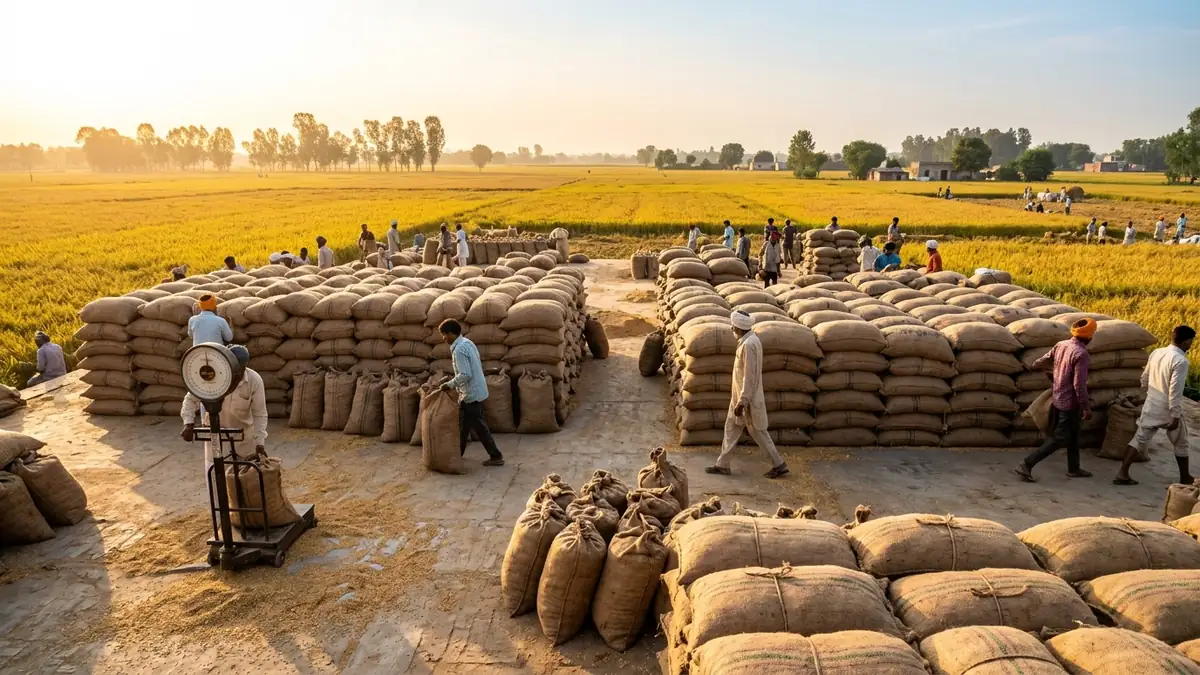
Paddy procurement in India is the world's largest government-backed agricultural grain purchase operation, guaranteeing millions of rice growers a remunerative price for their harvest while securing national food reserves for public distribution. Every year during the Kharif Marketing Season (KMS) and Rabi Marketing Season (RMS), the Food Corporation of India (FCI) alongside state civil supplies corporations, marketing federations, and Primary Agricultural Credit Societies (PACS) opens tens of thousands of temporary procurement centres across rural India. For smallholder and marginal farmers, selling paddy through official government procurement channels prevents distress sales to local village middlemen and private traders who frequently purchase grain far below official Minimum Support Price (MSP) benchmarks. Verify related KisanPe comparisons and official portal references via PIB.
Taking full advantage of government paddy procurement requires navigating a structured process: online farmer registration, revenue land record verification, mandi slot booking, grain moisture testing, physical weighment, and digital payment clearance. Whether managing field operations (detailed in our rice farming management guide), monitoring open-market arrivals via our mandi rates live tracker, or analyzing historical price swings on our mandi price trends portal, this guide explains official MSP benchmarks, moisture refraction norms, and state-specific DBT clearance timelines.
What is paddy procurement and how does the MSP mechanism operate?
Paddy procurement refers to the physical purchase of unhusked rice (paddy or dhan) from farmers by state agencies and the Food Corporation of India at the government-mandated Minimum Support Price (MSP). The harvested paddy enters the Central Pool of foodgrains, where it is milled into custom-milled rice (CMR) and stored in FCI silos and warehouses. This grain supplies the National Food Security Act (NFSA), the Pradhan Mantri Garib Kalyan Anna Yojana (PMGKAY), welfare hostels, disaster relief operations, and the Open Market Sale Scheme (Domestic) to stabilize domestic rice inflation.
Government paddy procurement operates through two primary administrative models across Indian states:
- Decentralized Procurement Scheme (DCP): Under the DCP system, designated state government agencies procure, store, mill, and distribute paddy and rice locally for their targeted public distribution systems. Surplus grain beyond the state's internal food distribution requirement is handed over to the Food Corporation of India for transfer to grain-deficit states. Leading DCP states include Chhattisgarh, Odisha, Madhya Pradesh, West Bengal, Tamil Nadu, Andhra Pradesh, Telangana, Bihar, and Uttar Pradesh.
- Non-Decentralized Procurement (Non-DCP): In non-DCP states, the Food Corporation of India directly purchases grain or takes over the entire stock procured by state agencies immediately after purchase and milling. The central pool manages all logistics, inter-state rail movements, and national buffer storage. Punjab and Haryana represent the primary non-DCP procurement regions in north India.
The Department of Food and Public Distribution (DFPD) coordinates national procurement operations alongside the Food Corporation of India (FCI), publishing seasonal operational guidelines and allocating cash-credit limits (CCL) through consortium banks led by the State Bank of India and Reserve Bank of India to finance upfront farmer disbursements.
Official MSP rates for paddy: KMS 2024-25 and KMS 2025-26
The Minimum Support Price for paddy is announced prior to the kharif sowing season by the Cabinet Committee on Economic Affairs (CCEA), chaired by the Prime Minister. The rates are calculated based on the recommendations of the Commission for Agricultural Costs and Prices (CACP), which evaluates comprehensive cultivation expenses (A2+FL cost formula covering all paid-out costs on seeds, fertilizer, fuel, hired labour, plus imputed value of family labour) ensuring a minimum 50 percent return margin over production costs.
The government classifies paddy into two distinct commercial grades for procurement purposes: Paddy (Common) and Paddy (Grade A). Paddy (Grade A) consists of superior varieties with longer, slender grain dimensions (length-to-breadth ratio greater than 2.5), demanding a consistent ₹20 per quintal price premium over Common varieties.
| Marketing Season | Paddy (Common) MSP (Rs/Qtl) | Paddy (Grade A) MSP (Rs/Qtl) | Net Annual Hike (Rs/Qtl) | Central Procurement Target (Rice LMT) |
|---|---|---|---|---|
| KMS 2023-24 | 2,183 | 2,203 | +143 | 521.27 LMT |
| KMS 2024-25 | 2,300 | 2,320 | +117 | 485.00 LMT |
| KMS 2025-26 | 2,369 | 2,389 | +69 | 463.50 LMT |
In addition to the central statutory MSP, several state governments offer state-level production bonuses and financial incentives. For instance, Chhattisgarh provides an additional top-up under the Krishak Unnati Yojana, effectively guaranteeing farmers up to ₹3,100 per quintal for paddy purchases up to 21 quintals per acre. Similarly, Telangana provides a special incentive bonus of ₹500 per quintal for fine paddy varieties (Sannalu) over and above the central MSP. Rice growers can project net seasonal profits using our interactive crop income calculator and verify land ownership credentials via the Bhulekh land records portal.
Who is eligible to participate in government paddy procurement?
Government paddy procurement is designed to support genuine agricultural cultivators. To ensure procurement benefits reach actual farmers rather than grain hoarders or commercial traders, state procurement agencies enforce strict digital eligibility verifications linked to revenue land databases.
The primary categories of eligible participants include:
- Owner Cultivators: Farmers who own clear agricultural land titles registered in state revenue records (Jamabandi, RoR, Khatauni, or 7/12 extract). Their registered land area and crop survey entries (Khasra Girdawari) must confirm active paddy cultivation during the ongoing season.
- Tenant Farmers and Sharecroppers (Bataidhar / Kauldar): Farmers who cultivate leased land can register in designated states (such as Odisha, Andhra Pradesh, West Bengal, and Bihar) by submitting lease agreements, an agreement from the landowner, or a village revenue officer certificate. Several states require a self-declaration or landlord no-objection certificate (NOC).
- Farmer Producer Organizations (FPOs) and Cooperatives: Registered FPOs, Primary Agricultural Credit Societies (PACS), and Large-sized Adivasi Multi-Purpose Societies (LAMPS) can aggregate paddy from member smallholders and deliver bulk consignments directly to procurement centres under institutional agency agreements.
Procurement quantities are subject to an acreage ceiling calculated by multiplying the farmer's verified paddy acreage by the district's average productivity norm (typically 18 to 30 quintals per acre depending on irrigation type). Any quantity exceeding the digital ceiling requires special field verification by the local revenue inspector (Tehsildar or Agriculture Extension Officer) to prevent unauthorized commercial grain dumping.
Mandatory documents required for paddy procurement registration
Farmers must assemble a standardized set of documentation before opening an application on their state's procurement portal. Having accurate and synchronized paperwork prevents registration rejections and DBT payment failures.
- Aadhaar Card: The 12-digit Aadhaar number is mandatory for biometric verification (e-KYC) and Direct Benefit Transfer (DBT) linking. The farmer's mobile number must be actively linked to Aadhaar to receive OTP authentication codes during registration and slot booking.
- Land Ownership Records: Digital land record extract showing clear parcel boundaries, Khasra numbers, Khatauni/Jamabandi details, and total land holding in acres or hectares. The name on the land record must match the applicant name or carry clear legal heir certification.
- Sown Crop Verification (Khasra Girdawari): Proof of crop cultivation uploaded by the local Patwari, Lekhpal, or through self-reporting digital mobile applications (such as e-Girdawari or Meri Fasal Mera Byora).
- Active Bank Account Passbook: Bank account details (account number and IFSC code) from a scheduled commercial bank, regional rural bank (RRB), or district cooperative bank. Crucially, the account must be seeded with the National Payments Corporation of India (NPCI) Aadhaar Payment Bridge System (APBS). Accounts not mapped to NPCI will suffer payment reversals.
- Active Mobile Number: An operational mobile number for receiving SMS alerts regarding registration verification, delivery token generation, moisture test scores, and DBT disbursement confirmations.
- Landlord Consent / Tenant Agreement (For Leaseholders): In case of tenant cultivation, a signed rent agreement, village headman endorsement, or RoFR (Recognition of Forest Rights) patta document.
Step-by-step registration and grain delivery process
Participating in government paddy procurement involves a structured six-step workflow from pre-harvest registration to post-delivery bank credit. Following these steps sequentially guarantees a hassle-free mandi experience.
- Step 1 - Online Portal Registration: Before the state's registration deadline (typically September to October for kharif, and March to April for rabi), farmers log into their state's procurement portal or visit their local Common Service Centre (CSC) or PACS office. The farmer enters their Aadhaar number, verifies via OTP, and inputs bank and land coordinates.
- Step 2 - Digital Revenue Verification: The portal cross-verifies the registered land survey numbers against the state's Bhulekh land database. Revenue officials verify the actual sown area of paddy through the digital Girdawari register to assign the farmer's maximum procurement quota.
- Step 3 - Purchase Centre Selection and Slot Booking: Once approved, the farmer selects their preferred procurement centre (Mandi, PACS godown, or sub-yard) and books a specific delivery date. The portal issues a digital Delivery Token (e-Token / Mandi Gate Pass) detailing the allotted date, time window, and maximum permissible bag count.
- Step 4 - Physical Transport and Mandi Arrival: On the designated slot date, the farmer transports the bagged paddy to the procurement yard using farm tractors or machinery hired through Custom Hiring Centers (CHC). Upon arrival at the entry gate, mandi officials scan the digital token to generate a gate inward slip.
- Step 5 - Quality Assaying and Moisture Testing: Mandi quality inspectors draw representative samples from multiple gunny bags across the trolley. The grain is tested for moisture percentage using calibrated digital grain moisture meters, alongside visual checks for foreign matter, damaged kernels, and shrunken grains.
- Step 6 - Electronic Weighment and Receipt Issuance: Following quality approval, the grain is weighed on calibrated electronic weighbridges. The procurement agency issues a signed, digital weighment certificate (known as J-Form in Punjab and Haryana, or W-Form / Purchase Receipt in other states) recording the exact net weight, quality grade, MSP rate, and total payable amount.
FCI Fair Average Quality (FAQ) standards: moisture limits and deductions
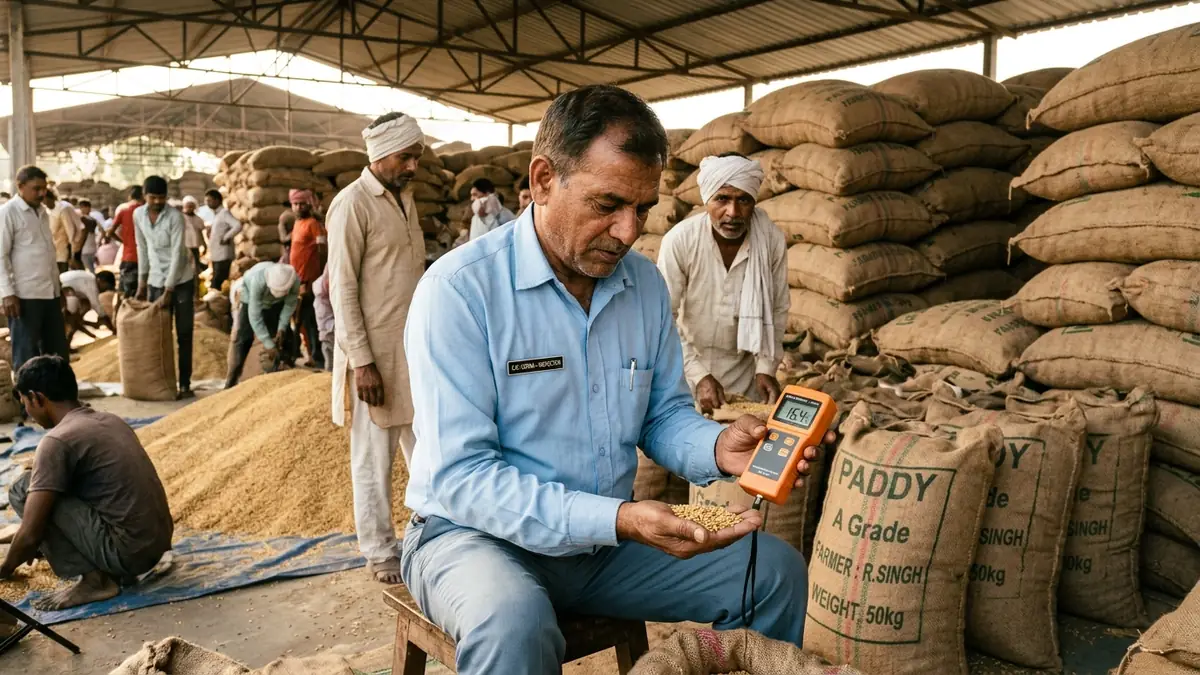
The Food Corporation of India enforces stringent Fair Average Quality (FAQ) standards for all paddy purchases. Grains that fail to meet these statutory parameters are either rejected at the mandi gate or subject to official value deductions (refractions). Understanding these thresholds allows farmers to properly clean and dry their grain before loading trolleys.
| Quality Parameter | Maximum Permissible Limit (%) | Official Rule & Deduction Benchmark |
|---|---|---|
| Moisture Content | 17.0% | Strict rejection above 17.0%. Sun-drying required before re-testing. |
| Foreign Matter (Inorganic) | 1.0% | Stones, mud, dust, glass. Grains with over 1% must be sieved and cleaned. |
| Foreign Matter (Organic) | 1.0% | Chaff, straw, weed seeds, stalks. Max 1% allowed; value cut applies above 1%. |
| Damaged, Discoloured & Sprouted Grains | 5.0% | Fungal, insect damaged, diseased, or discoloured kernels above 5% face rejection. |
| Immature, Shrunken & Shrivelled Grains | 3.0% | Underdeveloped thin grains; up to 3% accepted without penalty. |
| Admixture of Lower Classes | 6.0% | Common paddy mixed into Grade A consignments; over 6% reclassifies lot as Common. |
The 17 percent moisture limit is the single most frequent reason for grain rejection at mandis. Freshly harvested paddy cut with combine harvesters typically carries 20 to 24 percent moisture. If brought directly to the mandi without field conditioning or sun-drying, the moisture tester will immediately flag the load. Storing high-moisture paddy causes rapid fungal heating, discolouration, and aflatoxin contamination. Farmers should spread harvested paddy on clean threshing floors or tarpaulins for one to two days of open sunshine until moisture meters confirm 15 to 16.5 percent before bagging. Growers following organic farming certification standards and managing nutrients with a soil health card consistently record lower grain breakage and higher test weights.
State-wise paddy procurement portals, agencies and bonus schemes
Because agriculture is a state subject and decentralization governs grain operations across most of the country, each state maintains its own procurement infrastructure, registration timeline, and digital tracking portal.
| State / Union Territory | Official Procurement Portal | Key Operating Agencies | Special Features & Bonuses |
|---|---|---|---|
| Punjab | Anaaj Kharid (anaajkharid.in) | Pungrain, Markfed, Punsup, PSWC, FCI | Direct bank transfer via J-Form within 48 hours; centralized mandi gate pass system. |
| Haryana | Meri Fasal Mera Byora (fasal.haryana.gov.in) | Hafed, Haryana Warehousing (HWC), FCI | Automated slot booking; integrated Bhavantar and crop compensation links. |
| Uttar Pradesh | e-Kharid UP (fcs.up.gov.in) | UP State Food & Essential Commodities (UPSFECC), PCF, PCU | Biometric Aadhaar authentication at mandis; direct PFMS bank transfer. |
| Madhya Pradesh | e-Uparjan (mpeuparjan.nic.in) | MP State Civil Supplies Corporation (MPSCSC), Markfed | Mobile app registration; SMS delivery tokens; SMS banking integration. |
| Chhattisgarh | CG Khadhya / Kisan Panjiyan (khadya.cg.nic.in) | CG State Marketing Federation (Markfed), PACS | Krishak Unnati Yojana bonus topping total support to Rs 3,100 per quintal. |
| Odisha | Food Supplies & Consumer Welfare (foododisha.in) | OSCSC, Primary Agricultural Co-op Societies (PACS) | Biometric Iris and Fingerprint scanning; token-based regulated mandi entry. |
| Telangana | Online Paddy Management System (OPMS) | Telangana State Civil Supplies Corporation (TSCSC) | Rs 500/quintal fine paddy (Sannalu) bonus; Rythu Vedika coordination. |
| Andhra Pradesh | CMAPP / AP Civil Supplies Portal | AP State Civil Supplies Corporation (APSCSC), RBKs | Procurement at village level through Rythu Bharosa Kendras (RBKs). |
| Bihar | e-Procurement / PACS Portal (eproc.bihar.gov.in) | Bihar State Food & Civil Supplies Corp (BSFC), PACS | Procurement through local PACS and Vyapar Mandals across rural blocks. |
| West Bengal | WB Paddy Procurement (wbpub-paddyprocurement.nic.in) | WB Essential Commodities Supply Corp (WBECSC) | Mobile procurement camps; Krishak Bandhu verification linkage. |
| Jharkhand | Jharkhand State Food & Civil Supplies (JSFCS) | JSFCS, Large Adivasi Multi-Purpose Societies (LAMPS) | Paddy Procurement Scheme Jharkhand (PPSJ) with state financial subsidy. |
Punjab paddy procurement: Anaaj Kharid system
Punjab represents the largest contributor of rice to the central pool, routinely procuring over 120 to 185 lakh metric tonnes of paddy during October and November. The entire purchase operation is digitized through the Anaaj Kharid portal, managed by the Punjab Mandi Board. Farmers register their land parcels, review top-rated haulage equipment like the Swaraj 855 FE, and confirm arhtiya (commission agent) details. Payments are executed directly to farmers' bank accounts via electronic J-Forms within 48 hours of weighment, bypassing the historical practice of routing payments through intermediary agents.
Haryana paddy procurement: Meri Fasal Mera Byora
In Haryana, the Meri Fasal Mera Byora portal integrates crop registration, revenue land records, and procurement scheduling. Farmers who register their sown crops receive automated SMS tokens indicating the exact mandi gate and time window for delivery. Agencies such as Hafed and Haryana Warehousing Corporation manage moisture testing and weighment, ensuring electronic payment transfer within 72 hours directly via RTGS and NEFT.
Uttar Pradesh paddy procurement: e-Kharid UP
Uttar Pradesh operates procurement across two separate regional phases: western districts commence in October, while eastern districts begin in November and run through February. Under the e-Kharid portal, over 4,000 purchase centres operated by PCF, PCU, Mandi Parishad, and FCI utilize point-of-sale (PoS) biometric devices. Farmers verify their identity using Aadhaar fingerprint or iris scans at the purchase centre before issuing weighment receipts.
Madhya Pradesh paddy procurement: e-Uparjan
Madhya Pradesh's acclaimed e-Uparjan portal enables farmers to register online from village kiosks, cooperative societies, or their own smartphones. The system verifies land records directly against the Bhulekh database to prevent fictitious land registrations. SMS-based delivery tokens ensure that mandis maintain balanced vehicular traffic without congesting rural access roads.
Chhattisgarh paddy procurement: Krishak Unnati Yojana
Chhattisgarh is known as the 'Rice Bowl of Central India' (Dhan Ka Katora) and maintains an extensive village-level procurement network operated by PACS. Through the Krishak Unnati Yojana, the state government bridges the difference between the central MSP and ₹3,100 per quintal, offering one of the highest farmer profit margins in India for procurement up to 21 quintals per acre. The state routinely purchases over 140 lakh metric tonnes of paddy.
Odisha paddy procurement: OSCSC and PACS network
The Odisha State Civil Supplies Corporation (OSCSC) manages procurement through Primary Agricultural Cooperative Societies and Large Adivasi Multi-Purpose Societies. Odisha utilizes an advanced biometric iris and fingerprint authentication protocol at every society to protect tribal and smallholder farmers from merchant exploitation.
Telangana and Andhra Pradesh paddy procurement
Telangana procures paddy across both Kharif (Vanakalam) and Rabi (Yasangi) seasons via the Online Paddy Management System (OPMS). To incentivize cultivation of fine varieties, Telangana provides a dedicated state bonus of ₹500 per quintal over the central MSP. In Andhra Pradesh, procurement is decentralized directly to village wards through Rythu Bharosa Kendras (RBKs), eliminating long-distance transport costs for smallholders.
Bihar, West Bengal and Jharkhand paddy procurement
In eastern India, procurement operations through Bihar State Food Corporation (BSFC) and local PACS centres provide critical price support in regions historically impacted by distress sales. West Bengal operates mobile procurement camps through the Department of Food and Supplies, while Jharkhand facilitates procurement through the Paddy Procurement Scheme Jharkhand (PPSJ) with dedicated state incentive subsidies disbursed directly to registered bank accounts.
Direct Benefit Transfer (DBT), J-Form generation and payment tracking
A transformative reform in Indian paddy procurement over the past decade is the complete transition to 100 percent electronic Direct Benefit Transfer (DBT). Previously, payment cheques or cash were issued to commission agents (arhtiyas) or traders, creating delays, unauthorized commissions, and interest deductions.
Today, the payment clearance follows a secure digital pipeline:
- Electronic Weighment Slip: The mandi operator records the final weight on the electronic scale, generating a cryptographically signed digital receipt.
- J-Form / W-Form Generation: Within 24 hours of weighment, the procurement agency issues an electronic J-Form (or W-Form). This legal document certifies the exact quantity accepted, the applied MSP rate, and the gross payment obligation.
- PFMS Bill Submission: The state procurement corporation uploads the payment batch to the Public Financial Management System (PFMS), managed by the Ministry of Finance.
- NPCI Aadhaar Payment Bridge System (APBS): PFMS verifies that the farmer's Aadhaar number is actively mapped to a bank account on the National Payments Corporation of India (NPCI) mapper.
- Bank Credit and SMS Alert: The funds are credited directly to the farmer's savings bank account, typically within 48 to 72 hours of J-Form generation, triggering an automated confirmation SMS.
To track payment progress, farmers can log into their state's procurement portal using their registered mobile number or registration ID, navigate to the 'Payment Status' tab, and inspect the transaction reference number (UTR). Alternatively, farmers can visit the PFMS official portal (pfms.nic.in), select 'Know Your Payments', and enter their bank account number or registered mobile number to see real-time clearance status.
What paddy procurement means for rice farmer profitability
Selling paddy through formal government procurement fundamentally transforms farm economics compared to disposing of grain in unregulated local markets. In open village markets, private aggregators frequently offer ₹1,600 to ₹1,900 per quintal during peak harvest gluts, deducting arbitrary moisture cuts and charging high commission fees. Securing the official MSP of ₹2,300 to ₹2,369 per quintal delivers an immediate cash surplus of ₹400 to ₹700 per quintal directly into the cultivator's pocket.
For an average smallholder cultivating 3 acres of paddy yielding 60 quintals in total, selling through government procurement translates into gross revenue of approximately ₹1,38,000 to ₹1,42,000, compared to barely ₹95,000 to ₹1,05,000 in open distress markets. This net difference of over ₹35,000 to ₹40,000 covers seasonal input expenses, enables timely repayment of short-term crop loans under the Kisan Credit Card (KCC) scheme to retain zero percent interest subvention, and provides working capital for the upcoming rabi wheat, mustard, or pulse season.
Common pitfalls, rejection reasons and mandi dispute remedies
Despite the smooth digital architecture, thousands of farmers encounter unexpected delays or rejections during procurement. Being aware of common stumbling blocks ensures you take preventive action well before dispatching grain:
- Bank Account NPCI Mapping Inactive: The most common reason for payment failure is that while the bank account is active, it is not seeded with NPCI for DBT. Visit your bank branch and submit the 'Aadhaar Seeding and DBT Mandate Consent Form' to link your bank account to the NPCI mapper.
- High Moisture Exceeding 17%: Do not harvest during early morning dew or immediately after rain. Dry harvested paddy thoroughly on tarpaulins before loading onto trolleys. Always keep an inexpensive handheld moisture probe at the farm level to test moisture prior to departure.
- Discrepancy in Land Sown Area (Girdawari): If the Patwari recorded fewer acres of paddy than you actually cultivated, your procurement quota will be cut short. Request an immediate correction and physical inspection from your local Tehsildar or Sub-Divisional Magistrate (SDM) before the procurement window closes.
- Mandi Weight Deductions and Refraction Disputes: If an assayer imposes unjustified weight cuts exceeding 1 to 2 kg per quintal for dirt or chaff, demand an official composite laboratory re-test in the presence of the Mandi Secretary or farmer representative.
- Delayed Payment Redressal: If your payment is delayed beyond 72 hours of J-Form generation, file a grievance through your state's CM Helpline (such as CM Window in Haryana, Samadhan in UP, or 181 in MP) or call the national consumer helpline for agricultural procurement.
Frequently asked questions about paddy procurement in India
Frequently asked questions
- What is the official MSP rate for paddy in KMS 2024-25 and KMS 2025-26?
- For Kharif Marketing Season (KMS) 2024-25, the central government fixed the Minimum Support Price at ₹2,300 per quintal for Paddy (Common) and ₹2,320 per quintal for Paddy (Grade A). For KMS 2025-26, the MSP has been increased to ₹2,369 per quintal for Paddy (Common) and ₹2,389 per quintal for Paddy (Grade A), providing a guaranteed 50 percent return over cultivation costs, as published by the Department of Food and Public Distribution (DFPD). Growers can project seasonal returns using our crop income calculator.
- What is the maximum permissible moisture limit for paddy procurement by FCI?
- The Food Corporation of India mandates a strict maximum moisture limit of 17.0 percent under FCI Fair Average Quality standards. Review proper field drying methods in our rice farming guide. Any paddy consignment with moisture exceeding 17 percent is rejected at the mandi gate. Farmers must sun-dry their grain on threshing floors or tarpaulins to bring moisture levels to 15-16.5 percent before weighment.
- How long does it take for paddy procurement payment to reach the farmer bank account?
- Under the Direct Benefit Transfer (DBT) guidelines, payments are credited directly into the farmer Aadhaar-linked bank account through the Public Financial Management System (PFMS) within 48 to 72 hours of electronic J-Form generation. Farmers can verify registered land parcels on the Bhulekh land records portal and access working capital via the Kisan Credit Card scheme.
- Can tenant farmers and sharecroppers sell paddy under government procurement?
- Yes, tenant farmers and sharecroppers (Bataidhar) can sell paddy in most states, including Odisha, Andhra Pradesh, Bihar, and West Bengal. They must submit a signed lease agreement, a landlord no-objection certificate (NOC), or a verification certificate from the village local revenue officer (Patwari/VRO).
- What documents are required for online paddy procurement registration?
- Farmers require their Aadhaar Card, land revenue record (Khasra and Khatauni or Jamabandi/7-12 extract), verified crop sowing proof (Girdawari), bank passbook showing active account and IFSC code seeded with NPCI, and an active mobile phone number linked to Aadhaar for OTP verification.
- Why did my paddy procurement payment fail or bounce?
- Payment failures almost always happen because the farmer's bank account is not mapped to the National Payments Corporation of India (NPCI) Aadhaar Payment Bridge. Even if your account is active, you must visit your bank branch and submit the official Aadhaar DBT Seeding Mandate form to activate government welfare transfers.
- What is the difference between Paddy Common and Paddy Grade A?
- Paddy is categorized based on grain dimensions. Paddy (Grade A) consists of superior varieties where the length-to-breadth ratio of milled rice is 2.5 or higher (long, slender grains). Common Paddy includes short, medium, and coarse grain varieties. Grade A commands a statutory MSP premium of ₹20 per quintal.
- Which states provide extra bonuses over and above the central paddy MSP?
- Chhattisgarh offers the highest financial support through the Krishak Unnati Yojana, topping up total procurement value to ₹3,100 per quintal up to 21 quintals per acre. Telangana provides an additional incentive bonus of ₹500 per quintal for fine paddy varieties (Sannalu) over central MSP.
- How can farmers book a mandi delivery slot for paddy procurement?
- Farmers can book delivery slots online by logging into their state's procurement portal (such as e-Uparjan, Meri Fasal Mera Byora, or e-Kharid UP). After logging in, choose your nearest purchase centre and select an available calendar date to generate an electronic Delivery Token (e-Pass) with an allotted time window.
- What is a J-Form and why is it important for farmers?
- A J-Form is an official, digital sale receipt issued to the farmer after successful grain weighment in mandis (prominently in Punjab and Haryana). It serves as legal proof of crop sale, records the net weight and total payable MSP amount, and is accepted by banks as valid income documentation for loan approvals.
This article is for general information only and is not financial advice. Loan and scheme eligibility depends on partner and government criteria.