Chow Chow Price in India: Chayote Mandi Rate & Yield
Key takeaways
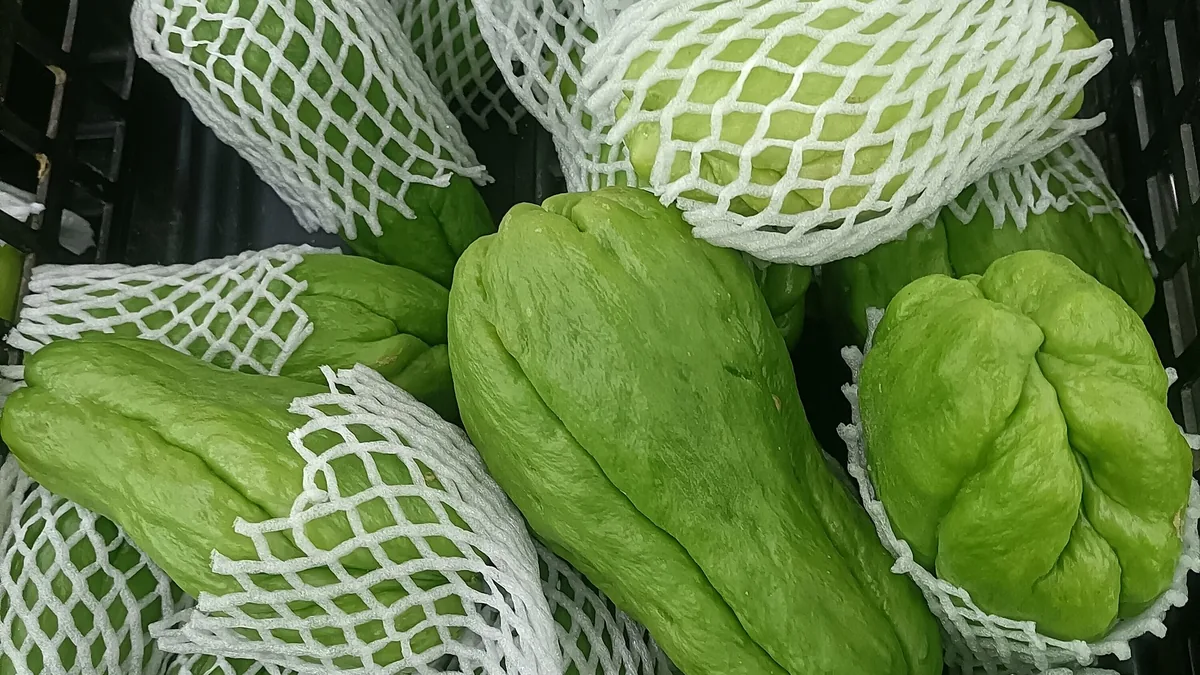
- Wholesale chow chow (Sechium edule / chayote / seemai kathirikai / iskush) trades indicatively between Rs 14 and Rs 34 per kg (Rs 1,400–Rs 3,400/qtl) across Oddanchatram, Kodaikanal, Bengaluru, and Koyambedu mandis (November 2026).
- Semi-perennial vine orchards trained on 2-meter overhead bamboo/wire pandal trellises yield 80 to 140 quintals (8 to 14 tonnes) per acre over 2–3 fruiting seasons per TNAU horticulture standards.
- Propagation uses intact viviparous mature sprouted fruits—planting 2–3 sprouted seeds per 45×45×45 cm organic pit spaced at 2.4 m × 1.8 m.
- Because lush hill vines bear continuously during May–November misty weather, grading clean glossy pale-green blemish-free fruits yields Rs 4–8/kg retail premiums.
Tracking the chow chow price in India—sold regionally under local vegetable names including Chayote, Bangalore Brinjal (Bengaluru Badanekai), Seemai Kathirikai in Tamil Nadu, Iskush / Iskut across Darjeeling, Sikkim, and Meghalaya, and Merangkai in Karnataka—is vital for hill and cool-belt market gardeners seeking dependable cashflow from a single planting lasting two to three continuous years! Unlike erratic single-harvest greens, well-tended Sechium edule vines yield frequent weekly pickings from raised overhead pandal canopies.
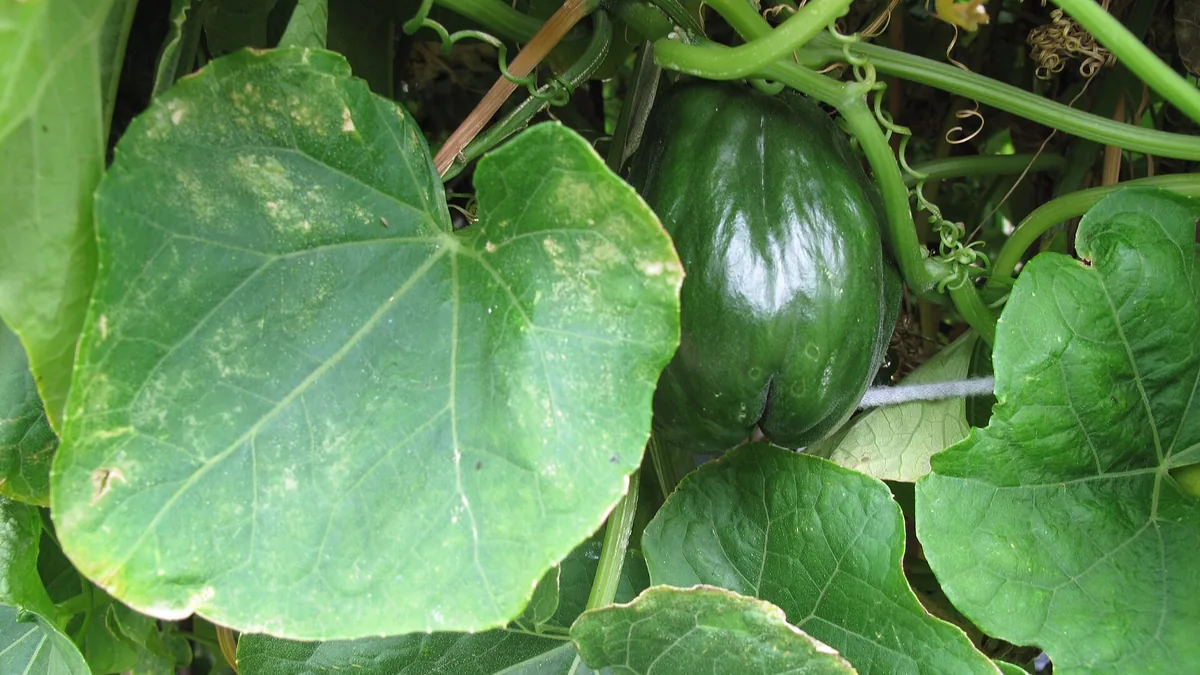
In November 2026 wholesale APMC auctions tracked via Agmarknet and state agricultural marketing boards, crisp green farm-grade chow chow trades indicatively between Rs 14 and Rs 34 per kg (Rs 1,400 to Rs 3,400 per quintal), with retail metropolitan vegetable stalls across Chennai, Bengaluru, Mysuru, Hyderabad, and Kolkata quoting Rs 35 to Rs 60 per kg depending closely on hill rain transport smoothness and cold mornings. Following crop production protocols validated by ICAR-IIHR Bengaluru and Tamil Nadu Agricultural University (TNAU) helps hill growers hit top 10–14 tonne per-acre yields profitably.
1. Chow Chow Mandi Price in India Across Major Trading Hubs (November 2026)
Tamil Nadu’s Oddanchatram (Dindigul district) and Kodaikanal Upper Palani Hills anchor southern interstate distribution into Kerala and Chennai, while Mysuru/Chikkaballapur fields supply Karnataka and Darjeeling–Kalimpong hills drive Northeast Indian Iskush wholesale supply. Verify daily district arrivals cleanly through Agmarknet and e-NAM before harvesting sack batches.
| Market / Wholesale Center | Origin Production Belt | Indicative Wholesale Rate (Nov 2026) | Grade & Packing Pattern |
|---|---|---|---|
| Oddanchatram Vegetable Mandi (TN) | Kodaikanal, Sirumalai & Thandikudi Hills | Rs 14 – Rs 26 / kg (Rs 1,400–2,600/qtl) | 50–60 kg gunny bags; young tender glossy pale-green top grade |
| Koyambedu Wholesale Market (Chennai) | Palani Hills & Krishnagiri / Hosur | Rs 18 – Rs 30 / kg | Graded cool tender fruits; spikes quickly on rainy hill landslides |
| KR Market / Binny Mill (Bengaluru) | Chikkaballapura, Kolar & Mysuru Belts | Rs 16 – Rs 28 / kg | Known locally as Bangalore Brinjal (Seemebadanekai) |
| Ernakulam / Chalai Wholesale (Kerala) | Kodaikanal, Idukki High Ranges & Munnar | Rs 22 – Rs 34 / kg | Steady household sambar & avial demand year-round |
| Siliguri Regulated Market (WB) | Kalimpong, Kurseong & Sikkim (Iskush) | Rs 15 – Rs 28 / kg | Spiny/smooth hill landraces shipped across Assam & Bihar |
| Bowenpally Market (Hyderabad) | Anantapur, Bengaluru & Nilgiris | Rs 20 – Rs 32 / kg | Transport-graded crisp crates with zero bruised ends |
2. Why Oddanchatram & Kodaikanal Dictate South India Chayote Pricing
Because Sechium edule thrives naturally in cool misty altitudes between 1,200 m and 1,500 m (18°C–22°C) and suffers poor pollination above 32°C dry plain heat, southern supply funnels largely through three cool-zone pockets alongside winter plains plots:
- Oddanchatram Auction Leverage: Nearly 60%–70% of fresh Seemai Kathirikai entering Kerala and Chennai auctions passes through Oddanchatram dawn auctions after winding down Kodaikanal hill ghat roads overnight.
- Green Smooth vs Pale-White Cultivars: Per TNAU horticulture manuals, urban Chennai and Bengaluru buyers strongly prefer smooth shiny light-green Chayote (without thick prickly skin spines), paying Rs 4 to Rs 7/kg above tough overgrown pale-white fruits.
- Monsoon Fog & Highway Slip Spikes: Heavy November rains across Western Ghats occasionally trigger mudslides or slow picking labor for 3–4 days—making daily mandi spread checks against tomato and onion rates valuable for farm dispatch timing.
3. How to Grow Chow Chow (Chayote): Viviparous Seeds, 2m Pandal & 10-Tonne Yield
Unlike tomatoes or gourds planted from small dried seed packets, chow chow exhibits vivipary—meaning its single flat seed actually sprouts directly inside the intact mature fleshy fruit! Adopting proven recommendations from TNAU and National Horticulture Board (NHB) turns half-acre slopes into persistent multi-year assets:
- Climatic Sweet Spot & Acidic Soil: Grows vibrantly at 18°C–22°C in deep fertile loam rich in humus (pH 5.5 to 6.5); in warm plains like Bengaluru/Hosur, time planting strictly for mild monsoon/winter months avoiding 36°C summer peaks.
- Sprouted Whole-Fruit Pit Preparation (April–May / Pre-Monsoon): Dig 45 cm × 45 cm × 45 cm pits spaced cleanly at 2.4 m × 1.8 m (~900–930 pits/acre). Fill each pit with topsoil, 10 kg well-rotted Farmyard Manure (FYM), and baseline NPK nutrients calculated via our fertilizer dosage calculator & Soil Health Card plan, burying 2 to 3 healthy sprouted whole fruits obliquely at 3–5 cm depth.
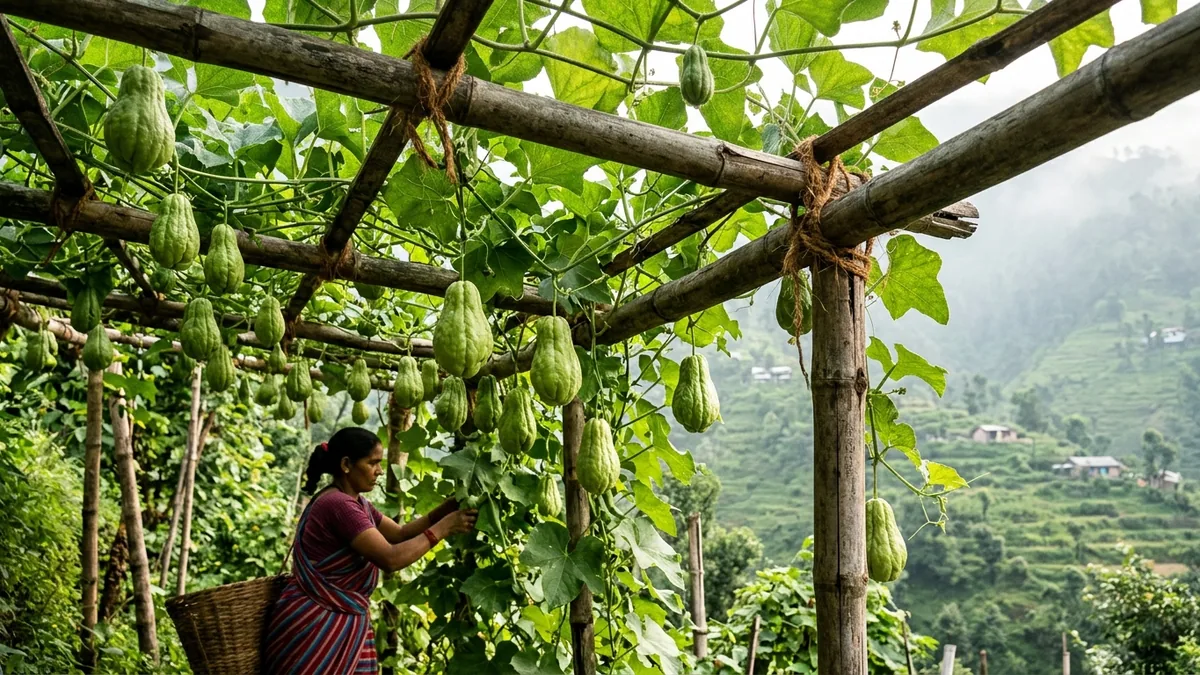
- Overhead 2-Meter Pandal (Trellis) Structure: Because vigorous perennial tendrils spread 4–6 meters quickly and support heavy wet clusters, construct a sturdy galvanized-wire or bamboo overhead pandal trellis at ~2 meters height so pickers harvest straight hanging clean fruits comfortably while enjoying brisk under-canopy airflow.
- Second-Year Winter Pruning Boost: Rather than uprooting healthy vines every autumn, cut main stems back ~30–45 cm above ground during cool January rest weeks, apply clean top-dressed Urea + FYM ring mulch, and watch second-year fruiting climb smoothly toward 100 to 140 quintals/acre (10–14 tonnes/acre per TNAU norms!).
4. One-Acre Chow Chow Profit Budget, Poly-Tunnel / Trellis Subsidies & KCC Tools
Initial infrastructure—primarily galvanized GI trellis wire, stone/concrete corner pillars, organic pit compost, and sprouted planting fruits (~2,500 nuts/acre)—runs indicatively around Rs 55,000 to Rs 85,000 per acre in Year 1, dropping sharply to just Rs 20,000–Rs 30,000 maintenance in Year 2 and Year 3! Harvesting ~100 quintals/acre at a conservative average farmgate realization of Rs 15/kg generates Rs 1.50 lakh gross revenue/year (and Rs 2.20 lakh+ when seasonal mandi modal bids hold Rs 22–25/kg!).
Check tailored vegetable farm cashflows using our crop income calculator and farm ROI calculator, calculate 40%–50% MIDH Horticulture pandal trellis & drip irrigation grants via our subsidy calculator & central schemes hub, access low-interest ~4% crop finance via our KCC loan calculator, verify clean schedule water volumes via our irrigation planner, guard soft shoots cleanly using our pesticide calculator & shade net guide, protect acreage under PMFBY (claim checker), and maintain active Farmer ID enrollment.
5. Protecting Pandal Vines from Mosaic Virus, Fruit Fly & Post-Harvest Shriveling
Long-term profitability over 36 continuous months of harvesting depends heavily on guarding young tendrils against melon fruit flies, aphid-borne viral mottling, and humid anthracnose/powdery mildew patches beneath shaded canopy leaves:
- Harvest Strictly Young Tender Fruits (~180–250 g): Delayed picking turns green skins dull pale-yellowish and grows tough woody center seeds that wholesalers downgrade instantly! Walk underneath the 2m pandal twice weekly clipping glossy bright-green fruits cleanly with short 1–2 cm stalks attached.
- Sanitize Pruning Knives & Pull Viral Clumps Early: Aphids transmitting Chayote Mosaic cause yellow mottled curling leaves and lumpy deformed fruits—prune off stray infected runners promptly and manage sucking vectors hygienically following ICAR-IIHR advisory intervals.
- Breathable Vent Mesh Bags Over Air-Tight Plastic Sacks: Never suffocate newly picked warm seemai kathirikai inside sealed polythene bags overnight; aerated woven net bags or slotted plastic crates keep skins crisp and green through overnight highway dispatch to destination mandis.
For growers expanding perennial trellised chow-chow orchards on terraced mid-altitude slopes across Kodaikanal, Sirumalai, Nilgiris, and Kalimpong, inter-cropping quick leafy herbs or shallow-root ginger/garlic bands strictly along sunlit outer pit borders during Year 1 generates interim cashflow during the first 120–150 days before dense vine tendrils blanket overhead GI meshes! Equally critical is monitoring melon fly pheromone lure traps (5–6 cuelure traps per acre) along orchard perimeters so translucent maggot punctures never ruin glossy pale-green wholesale export grades.
Remember also to apply organic well-decomposed vermicompost plus 10–15 kg/pit neem cake around basin collars at winter pruning every January—suppressing root-knot nematodes cleanly while sustaining lively fruiting flushes well past Month 36 without sharp Year-3 yield drop-offs! Combine farm field books cleanly with weekly wholesale tracking on Agmarknet and e-NAM before hauling loaded gunny crates down winding hill highways.
From a market diversification perspective, progressive farmer groups across Oddanchatram, Kodaikanal, and Bengaluru also preserve seasonal chow-chow price stability by grading harvest sacks into clean Export/Supermarket Grade A (uniform pale-green ~200 g zero-scar smooth pears), Hotel Catering Grade B (medium-large 300–400 g fruits), and discarding scarred fibrous old gourds rather than mixing ugly fruits inside prime wholesale gunny sacks! Maintaining clean dry ventilated shade canopies along collecting centers stops post-harvest fungal neck-rot even when coastal monsoons pause rural trucks overnight—supporting reliable year-round hill horticulture livelihoods.
Frequently asked questions
- What is the chow chow price per kg in India today across wholesale mandis?
- Indicative November 2026 APMC wholesale auction prices across Oddanchatram, Bengaluru, Koyambedu, and Ernakulam stand between Rs 14 and Rs 34 per kg (Rs 1,400 to Rs 3,400 per quintal) on Agmarknet, while urban retail groceries sell tender green fruits at Rs 35–Rs 60/kg.
- What are the other Indian regional names for chow chow vegetable?
- Known scientifically as Sechium edule (Chayote squash), Indian buyers call it Seemai Kathirikai in Tamil, Bangalore Brinjal / Seeme Badanekai in Karnataka, Iskush / Iskut in West Bengal, Sikkim & Northeast India, and Chikudi / Chow Chow across Andhra & Kerala.
- Which vegetable mandi sets the main wholesale price for chow chow in South India?
- Oddanchatram Mandi (Dindigul district, Tamil Nadu) fed by Kodaikanal and Upper Palani Hill gardens drives daily South Indian benchmark wholesale prices tracked via e-NAM and regional trade portals.
- How many tonnes or quintals of chow chow are harvested per acre?
- Per Tamil Nadu Agricultural University (TNAU) standards, irrigated trellised farms normally harvest 80 to 140 quintals per acre (8 to 14 tonnes/acre) annually, with peak second-year vines reaching highest yields.
- How do farmers plant chow chow seeds if it does not come in dried seed packets?
- Chow chow reproduces through vivipary—its flat seed germinates directly inside the whole mature fruit! Plant 2 to 3 cleanly sprouted mature fruits per 45×45×45 cm compost-enriched pit spaced at 2.4 m × 1.8 m (~900 pits/acre).
- How tall should a pandal trellis be for commercial chayote vine farming?
- Construct a sturdy overhead bamboo or GI-wire pandal trellis at ~2 meters height—strong enough to support heavy summer rain vine foliage while letting workers easily spot and pick hanging fruits cleanly underneath.
- How many years does a single chow chow plantation yield continuously?
- Being a semi-perennial tuberous vine, a well-drained disease-free chow chow vineyard bears profitably for 2 to 3+ continuous years when pruned sharply back toward ground height every cool January and top-dressed cleanly using balanced nutrients calculated on farm dosage sheets.
- Why do wholesalers pay more for smooth light-green chow chow over overgrown spiky fruits?
- Small-to-medium glossy light-green fruits (180–250 g) peel quickly without annoying skin prickles and hold tender crisp flesh inside, whereas late-picked overgrown yellowish fruits harden into stringy seed tissue rejected by home cooks.
- Can chow chow grow successfully in warm North Indian plains?
- Extreme summer heat (above 38°C–44°C) in plains stalls flowering and dries delicate shoots. Mild foothill belts (Himachal, Uttarakhand, Assam, Wayanad, Kodaikanal, Bengaluru, Hosur) excel naturally, while mild winters support short plains crops.
- Are government subsidies available for building pandal trellises and drip irrigation?
- Yes! Under MIDH / State Horticulture Missions, vegetable farmers qualify for 40%–50% subsidy grants on permanent GI trellis pandal structures and drip micro-irrigation—estimate likely savings via our subsidy calculator.
- What soil pH works best for chow chow cultivation?
- Per ICAR-IIHR guidelines, slightly acidic well-drained sandy loam rich in humus with soil pH between 5.5 and 6.5 outperforms alkaline/waterlogged black clays cleanly.
- How long does fresh chow chow stay crisp after harvest without rotting?
- Packaged cleanly in aerated crates inside cool shady storage (10°C–12°C), crisp undamaged chow chow keeps remarkably well for 2 to 3 weeks compared to just 3 days for soft leafy vegetables—helping farmers smooth transport schedules (income calculator).
This article is for general information only and is not financial advice. Loan and scheme eligibility depends on partner and government criteria.