Coconut Price Today: Kerala, Tamil Nadu & Copra MSP Guide
Key takeaways
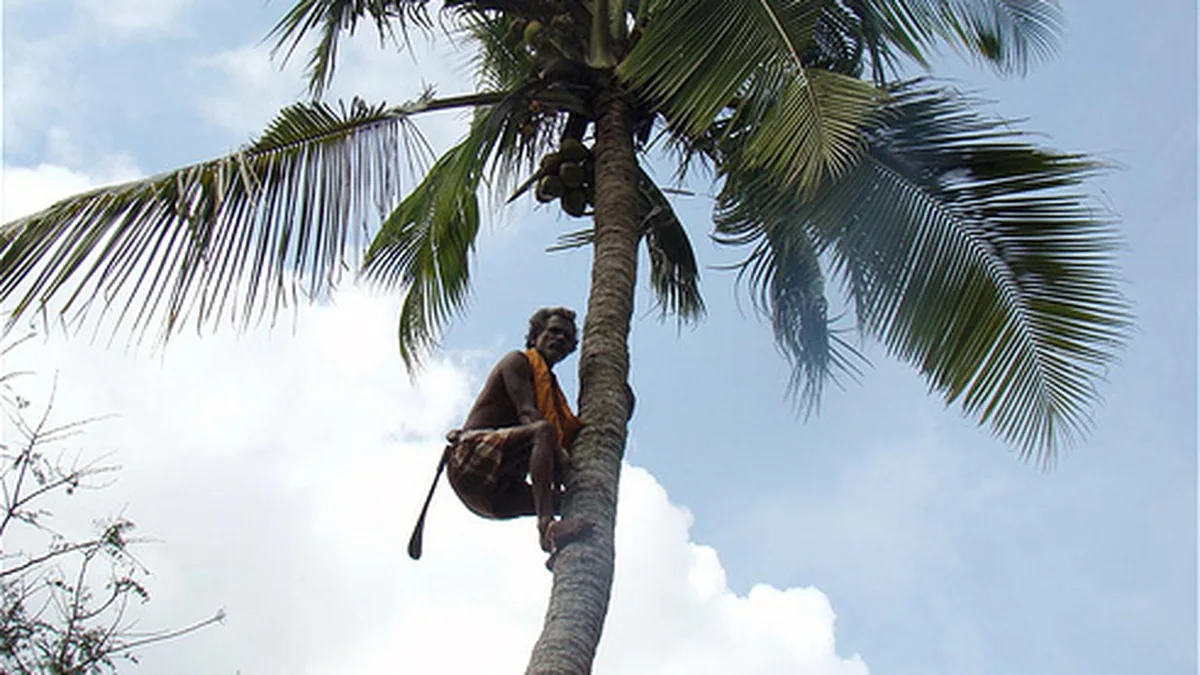
- As of November 2026, tightened palm output and strong South Indian milling demand lift indicative wholesale dehusked mature coconut rates around ₹38–₹58/kg (₹3,800–₹5,800/quintal) across Pollachi, Kochi, Kozhikode, Tiptur, and Godavari markets, while fresh tender nuts vary ₹24–₹42 per piece by size.
- Per official CCEA/PIB announcements, the statutory Minimum Support Price (MSP) for the 2026 Copra season stands at ₹12,027 per quintal (₹120.27/kg) for Milling Copra FAQ and ₹12,500 per quintal (₹125/kg) for Ball Copra—up +₹445 and +₹400 respectively from 2025.
- Central procurement under the Price Support Scheme (PSS) runs via NAFED and NCCF through state agencies such as Kerafed and Tamil Nadu co-ops whenever market spot prices fall near statutory MSP floors.
- Milling copra in benchmark Kerala yards trades far firmer near ₹15,800–₹16,400/qtl alongside surging Kochi/Kozhikode wholesale coconut oil rates (~₹25,000–₹27,100/qtl).
- Growers maximize orchard net returns using Coconut Development Board (CDB) replanting grants, balanced potassium-boron palm nutrition, and Rhinoceros beetle IPM via coconutboard.gov.in.
Tracking the genuine coconut price today before cutting mature bunches across Kerala, Tamil Nadu, Karnataka, or Andhra Pradesh separates top orchard profit from arbitrary village collector cuts. Over 2025–2026, erratic monsoon cycles and intense summer heat reduced palm nut counts across southern belts while edible oil, tender hydration, and export desiccated-coconut demand remained fierce—pushing wholesale dehusked mature coconut rates broadly toward ₹38 to ₹58 per kg (₹3,800–₹5,800/qtl) alongside elevated milling copra (₹15,800–₹16,400/qtl spot vs the official 2026 ₹12,027/qtl Milling Copra MSP!). Before dispatching farm-gate trucks or drying copra yards, verify official procurement floor circulars on PIB India, monitor daily yard modals on Agmarknet, review Coconut Development Board (CDB Kochi) schemes, and inspect KisanPe's coconut oil price dashboard, orchard agronomy guide, and CDB financial subsidy explainer.
1. Indicative Coconut Price Today Across India & Copra MSP Benchmarks (Nov 2026)
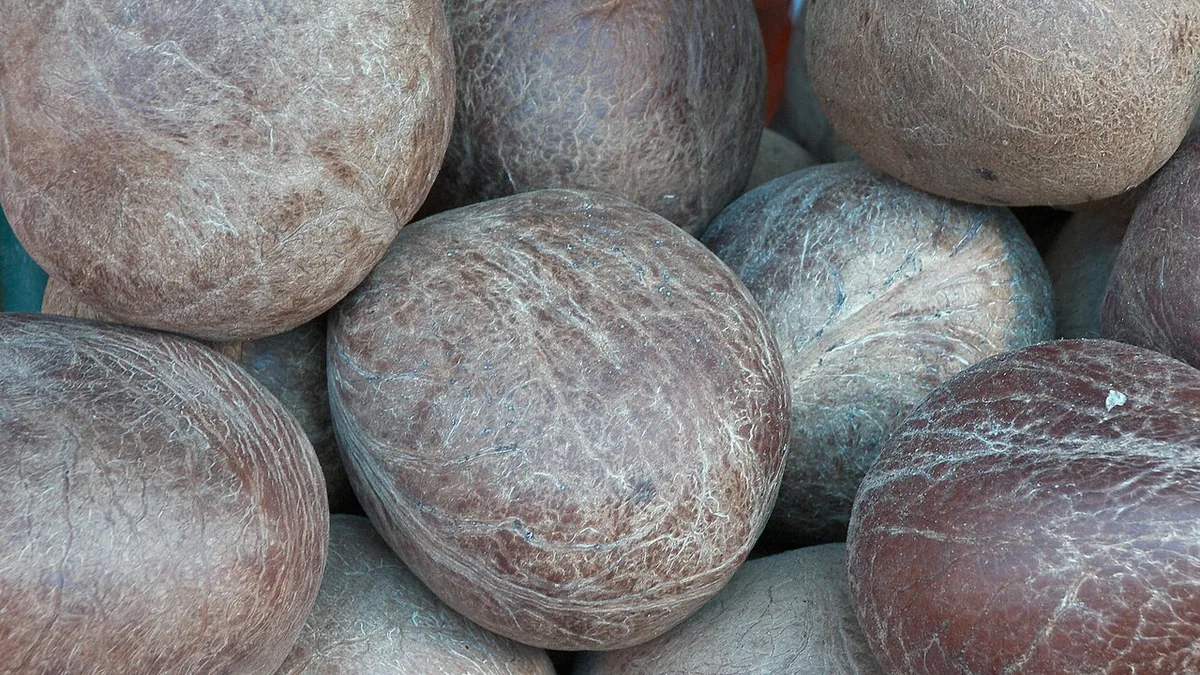
Because buyers trade coconut in four completely distinct physical forms—raw tender drinking nut (piece), dehusked mature culinary/milling nut (kg/qtl), semi-husked export nut, and sun/kiln-dried Milling & Ball Copra (qtl)—quotations across states must always be converted on uniform moisture and shell weight. Notice how converting 1 kg of raw mature dehusked coconut (~2.2–2.8 nuts depending on cultivar) converts roughly at ~50%–55% fresh kernel yield into ~28%–32% dry copra weight! Review verified November 2026 official MSP benchmarks and indicative regional spot bands below:
| Product / Benchmark Market | Trading Unit & Grade | Indicative Spot / Official Floor Rate (Nov 2026) | Typical Quality / Weight Norm | Key Pricing Driver |
|---|---|---|---|---|
| Statutory CCEA Milling Copra MSP (2026) | Fair Average Quality (FAQ) per Quintal | ₹12,027 / qtl (₹120.27 / kg) — Up ₹445 vs 2025 | Dry ≤6% moisture, clean white meat | Official NAFED & NCCF PSS procurement floor |
| Statutory CCEA Ball Copra MSP (2026) | Grade-A Whole Ball per Quintal | ₹12,500 / qtl (₹125.00 / kg) — Up ₹400 vs 2025 | Unbroken shaded-cured spherical kernel (Tiptur) | Religious/festive edible trade & Karnataka auctions |
| Pollachi & Kangayam (Tamil Nadu) | Dehusked Mature Nut & Milling Copra | ₹40–₹54 / kg raw nut · ₹15,500–₹16,300 / qtl copra | Semi-husked / dehusked bold ~450–550 g/nut | Oil crushers, North India transport & desiccated mills |
| Kochi & Kozhikode (Kerala Benchmarks) | Milling Copra & Wholesale Oil Parity | ₹15,800–₹16,400 / qtl copra · ~₹42–₹58 / kg nut | Well-dried sulphur-free clean Kerala halves | Kerafed / state oil mills (~₹25k–₹27.1k/qtl oil) |
| Tiptur APMC (Karnataka) | Edible Ball Copra Auction | ₹14,200–₹16,800 / qtl range | 10–12 month vine-cured hollow ball grades | Festival & dry-fruit wholesale packing demand |
| Amalapuram / Konaseema (Andhra Pradesh) | Tender Coconut & Dry Mature Nut | ₹24–₹40 / tender nut · ₹36–₹49 / kg mature | Thick water cavity tender (7-month) / 11-month mature | Metro tender water lorries & religious whole-nut trade |
Notice how physical Kerala and Tamil Nadu copra spot arrivals currently clear dramatically above the statutory ₹12,027/qtl 2026 MSP safety net due to tight global lauric oil balances! Still, always monitor weekly state trends via KisanPe's Mandi Rates tracker, gauge supply cycles on Mandi Intelligence and daily price watch panels, compare local vs interstate auctions via e-NAM vs traditional APMC guides, and check how to verify official bhav cleanly before quoting farm-gate traders.
2. State-Wise Hub Comparison: Kerala, Tamil Nadu, Karnataka & Andhra
Four coastal and interior belts produce over 90% of India's coconuts, yet each state specializes in a distinct commercial end-market that shifts farmer net revenue dramatically across seasons:
Kerala (Kochi, Kozhikode & Thrissur – High Oil & Kerafed Parity)
Kerala West Coast Tall (WCT) palms carry famously thick, dense white meat yielding higher 62%–65% oil extraction inside rotary expellers compared to thinner coastal nuts. Consequently, Kochi and Kozhikode millers bid aggressively whenever retail cooking oil surges, keeping Kerala grower parity consistently near the top of Indian price charts. Remember to check local agricultural department updates on refined & cold-pressed coconut oil rates before deciding whether to sell fresh nuts vs dry copra.
Tamil Nadu (Pollachi, Kangayam & Salem – Solar Copra & Tender Hubs)
Kangayam and Pollachi act as India's largest modern copra sun-drying and oil-milling industrial corridor thanks to crisp sunny trade winds! Tamil Nadu farmers increasingly install solar-tunnel polycarbonate dryers backed by CDB capital subsidies, turning split nuts into snow-white sulfur-free Milling Copra cleanly in 3 days—avoiding monsoon spoilage completely while locking zero smoky fuel odor!
Karnataka (Tiptur, Tumakuru & Arsikere – Edible Ball Copra)
In semi-arid Tumakuru and Hassan, growers hold full 12-month mature unhusked coconuts inside raised shaded bamboo lofts (attics) for 8 to 11 months until internal coconut water evaporates completely and the dried sweet whole white kernel rattles cleanly inside its brown shell—creating intact Edible Ball Copra earning official ₹12,500/qtl MSP protection and strong North Indian dry-fruit auction premiums!
Andhra Pradesh & Odisha (Konaseema & Puri – Tender Water & Temple Trade)
Konaseema (East Godavari) dominates fast-turnaround 7-month tender drinking coconut shipments moving straight onto express lorries bound for Hyderabad, Mumbai, Pune, and Delhi. Selling 7-month tender bunches turns palm capital every 45 days and skips nut-fall losses—though chronic tender harvesting requires attentive irrigation and potassium feeding (compute balanced NPK nutrition) so successive palm fronds stay vigorous.
3. Calculating Nut-to-Copra Conversion & Value-Addition Math
Farmers owning 200+ bearing palms often wonder whether selling farm-gate raw dehusked coconuts at ₹45/kg earns more or drying Milling Copra at ₹15,800/qtl pays better after labour expenses. Run clean conversion arithmetic before harvesting:
- Standard Yield Ratio: Roughly 6,500 to 7,500 medium mature WCT/hybrid coconuts (or ~3.2–3.4 tonnes dehusked weight) produce 1 metric tonne (1,000 kg / 10 quintals) of crisp 6%-moisture dry Milling Copra.
- By-Product Bonus Recovery: When drying your own copra or toll-crushing at village chekkus, farmers keep coconut shells (~₹14–₹20/kg sold to activated charcoal units!) plus husk fibre and protein-rich coconut oil cake (Punnakku) (~₹32–₹40/kg) ideal for dairy cattle rations.
- Breaking Even Safely: Subtract ₹2.50–₹4.00/kg of copra for harvesting climber fees, splitting, dehusking, and drying yard wages. Whenever copra spreads trade >3.6x the per-kg raw dehusked nut offer, on-farm copra curing yields clear extra farm income!
4. Boosting Yield & Accessing Coconut Development Board (CDB) Schemes
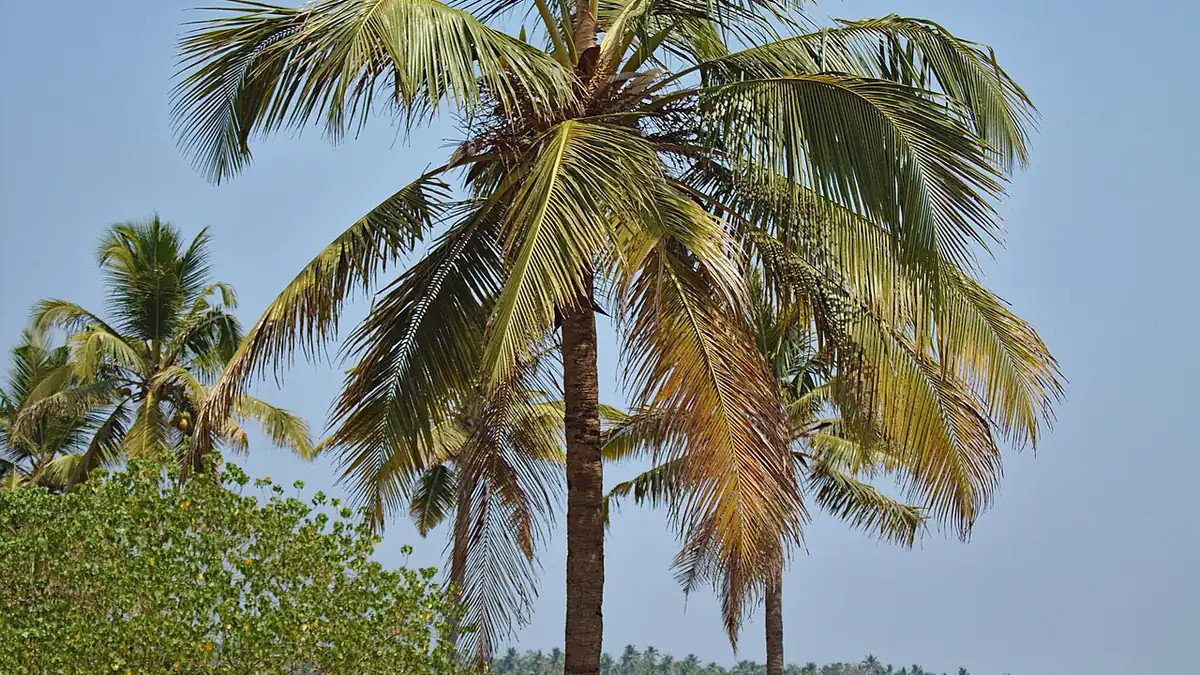
High market rates mean little if neglected palms drop button-sized immature nuts prematurely from eriophyid mite or nutrient starvation! Protect orchard bearing potential using three official agronomic levers backed by ICAR-CPCRI (Kasaragod) and Coconut Development Board grants:
- Balanced Potash & Micronutrient Care: Coconut palms export colossal potash and chlorine in husk + water! Alongside organic green-manure basin incorporation verified via Soil Health Cards, supplement soil potash (SOP) and boron nutrition cleanly to stop cracked deformed buttons and boost kernel thickness.
- Beetle & Wilt Integrated Pest Control: Eliminate breeding pits immediately and maintain neem-cake crown traps detailed in our Rhinoceros beetle IPM guide; select vigorous dwarf/tall crosses via certified coconut seedling nurseries.
- Apply for CDB Replanting, Area Expansion & Machinery Grants: CDB provides per-palm financial subsidies for cutting senile disease-hit palms, intercropping spices/cocoa, solar copra dryers, and FPO aggregation units—check exact step-by-step documentation inside our CDB scheme directory, explore working capital loans on KCC credit lines, and review state drip irrigation grants.
5. Export Desiccated Coconut, Coir By-Products & Moisture Grading Norms
Beyond raw culinary kitchens and domestic cooking oil presses, South India's export-oriented desiccated coconut powder (DC) factories around Tumakuru, Pollachi, and Erode establish a vital secondary demand floor under wholesale nut pricing! Export processors seek fully mature 11-month dehusked nuts with thick crisp snow-white meat yielding 140–155 kg of dry shredded DC powder per 1,000 clean coconuts. Never deliver scarred, sprouted, or cracked-water nuts into factory sorting bays, as fermented endosperm turns shredded flakes rancid yellow and fails batch peroxide testing. Meanwhile, smart orchard collectives pooling dry husks earn an extra ₹1.50 to ₹3.00 per coconut supplying local coir defibring mills along Alappuzha, Kozhikode, and Pollachi industrial belts—turning husk waste into geotextile yarn and buffered coco-peat blocks for greenhouse nurseries (horticulture seedling trays) while returning clean decomposed potash-rich coir pith back onto palm basins!
6. Frequently Asked Questions on Coconut Price Today & Copra MSP
Explore direct verified answers covering current indicative coconut rates per kg, CCEA 2026 Copra MSP norms, NAFED procurement centers, nut-to-oil conversions, and orchard subsidies.
Frequently asked questions
- What is the indicative coconut price today per kg and per piece in India?
- As of November 2026, indicative wholesale dehusked mature coconut prices span roughly ₹38 to ₹58 per kg (₹3,800–₹5,800/quintal) across Pollachi, Kochi, Kozhikode, and Karnataka markets depending on kernel thickness, while fresh tender drinking coconuts range ₹24 to ₹42 per nut wholesale. Confirm daily yard arrivals via Agmarknet and KisanPe Mandi Rates.
- What is the official Government MSP for Milling Copra and Ball Copra in 2026?
- Per official Cabinet Committee on Economic Affairs notices on PIB India, the 2026 Copra MSP stands at ₹12,027 per quintal (₹120.27/kg) for FAQ Milling Copra and ₹12,500 per quintal (₹125/kg) for Ball Copra—up ₹445 and ₹400 respectively above 2025.
- How do farmers sell copra at MSP under NAFED Price Support Scheme?
- Whenever open market copra rates dip below statutory MSP, farmers register land/palm proofs and Aadhaar-bank details through designated NAFED / NCCF state procurement centers holding <6% moisture FAQ copra—check scheme rules inside KisanPe's Coconut Development Board guide.
- How many mature coconuts are needed to make 1 quintal (100 kg) of dry copra?
- Depending on nut weight (West Coast Tall vs smaller dwarf hybrids), roughly 650 to 750 mature dehusked nuts yield 100 kg (1 quintal) of clean 6%-moisture white Milling Copra, which subsequently crushes into ~62–65 kg of pure oil—compare crushing returns inside our coconut oil market guide.
- Why does Tiptur Ball Copra trade differently from Kochi Milling Copra?
- Tiptur Ball Copra consists of unbroken spherical edible dry kernels naturally cured in bamboo attics for 8–11 months for North Indian sweet & religious trade, whereas Kochi/Pollachi Milling Copra comprises split kiln/sun-dried halves pressed heavily for edible oil—check grading rules via Coconut Development Board Kochi.
- Which time gives higher farm profit: selling 7-month tender nuts or 11-month mature copra?
- Tender harvesting unlocks faster 45-day cash rotation and avoids pre-harvest nut-fall storms, whereas full 11–12 month mature copra yields extra shell/oil value-addition during tight edible oil cycles—pair palm fertilization cleanly using our Fertilizer Calculator.
- What causes immature coconut button shedding and small kernel sizes?
- Button drop commonly arises from prolonged soil moisture stress, boron/potash micronutrient deficiencies, and unchecked mites/fungal bud rots—maintaining soil organic mulch and balanced irrigation boosts nut weight sharply.
- Does CDB offer subsidies for setting up solar copra dryers or replanting old palms?
- Yes! The Coconut Development Board provides targeted capital grants for rejuvenating unproductive/wilt-hit coconut gardens, planting quality nursery seedlings, and solar-dryer copra processing units via registered FPOs and individual farmers.
This article is for general information only and is not financial advice. Loan and scheme eligibility depends on partner and government criteria.