Mentha Oil Rate Today: MCX Futures, Mandi Bhav & Trends

Key takeaways
- Mentha oil rate today across major physical spot mandis in Uttar Pradesh trades within the benchmark range of Rs 940 to Rs 1,010 per kg, with Sambhal and Chandausi quoting top export-grade rates.
- A standard commercial galvanized iron (GI) drum holds 180 kg net of crude mentha oil, translating to a per-drum spot price between Rs 1,69,200 and Rs 1,81,800 at prevailing mandi bhav.
- On the Multi Commodity Exchange (MCX India), mentha oil futures trade in contract units of 360 kg (2 drums) with physical delivery settlement centered around Chandausi in Western Uttar Pradesh.
- Mentha oil rate today in Barabanki and Sitapur averages Rs 940 to Rs 980 per kg, serving as Central Uttar Pradesh’s primary bulk aggregation corridor for pharma and menthol crystal manufacturers.
- Indian farmers produce over 80% of the world’s natural mentha oil, with improved CSIR-CIMAP varieties (Kosi, CIM-Kranti, CIMAP Saryu) yielding 35 to 45 kg of oil per acre over a 90 to 105 day crop cycle.
- Crude mentha oil purity is assessed by total L-menthol concentration (benchmark 75% to 82%) and congealing point (freezing between 24 deg C and 28 deg C); higher purity lots earn a Rs 15 to Rs 30 per kg premium.
Mentha oil (commercial Japanese mint oil extracted from Mentha arvensis) is one of India’s foremost agro-industrial cash commodities and high-value export earners. India stands as the unrivaled global producer of natural menthol, supplying between 75% and 85% of total international demand. Within the domestic supply chain, the northern state of Uttar Pradesh accounts for more than 80% of India’s overall cultivation footprint, spanning intense agricultural pockets in Sambhal, Chandausi, Barabanki, Sitapur, Rampur, Budaun, Lakhimpur Kheri, and Bareilly.
For commercial mint growers, primary distillers, and essential oil merchants, keeping a close pulse on the mentha oil rate today (मेंथा तेल का आज का भाव) is fundamental for making profitable harvest, distillation, and marketing decisions. Because mentha oil does not fall under government Minimum Support Price (MSP) schemes like paddy cultivation or wheat, spot market realizations depend entirely on dynamic market factors: domestic pharmaceutical consumption, confectionery demand, synthetic menthol competition, international currency fluctuations, and commodity futures settlements.
Mentha Oil Rate Today Across Uttar Pradesh APMC Mandis
Spot trading for mentha oil occurs daily in designated Agriculture Produce Market Committee (APMC) grain and commercial commodity mandis. Local village arhtiyas, cooperative aggregators, and industrial procurement agents buy field-distilled crude oil packed in standard 15 kg tin containers or 180 kg galvanized iron drums. Prices fluctuate based on immediate daily arrivals, moisture content, specific gravity, and laboratory-tested menthol purity percentage reported through our live mandi rates tracker and official Agmarknet portals.
The table below details physical spot mandi rates, modal benchmark figures, and per-drum values recorded across the primary trading hubs of Western and Central Uttar Pradesh as of November 2026:
| Mandi / Trading Hub | State Region | Min Rate (Rs/kg) | Max Rate (Rs/kg) | Modal Rate (Rs/kg) | 180 kg Drum Price (Rs) | Common Mint Variety & Grade |
|---|---|---|---|---|---|---|
| Sambhal APMC | Western UP | Rs 960 | Rs 1,005 | Rs 985 | Rs 1,77,300 | Shivalik / Kosi (78-81% Menthol) |
| Chandausi APMC | Western UP | Rs 965 | Rs 1,010 | Rs 990 | Rs 1,78,200 | CIM-Kranti / Kosi (Export Benchmark) |
| Barabanki Mandi | Central UP / Terai | Rs 940 | Rs 980 | Rs 960 | Rs 1,72,800 | Damroo / Shivalik (76-79% Menthol) |
| Viswan (Sitapur) | Central UP | Rs 935 | Rs 975 | Rs 955 | Rs 1,71,900 | Commercial Arvensis (Standard Grade) |
| Rampur APMC | Rohilkhand | Rs 950 | Rs 990 | Rs 970 | Rs 1,74,600 | Kosi / CIMAP Saryu (78% Menthol) |
| Budaun Mandi | Rohilkhand | Rs 945 | Rs 985 | Rs 965 | Rs 1,73,700 | Shivalik (77-80% Menthol) |
| Bareilly Mandi | Rohilkhand | Rs 940 | Rs 980 | Rs 960 | Rs 1,72,800 | Mixed Commercial Grade |
| Lakhimpur Kheri | Terai Belt | Rs 930 | Rs 970 | Rs 950 | Rs 1,71,000 | Terai Distillation Bulk Grade |
| Aligarh / Hathras | Braj / Western UP | Rs 945 | Rs 985 | Rs 965 | Rs 1,73,700 | Semi-Refined Crude Mentha |
| Ambala / Yamunanagar | Haryana Border | Rs 950 | Rs 995 | Rs 975 | Rs 1,75,500 | Northern Industrial Processing Grade |
Farmers in Uttar Pradesh evaluating their seasonal cash flow alongside mentha revenues can also cross-reference our foundational mentha oil rate benchmark guide, compare local produce on our vegetable mandi rates directory, and explore our general all India daily mandi rates directory to optimize overall crop marketing timing.
Mentha Oil Rate Today in Barabanki and Sitapur
The central plains of Uttar Pradesh, particularly Barabanki, Sitapur, and Lakhimpur Kheri, represent the largest contiguous mentha cultivation cluster in the country. Mentha oil rate today in Barabanki hovers between Rs 940 and Rs 980 per kg, with modal daily transactions averaging around Rs 960 per kg. Barabanki’s extensive canal irrigation networks and alluvial soils allow local farmers to plant high-density mentha immediately after the late winter potato harvest or mustard cutting.
In Barabanki mandis such as Safdarganj, Fatehpur, and Haidergarh, daily arrivals peak from late May through early July. Because many smallholders operate on immediate cash needs, spot discounts of Rs 10 to Rs 20 per kg compared to Chandausi quotes frequently occur during the height of the summer rush. Progressive growers who store their oil in airtight drums until late autumn consistently capture the higher prices seen during the winter pharmaceutical manufacturing peak, financing holding costs via the Kisan Credit Card (KCC) scheme.
Sambhal & Chandausi: Western UP Export Benchmarks
Sambhal and Chandausi function as the Wall Street of India’s essential oil trade. While Barabanki produces enormous volume, Chandausi and Sambhal host the country’s largest concentration of fractional distillation plants, crystallizers, and testing laboratories. Mentha oil price today in Sambhal reaches Rs 960 to Rs 1,005 per kg, with premium lots testing above 80% L-menthol commanding up to Rs 1,010 per kg.
Because Chandausi is the official delivery and grading hub for organized commodity futures contracts on the Multi Commodity Exchange (MCX India), local warehouses maintain strict purity standards overseen by agricultural scientists from CSIR - Central Institute of Medicinal and Aromatic Plants (CIMAP). Brokers evaluate samples using gas chromatography (GC) and refractometers, penalizing moisture content or adulteration with heavy cutting oils.
MCX Mentha Oil Commodity Futures: Pricing Linkage & Settlement
The Multi Commodity Exchange of India provides the sole national electronic derivatives benchmark for mentha oil. Even though smaller cultivators sell their physical drums directly to local mandis, the MCX futures settlement price serves as the definitive reference point that wholesale merchants, commission agents, and chemical exporters utilize to establish opening spot bids each morning. Understanding contract specifications enables farmers and commercial aggregator farmer producer organizations (FPOs) to protect their profits against sudden post-harvest market drops through organized price hedging.
| Contract Parameter | Official Specification Details | Significance for Spot Traders & Farmers |
|---|---|---|
| Trading Symbol | MENTHAOIL | Standard exchange contract code across all trading terminals. |
| Trading Unit / Lot Size | 360 kg (equal to 2 standard GI drums) | Minimum derivative trade size, aligning with standard truckload drum packaging. |
| Quotation Base | Rs per kg (Ex-Warehouse Chandausi, exclusive of GST) | Directly comparable to local mandi quotes before local commission and mandi cess. |
| Tick Size | Re 0.10 per kg (Rs 36 per contract) | Smallest allowable price movement on the exchange matching engine. |
| Daily Price Limit (Circuit) | 4% initial circuit filter (extended by 2% after cooling period) | Prevents catastrophic overnight crashes and excessive speculative volatility. |
| Compulsory Delivery Centers | Chandausi (Basis Center); Sambhal and Barabanki (Additional Delivery) | Designated physical accredited warehouse locations for certified physical delivery. |
| Minimum Quality Benchmark | Total menthol minimum 75%, congealing point min 24 deg C | Ensures only pure, unadulterated essential oil enters the exchange delivery system. |
| Settlement Mechanism | Compulsory physical delivery against valid warehouse receipts | Guarantees that futures prices converge closely with actual physical spot rates on expiry. |
The linkage between MCX futures and spot physical rates is governed by the "basis" — the spread between the local spot mandi price and the near-month futures quotation. When MCX trades at a significant premium to local spot prices in Barabanki or Sambhal (a contango market), traders buy spot physical drums and hedge them on MCX, locking in storage returns. Conversely, when spot prices exceed futures (backwardation), it indicates tight physical supplies, signaling farmers to release physical stocks.
Natural Mentha Oil vs Synthetic Menthol: Global Demand & Price Drivers
One of the most vital structural questions influencing mentha oil price today is the ongoing competition between Indian natural menthol and imported synthetic menthol. For decades, natural Mentha arvensis cultivation in Uttar Pradesh held an unassailable monopoly over global markets. However, the commercial expansion of synthetic menthol plants operated by multinational chemical conglomerates has altered the price ceiling for Indian natural mentha.
Synthetic menthol is produced through chemical synthesis from petrochemical raw materials (m-cresol or myrcene). When crude petroleum prices fall, synthetic menthol production costs drop, placing downward pressure on natural mentha oil exports from India. Conversely, when petroleum prices surge or international pharmaceutical brands prioritize "100% natural bio-based origin" certifications, demand for Indian natural mentha rebounds vigorously.
| Commodity Grade / Fraction | Chemical Composition | Industrial End-Use Application | Indicative Market Value (Rs/kg) |
|---|---|---|---|
| Crude Mentha Oil | 75% to 82% Total L-Menthol | Direct feed for fractionation into crystals and DMO | Rs 940 – Rs 1,010 |
| Menthol Crystals (Bold/Flakes) | 99.5%+ Pure USP / BP Grade L-Menthol | Pharmaceutical lozenges, vapor rubs, analgesics, toothpaste | Rs 1,180 – Rs 1,320 |
| Dementholized Oil (DMO) | 30% to 45% Residual Menthol + Terpenes | Confectionery flavorings, chewing gum, mint beverages | Rs 620 – Rs 710 |
| Cis-3-Hexenol & Terpenes | Minor aromatic fractions and menthone | Perfumery, cosmetic fragrances, household cleansers | Rs 450 – Rs 850 |
| Synthetic Menthol (Imported) | Chemically synthesized racemic or L-isomer | Low-cost industrial cosmetics, synthetic mouthwashes | Rs 880 – Rs 940 |
Major multinational consumer healthcare and oral care manufacturers maintain strict botanical specifications for their flagship brands. Pure natural Indian mentha oil delivers a sweeter, rounder cooling sensation compared to synthetic alternatives, guaranteeing a persistent base demand for authentic Indian harvests.
Mentha Distillation Economics: Yield per Acre & Farmer Net Profit
Japanese mint fits exceptionally well into northern India’s irrigated agricultural calendar as a short-duration cash catch crop. Planted in late February or early March after harvesting potatoes, mustard, or early sugarcane, mentha matures in just 90 to 105 days. A typical cultivation cycle allows for two separate cuts before the land is prepared for the main Kharif paddy crop cultivation.
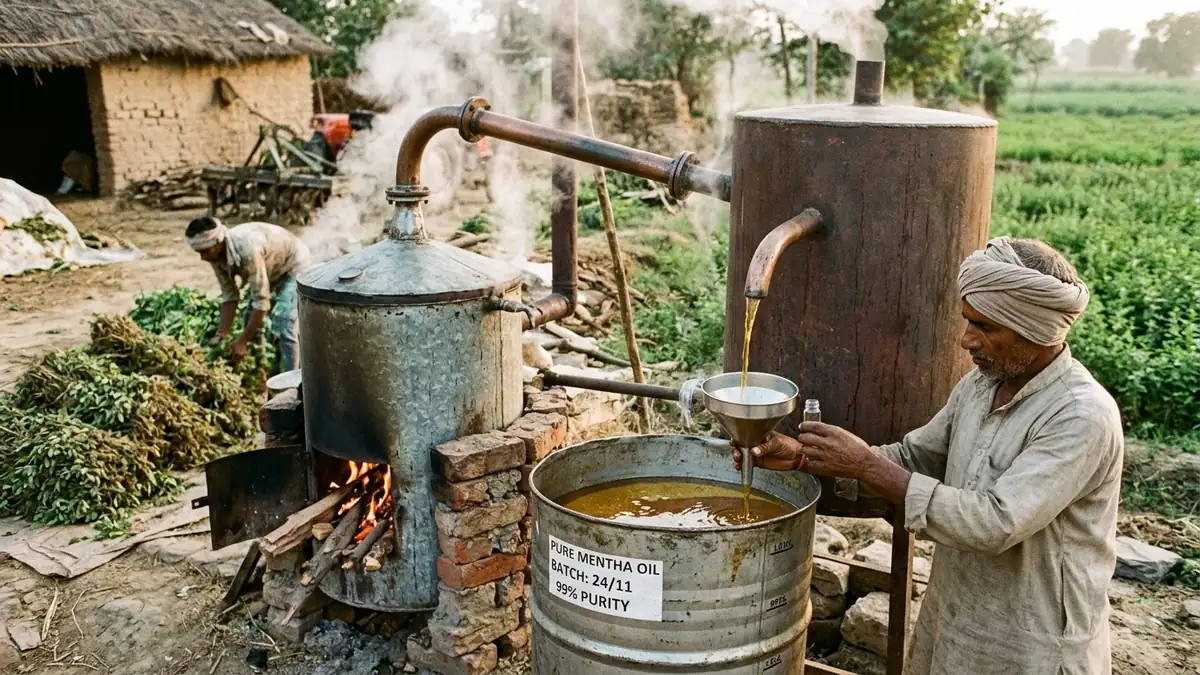
The table below details the complete per-acre cost of cultivation, field distillation operating costs, gross mandi revenues, and net profits for an Indian farmer using improved CSIR-CIMAP varieties:
| Expense / Revenue Category | Physical Inputs / Operations | Cost Range per Acre (Rs) | Operational Best Practices |
|---|---|---|---|
| Planting Material (Suckers/Stolons) | 150 – 200 kg certified root suckers | Rs 5,000 – Rs 6,500 | Use CIM-Kranti or Kosi varieties from certified nursery nurseries. |
| Field Preparation & Ridging | 2 disc ploughings + 2 harrowings + ridge making | Rs 2,500 – Rs 3,200 | Create shallow ridges spaced 45 cm apart for efficient irrigation. |
| Fertilizers & Manure | 60 kg Nitrogen + 25 kg P2O5 + 20 kg K2O + Zinc/Sulfur | Rs 3,200 – Rs 4,200 | Apply half N at planting, remainder split after each cutting. |
| Irrigation (6 to 8 cycles) | Tube-well electricity or diesel engine pumping | Rs 3,000 – Rs 4,500 | Light, frequent watering every 8 to 10 days during peak summer heat. |
| Weeding & Plant Protection | Manual weeding (2 rounds) + biological insecticides | Rs 2,000 – Rs 2,800 | Avoid chemical sprays near harvest to prevent residue in oil. |
| Harvesting & Biomass Hauling | Sickle cutting at 10% flowering stage + transport | Rs 2,500 – Rs 3,500 | Wilt cut herb in field for 24 hours to reduce boiler fuel load. |
| Field Steam Distillation | Boiler operational fee + wood/mustard straw fuel | Rs 3,500 – Rs 4,800 | Utilize stainless steel or high-efficiency CIMAP direct-fired units. |
| Total Production Cost (Acre) | Complete cycle expenses (both cuts combined) | Rs 21,700 – Rs 29,500 | Overall input investment across 100 days of cultivation. |
| Gross Mandi Revenue | 38 to 44 kg crude oil @ Rs 970/kg modal average | Rs 36,860 – Rs 42,680 | First cut yields 22-25 kg; second cut yields 16-19 kg oil. |
| Net Farmer Profit per Acre | Gross Revenue minus Total Cultivation & Boiler Cost | Rs 15,160 – Rs 21,980 | Clean cash profit generated in under 3.5 months before paddy. |
Farmers seeking to lower production costs can calculate their expected returns with our crop income and profit calculator, balance soil fertility with our fertilizer dose calculator, and replace costly diesel boilers by deploying subsidized solar irrigation under PM KUSUM solar pumps.
Maximizing Distillation Yield: Essential Agronomic Steps
Distillation efficiency makes the difference between marginal earnings and outstanding profit. To maximize recovery from the field biomass, farmers must adhere to four essential scientific steps developed by CSIR-CIMAP Lucknow:
- Optimal Harvest Timing: Cut the crop when approximately 10% of the plants begin flowering. Harvesting too early results in low menthol percentage; harvesting too late causes lower leaves to drop, forfeiting significant oil content.
- Proper Field Wilting: Allow harvested mint herbs to wilt in the field under indirect sunlight for 24 to 30 hours. Wilting reduces moisture weight by 25% to 35% without losing volatile oil, which lowers boiler steaming time from 3 hours to under 2 hours, saving valuable firewood.
- Condenser Temperature Control: Maintain cooling water outflow temperature between 40 deg C and 45 deg C. If cooling water is excessively cold (below 20 deg C), high-menthol oil will congeal inside the condenser coils and block pipes. If cooling water is too hot (above 55 deg C), light volatile aromatic fractions escape as uncondensed vapors.
- Moisture Decantation: After collecting the oil-water distillate, let the crude oil settle in a glass or stainless steel Florentine flask for at least 3 hours. Completely drain the bottom water layer. Any residual water left inside the storage drum will hydrolyze the esters and turn the oil rancid within weeks.
Standard 180 kg Drum Price Calculation & Quality Standards
In the commercial essential oil trade, bulk transactions are priced and settled on the basis of standard 180 kg net weight galvanized iron (GI) drums. When a broker quotes aaj ka mentha oil rate at Rs 980 per kg, the math for a full drum transaction proceeds as follows:
Gross Weight on Mandi Scale = 197.5 kg. Standard Empty GI Drum Tare Weight = 17.5 kg. Net Crude Mentha Oil Weight = 180.0 kg. Total Drum Value = 180 kg × Rs 980 = Rs 1,76,400. In mandi transactions, buyers may deduct 0.5% to 1.0% if moisture content exceeds 0.2%, reinforcing the necessity of thorough settling and water separation. Growers can also protect their seasonal income through PM Fasal Bima Yojana.
| Quality Test / Physical Property | Bureau of Indian Standards (BIS) Limit | Field Testing Procedure | Farmer Impact on Mandi Price |
|---|---|---|---|
| Total L-Menthol Content | Minimum 75.0% by weight (optimal 78-82%) | Laboratory Gas Chromatography (GC) analysis | Lots testing >80% receive Rs 15-30/kg premium. |
| Congealing Point (Freezing) | 24.0 deg C to 28.5 deg C | Cooling oil sample in ice water bath until it solidifies | Higher freezing temperature confirms high natural menthol. |
| Specific Gravity at 25 deg C | 0.890 to 0.912 | Hydrometer or digital density meter test | Readings >0.915 indicate adulteration with heavy solvents. |
| Optical Rotation | -35 deg to -43 deg | Polarimeter optical angle testing | Detects presence of synthetic racemic menthol adulteration. |
| Moisture & Water Content | Maximum 0.2% by volume | Visual clarity check; warm air transparency test | Cloudy or turbid oil incurs immediate 1-2% price cut. |
| Appearance & Aroma | Colorless to pale yellow; sharp pungent minty odor | Visual inspection and olfactory organoleptic test | Dark brown or oxidized oil indicates rusted storage drums. |
Practical Selling Strategy: When to Sell vs When to Store
One of the most frequent mistakes made by small-scale mint growers in Uttar Pradesh is panic selling during peak harvest arrivals in June and July. Because thousands of field distillation boilers operate simultaneously across Budaun, Sambhal, and Barabanki, local spot mandis become inundated with fresh crude oil. Commission agents take advantage of the glut by lowering their buying bids.
Historically, seasonal price charts reveal a consistent annual pattern: prices bottom out between June and August (ranging from Rs 880 to Rs 930 per kg) and appreciate steadily as winter approaches, reaching Rs 980 to Rs 1,050+ per kg between November and February. The winter surge is powered by pharmaceutical manufacturers ramping up production of cough syrups, throat lozenges, and cold rub balms.
Farmers who have access to institutional credit facilities like the Kisan Credit Card or institutional crop loans can borrow low-interest working capital to cover their Kharif sowing expenses, allowing them to warehouse their mentha drums securely for 4 to 6 months. Storing two drums of mentha oil (360 kg) can net an additional Rs 25,000 to Rs 35,000 in pure capital gain simply by timing the sale to the winter rally.
Growers can reinvest mint earnings into robust machinery like John Deere 60 HP tractors or versatile Swaraj tractors, integrate sustainable livestock systems with dairy farming, and track statutory installment disbursements via PM Kisan beneficiary status.
Frequently asked questions
- What is the mentha oil rate today in Uttar Pradesh mandis?
- Mentha oil rate today across Uttar Pradesh spot mandis trades in the benchmark range of Rs 940 to Rs 1,010 per kg. Primary trading centers like Sambhal and Chandausi quote Rs 960 to Rs 1,005 per kg for high-grade oil, while Barabanki and Sitapur quote Rs 940 to Rs 980 per kg. You can check daily fluctuations on our mandi rates platform.
- How much does one 180 kg drum of mentha oil cost today?
- At prevailing spot prices between Rs 940 and Rs 1,010 per kg, a standard commercial galvanized iron (GI) drum containing 180 kg net of crude mentha oil is valued between Rs 1,69,200 and Rs 1,81,800 in physical mandi markets.
- What is the trading lot size for mentha oil on MCX India?
- On the Multi Commodity Exchange (MCX India), 1 trading lot of mentha oil equals exactly 360 kg (the equivalent of 2 standard 180 kg commercial drums), with mandatory physical delivery settlement centered around accredited warehouses in Chandausi, Uttar Pradesh.
- Why does mentha oil rate today in Barabanki differ from Chandausi?
- Barabanki functions primarily as a high-volume agricultural production and field distillation hub, where large summer arrivals cause temporary spot supply gluts. Chandausi is an industrial processing and export hub hosting fractional distillation refineries and the MCX delivery warehouse, resulting in a Rs 15 to Rs 30 per kg premium for Chandausi quotes.
- How many kilograms of mentha oil can a farmer produce from one acre of land?
- Using improved CSIR-CIMAP varieties like Kosi or CIM-Kranti, one acre yields approximately 35 to 45 kg of crude mentha oil across two seasonal cuttings: 20 to 25 kg during the first cutting in May-June, and 15 to 20 kg during the second cutting in July. Net margins can be calculated with our crop income calculator.
- How does synthetic menthol impact natural mentha oil price today?
- Synthetic menthol synthesized from petrochemical feedstocks (m-cresol) creates an effective price ceiling for natural menthol. When global crude oil prices decline, synthetic menthol becomes cheaper, dampening export demand for Indian natural mentha oil; when petroleum prices rise or buyers require natural certification, natural prices rally.
- What is the congealing point of pure mentha oil and why does it freeze in winter?
- Pure natural crude mentha oil congeals and crystallizes between 24 deg C and 28.5 deg C because it contains 75% to 82% natural L-menthol, which has a natural melting point of approximately 42 deg C. Solidification during cooler months is a primary physical proof of authentic, high-menthol purity, as certified by CSIR-CIMAP.
- What is Dementholized Oil (DMO) and how does its price compare to crude mentha oil?
- Dementholized Oil (DMO) is the residual liquid essential oil remaining after freezing and crystallizing out pure L-menthol crystals from crude mentha oil. DMO contains approximately 30% to 45% menthol along with natural mint terpenes, trading at a 30% to 35% discount (Rs 620 to Rs 710 per kg) for confectionery and cosmetic fragrance use.
- Is GST applicable when farmers sell crude mentha oil in mandis?
- Individual agricultural cultivators selling crude mentha oil produced from their own farm distillation are exempt agricultural producers under GST rules. However, registered commercial traders, aggregators, and processing refineries charging commissions or selling processed derivatives must pay 12% GST under HSN code 3301.
- What are the best containers and storage conditions for mentha oil?
- Mentha oil should be stored exclusively in clean, airtight galvanized iron (GI) drums or food-grade epoxy-lined steel drums filled to 95% volume to minimize headspace air. It must be kept in a cool, covered, well-ventilated godown away from direct sunlight; plastic carboys should never be used for long-term storage as menthol degrades polymers.
- When during the year does mentha oil price reach its highest level?
- Mentha oil prices historically reach their annual peak between November and February, driven by strong winter pharmaceutical demand for cold, cough, and analgesic formulations alongside depleted physical mandi arrivals following the monsoon.
- How can farmers detect water or cutting oil adulteration in mentha oil?
- Farmers and buyers detect moisture by inspecting clarity: pure dry oil is crystal clear, whereas moisture makes it cloudy. Adulteration with diesel, mineral turpentine, or heavy solvents is detected by measuring specific gravity (normal range 0.890 to 0.912) and conducting the congealing freeze test in an ice water bath.
This article is for general information only and is not financial advice. Loan and scheme eligibility depends on partner and government criteria.