Tractor Seed Drill Price 2026: Models & SMAM Subsidy
Key takeaways
- Complete farmer guide to tractor seed drills in India: zero-till vs rotavator cum seed drill prices, SMAM 40%-50% subsidy, calibration, and crop spacing.
- Covers Seed Drill Types, Tractor HP Needs & Indicative Indian Price Ranges with government-linked benchmarks and practical Indian farm guidance.
- Covers How a Modern Seed Drill Works: Core Functional Parts Explained with government-linked benchmarks and practical Indian farm guidance.
- Covers Field Calibration Steps Before Every Crop Sowing Season with government-linked benchmarks and practical Indian farm guidance.
Broadcasting grain by hand wastes 15% to 25% of expensive certified seed on dry crust or uneven depth, cutting uniform germination before a single winter irrigation starts! Upgrading to a calibrated tractor-drawn seed drill (seed-cum-fertilizer drill) places seed and basal DAP phosphate in crisp parallel rows at uniform 4–6 cm soil depth simultaneously—boosting crop emergence speed, cutting seed bills cleanly, and simplifying mechanized weeding across wheat, soybean, gram, mustard, maize, and groundnut fields.
Whether budgeting for a classic 9-tyne rigid tine unit, a heavy-duty Zero-Till seed drill, a stubble-mulching Happy Seeder / Super Seeder, or an inclined-plate pneumatic planter, inspect official testing standards at CFMTTI Budni and 40%–50% SMAM subsidies at agrimachinery.nic.in before ordering. Compare operational setups inside our technical seed drill setup guide, Happy Seeder zero-till walkthrough, and Seed Rate Calculator.
1. Seed Drill Types, Tractor HP Needs & Indicative Indian Price Ranges
Prices across Punjab, Haryana, MP, and UP implement clusters depend heavily on frame angle weight (50x50 mm vs heavy 65x65 mm box chassis), dual split hopper capacity, fluted-roller vs inclined-plate seed metering precision, and spring-loaded tyne assemblies. Below are clean indicative ex-workshop/dealer price ranges before SMAM subsidy for CFMTTI-compliant Indian farm models:
| Seed Drill Type | Typical Rows / Tynes | Recommended Tractor HP | Indicative Ex-Showroom Price (Pre-Subsidy) |
|---|---|---|---|
| Standard Seed-Cum-Fertilizer Drill (Fluted Roller) | 9 to 11 Tynes (Rigid / Spring) | 35 – 45 HP (e.g., Swaraj 735 / 744) | ₹45,000 – ₹78,000 |
| Heavy Zero-Till Seed-Cum-Fertilizer Drill | 9 to 13 Inverted-T Openers | 45 – 55 HP (e.g., Farmtrac 60 / Arjun 605) | ₹65,000 – ₹98,000 |
| Inclined-Plate Multi-Crop Precision Planter | 5 to 9 Rows (Maize / Soybean / Gram) | 40 – 50 HP | ₹75,000 – ₹1,25,000 |
| Rotary Till Drill / Roto-Seed Drill (3-in-1) | 5 ft to 7 ft Rotavator + Hopper | 45 – 60 HP High-Torque PTO | ₹1,15,000 – ₹1,75,000 |
| Happy Seeder / Super Seeder (Direct Paddy Stubble) | 9 to 11 Rows + Flail / Rotor | 50 – 65 HP (Dual Clutch / 4WD) | ₹1,65,000 – ₹2,75,000 |
Source: SMAM Agrimachinery Portal indicative equipment cost slabs & CFMTTI Budni implement test classes. Always confirm current GST, iron freight, and district CHC quotes locally.
2. How a Modern Seed Drill Works: Core Functional Parts Explained
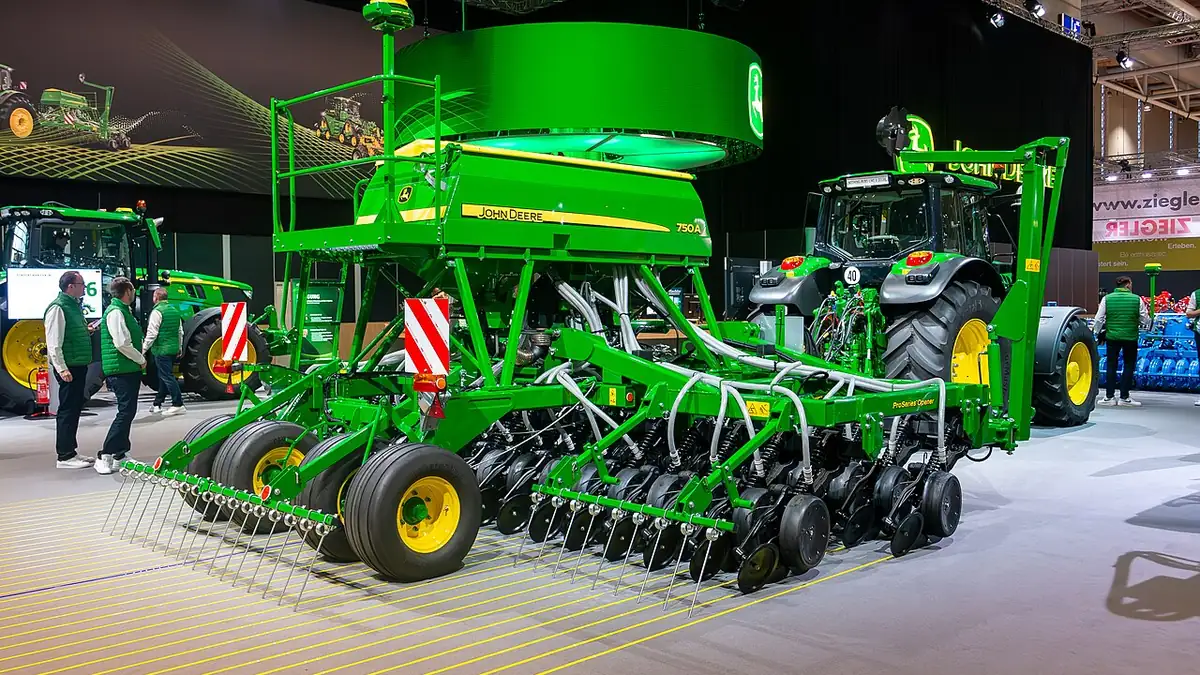
Farmers and agricultural students looking up tractor drawn seed drill diagram mechanics will find six simple coordinated assemblies operating smoothly across every tractor pass:
- Split Grain & Fertilizer Hopper Box: Two weather-proof steel compartments keeping grain seeds separate from hygroscopic chemical granules (DAP or NPK) so damp fertilizer salts never burn seed viability during germination.
- Ground Drive Wheel & Chain Sprocket Transmission: A spiked cast-iron or rubber-tread ground wheel rolls across the soil, turning the main horizontal metering shaft strictly proportional to tractor forward speed—preventing double dumping at field headlands when lifted via the 3-point hitch!
- Fluted Rollers / Inclined Seed Plates: Adjustable grooved aluminum fluted rollers shift sideways via calibrated lever screws to dial precise wheat, barley, or moong kg/acre drops—whereas interchangeable multi-hole inclined plates drop big round soybean, chickpea, and maize seeds one-by-one without seed-coat cracking.
- Transparent Plastic Delivery Tubes: Spiral flexible pipes drop metered seeds and fertilizer down smoothly inside hollow tyne boots with clear visibility so operators spot clogged chaff fast.
- Furrow Openers & Depth-Control Hitch: Reversible shovel tines or inverted-T zero-till blades slice narrow soil trenches, dropping fertilizer slightly below or beside the seed ribbon before soil crumbles gently overhead.
- Trailing Planker / Press Wheel Bar: Levels open ridges softly right behind openers so moisture remains locked cleanly around newly placed seeds.
3. Field Calibration Steps Before Every Crop Sowing Season
Never head into 10-acre Rabi wheat or Kharif soybean blocks relying purely on an old factory paint mark on the seed regulator lever! Variations in seed weight (bold varieties vs small-seeded varieties), swollen humidity, or worn chain slack routinely skew output by ±12 kg/acre unless you spend five clean minutes completing stationary ground-wheel calibration using your exact target seed lot checked against KisanPe's Seed Rate Calculator and certified seed purity standards:
| Calibration Step | Exact Farmer Action on Farm Yard | Target Example (Wheat 11-Tyne @ 20 cm) |
|---|---|---|
| 1. Measure Effective Sowing Width | Multiply Number of Openers x Row-to-Row spacing in meters | 11 tynes x 0.20 m = 2.20 meters working width |
| 2. Measure Drive Wheel Circumference | Wrap string or chalk-mark 1 full tire revolution on hard ground | Example: 1.50 meters per full wheel rotation |
| 3. Compute Revolutions for 1/10th Acre | Area covered per turn = Width x Circumference; divide 404.7 sq.m (0.1 acre) by that number | 2.20 x 1.50 = 3.30 sq.m/rev -> ~123 wheel turns = 0.1 acre |
| 4. Jack Wheel, Tie Bags & Weigh | Raise drive wheel, tie plastic bags under all 11 tubes, spin exactly 123 turns, weigh total grain | Target 4.0 to 4.5 kg collected = clean 40 to 45 kg/acre field rate! |
Source: ICAR Central Institute of Agricultural Engineering & KisanPe Seed Drill Calibration Guidelines.
4. Applying for 40%–50% SMAM Subsidy & Custom Hiring Finance
Buying a new CFMTTI-approved modern seed drill, Zero-Till planter, or Super Seeder does not require paying 100% cash upfront! Under the Ministry of Agriculture's SMAM (Sub-Mission on Agricultural Mechanization) portal (agrimachinery.nic.in) and state CRM (Crop Residue Management) schemes across Punjab, Haryana, UP, and MP, individual small/marginal/SC/ST/women farmers routinely receive 50% subsidy (general farmers 40%, and CHCs/FPOs 40%–80% depending on CRM packages) directly transferred via DBT after joint physical verification!
Prepare updated Khatauni/Jamabandi land papers cleanly via our SMAM Farm Machinery Subsidy walkthrough, inspect companion state tractor programs on KisanPe Tractor Subsidies, browse matching tractors inside our tractors comparison hub (rotavator PTO combinations), and compute equipment EMIs with our Tractor Loan Calculator.
5. Choosing Zero-Till vs Roto-Drill & Monsoon Maintenance Tips
Choosing between a standalone Zero-Till drill (Zero-Till & Happy Seeder guide) and a tractor-driven Roto-Seed Drill comes down strictly to paddy straw volume, tractor horsepower, and moisture timing. Where late-maturing basmati harvest leaves sticky wet topsoil in November, a single-pass Roto-Seed Drill saves three costly ploughing passes—provided your tractor delivers genuine 50+ PTO HP so high rotary blade loads don't starve forward wheel speeds. Conversely, across standing short wheat stubble or dry harvested maize-soybean plots in Madhya Pradesh and Rajasthan, a lightweight Zero-Till inverted-T seed drill pairs brilliantly with existing 40–45 HP rigs like Swaraj 735/744 or Mahindra 575, cutting fuel expense down below 3.5–4.5 liters of diesel per acre while conserving precious residual soil moisture!
Finally, protect your investment every May after Zaid and Kharif sowing ends: fertilizer salts inside DAP and Urea hoppers absorb humid monsoon air and rust steel shutter plates fast! Empty hoppers completely on the final sowing evening, brush out dusty seed pockets cleanly with dry paintbrushes, grease chain sprockets and bearing housings thoroughly, coat fluted roller shafts with anti-rust waste engine oil, and stand tine shoes on wooden blocks inside dry sheds so rubber seed pipes stay supple and crack-free across 10+ seasons of reliable wheat and pulse sowing. Check seasonal scheme lists on KisanPe Subsidies and budget KCC working credit cleanly ahead of peak October sowing rushes!
Field operators can also elevate uniform germination markedly by pairing exact row depth settings with pre-sowing seed-bed moisture checks! Across North Indian sandy loams in November, setting furrow openers squarely between 4.0 and 5.0 cm depth ensures plump wheat and gram embryos stay nestled inside damp subsoil moisture right beneath dry loose topsoil—whereas sowing blindly past 7.5 cm depth exhausts coleoptile emergence energy and creates spindly, frost-vulnerable plants! On top of depth checks, verify equal spring tension across all 9 or 11 tine arms along uneven tractor wheel tracks behind rear tyres: adjusting the rear wheel-track tynes 1.0–1.5 cm deeper compensates smoothly for tyre compaction ridges so every single crop row germinates simultaneously within 6 to 7 days of sowing. Maintaining simple tractor implement records (row widths, sprocket tooth ratios verified per crop—20 cm wheat vs 45 cm soybean vs 30 cm gram/mustard) inside the farm office logbook eliminates trial-and-error wastage during short peak sowing windows every season. Moreover, growers contracting nearby Custom Hiring Centre (CHC) tractors for Rs 600–Rs 900/acre sowing runs should walk behind the operating machine over the first 50 meters of the strip: dig up 5–6 soil spots lightly by hand to inspect true seed placement depth, confirm moist subsurface crumb contact around dropped grains, verify zero broken grains beneath worn steel metering gates, and check every delivery tube frequently during slow headland turns so damp soil clods never choke an entire single furrow silently across a 4-acre plot! Balancing accurate dry furrow depth (4–5 cm), fresh non-caked fertilizer hopper cleaning after every seasonal crop, and verified SMAM DBT bill filing ensures multi-crop line drilling lifts winter and monsoon farm yields smoothly across 10+ seasons of dependable sowing performance. Synchronize calibrated line seeding seamlessly across wheat marketing goals, optimal winter wheat spacing, hardy chickpea cultivar planting, clean basal NPK splitting, quality seed verification basics, proper machinery loan checklists, and active state equipment subsidy schemes.
6. Frequently Asked Questions on Tractor Seed Drills & Prices
Explore quick factual answers on seed-cum-fertilizer drill pricing, tractor HP sizing, Happy Seeder subsidies under SMAM, row calibration, and line sowing crop benefits.
Frequently asked questions
- What is the indicative price of a tractor seed drill in India in 2026?
- Standard 9–11 tyne seed-cum-fertilizer drills range broadly from ₹45,000 to ₹78,000, heavy Zero-Till drills cost ₹65,000 to ₹98,000, and combined Roto-Seed / Super Seeders span ₹1.15 lakh to ₹2.75 lakh before subsidies—check full calibration checklists in our technical seed drill guide.
- Can farmers get a Government subsidy on tractor seed drills and Zero-Till machines?
- Yes! Under the Central SMAM Agrimachinery portal and state CRM schemes, eligible small/marginal/SC/ST farmers receive 50% subsidy (40% general) on CFMTTI-approved drills—follow exact DBT application steps inside our SMAM subsidy portal guide.
- Which tractor HP is required for an 11-tyne seed drill vs a Super Seeder?
- A standard 9- or 11-tyne rigid/zero-till drill works comfortably with 35–45 HP tractors, whereas combined Super Seeders and Roto-Seed Drills running rotary puddling blades alongside sowing hoppers require 50–65 HP tractors listed on our Indian tractor comparison hub.
- How do fluted rollers and inclined plates differ in a modern seed drill?
- Fluted rollers meter small, free-flowing seeds continuously (wheat, barley, sorghum, mustard), whereas inclined seed plates gently scoop individual larger seeds (soybean, chana, maize, cotton) cleanly without mechanical crushing or patchy skips.
- Why should wheat be sown with a seed drill instead of broadcasting?
- Line sowing cuts seed waste by 15%–20% (calibrated accurately via KisanPe's Seed Rate Calculator), places basal DAP fertilizer cleanly near emerging roots, yields uniform plant spacing, and reduces winter crop lodging after canal irrigation.
- Can a Zero-Till seed drill sow directly into combined-harvested paddy fields?
- Standard inverted-T zero-till drills tangle in thick loose combine straw unless straw is cut/baled cleanly first; for heavy loose paddy straw, farmers prefer a Happy Seeder or Super Seeder designed to cut, mulch, and drill seeds simultaneously in a single pass.
- How do you convert wheel turns into exact kg/acre during seed drill calibration?
- Multiply implement width (meters) by one ground-wheel circumference (meters), divide 404.7 sq.m (0.1 acre) by that per-turn area to get required wheel rotations, jack the wheel and spin those exact turns with bags tied underneath, then multiply collected seed weight by 10.
- What post-season storage check prevents seed-cum-fertilizer drill rusting?
- Empty both hoppers completely after final seasonal runs because hygroscopic DAP and Urea residues trap monsoon moisture and rapidly corrode metering plates, wash tubes cleanly, coat iron parts lightly with oil, and store shaded indoors.
This article is for general information only and is not financial advice. Loan and scheme eligibility depends on partner and government criteria.