Sugar Price Today: Ex-Mill, Wholesale Mandi & Retail Rates
Key takeaways
- Indicative wholesale ex-mill sugar prices in India (November 2026) range between ₹3,480 to ₹3,620 per quintal in Maharashtra (S-30 grade) and ₹3,720 to ₹3,880 per quintal in Uttar Pradesh (M-30 grade) as of 23 November 2026.
- Wholesale APMC mandi prices in major consuming metropolitan centers trade between ₹3,950 to ₹4,150 per quintal in Delhi, ₹3,720 to ₹3,920 in Mumbai (Vashi), and ₹4,050 to ₹4,280 in Kolkata.
- Retail loose sugar prices across local grocery stores benchmark between ₹42 to ₹46 per kilogram, while packaged and branded refined sugar retails at ₹48 to ₹56 per 1 kg pouch.
- The Central Government fixed the Fair and Remunerative Price (FRP) of sugarcane at ₹340 per quintal for the 2024-25 season and ₹355 per quintal for the 2025-26 season, linked to a basic sugar recovery rate of 10.25 percent.
- Domestic market prices are stabilized by the Directorate of Sugar through monthly sales quota allocations to mills and the diversion of excess sucrose toward the 20 percent Ethanol Blending Programme (E20).
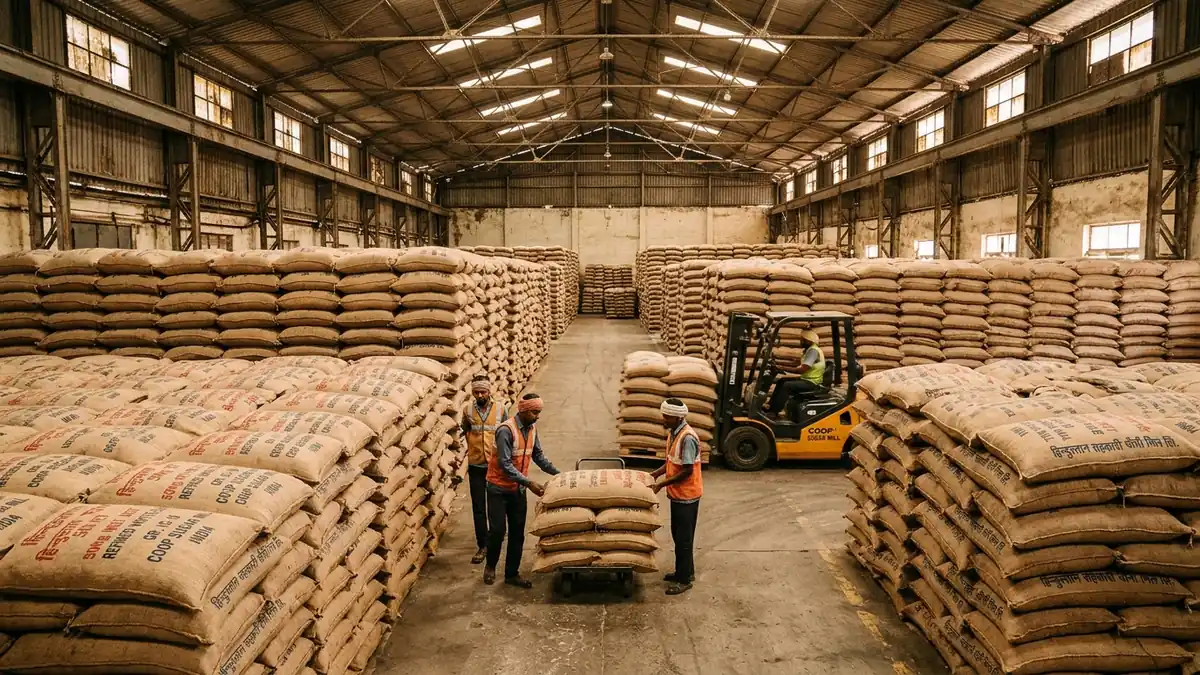
Indicative sugar prices in India (November 2026) range between ₹3,480 to ₹3,880 per quintal at factory ex-mill gates, while wholesale APMC mandi rates across major consuming cities trade between ₹3,720 to ₹4,280 per quintal as of 23 November 2026. For end consumers, retail loose white sugar sells between ₹42 to ₹46 per kilogram, and premium packaged sugar (such as Trust, Madhur, or Dhampure) retails between ₹48 to ₹56 per 1 kg packet depending on regional logistics, packaging grade, and local merchant margins.
Sugar is one of India's most politically sensitive and economically vital agricultural commodities, directly impacting the livelihoods of over 5 crore sugarcane farmers and hundreds of thousands of workers employed across more than 500 operational cooperative and private sugar mills. Whether you are a sugarcane grower evaluating mill payment realisations, an institutional bulk buyer in confectioneries, beverages, and bakeries, or a household consumer tracking essential kitchen budgets, understanding how daily sugar prices are determined is essential. Whether evaluating mill payment realisations with our sugarcane agronomy guide, tracking real-time mandi rates on our mandi rates live portal, or projecting seasonal earnings with the crop income calculator, this guide breaks down central ex-mill quotes, state SAP bonuses, and retail price dynamics monitored by the Department of Food and Public Distribution (DFPD). Readers can also compare daily retail updates in our companion report on today's sugar price analysis.
Sugar price by state: indicative ex-mill and wholesale rates
In India, commercial sugar prices exist at two fundamental trading levels: the factory ex-mill price (the price at which sugar factories sell 50 kg bags to commercial wholesalers) and the wholesale mandi price (the price charged by stockists and commission agents inside major urban APMC wholesale markets). Regional freight, state local taxes, handling charges, and transit margins create a structured price gradient between producing sugar belts and distant consumption centers.
| State / Market Hub | Commercial Grade | Ex-Mill Price (Rs/Qtl) | Wholesale Mandi Rate (Rs/Qtl) | Retail Consumer Price (Rs/Kg) |
|---|---|---|---|---|
| Maharashtra (Kolhapur / Pune) | S-30 Grade | 3,480 - 3,580 | 3,720 - 3,820 | 42 - 44 |
| Maharashtra (Solapur / Ahmednagar) | S-30 Grade | 3,460 - 3,560 | 3,700 - 3,800 | 42 - 44 |
| Uttar Pradesh (Muzaffarnagar / Meerut) | M-30 Grade | 3,740 - 3,880 | 3,920 - 4,050 | 43 - 46 |
| Uttar Pradesh (Lakhimpur / Bareilly) | M-30 Grade | 3,720 - 3,840 | 3,900 - 4,020 | 43 - 45 |
| Karnataka (Belagavi / Bagalkot) | S-30 Grade | 3,510 - 3,620 | 3,750 - 3,880 | 42 - 45 |
| Gujarat (Surat / Gandevi) | S-30 Grade | 3,560 - 3,680 | 3,800 - 3,920 | 43 - 45 |
| Delhi NCR (Naya Bazar Mandi) | M-30 Grade | 3,850 - 3,950 (F.O.R.) | 3,980 - 4,150 | 44 - 46 |
| Mumbai (Vashi Navi Mumbai APMC) | S-30 Grade | 3,580 - 3,680 (F.O.R.) | 3,750 - 3,920 | 42 - 45 |
| Kolkata (Posta Mandi) | M-30 Grade | 3,920 - 4,050 (F.O.R.) | 4,080 - 4,280 | 45 - 48 |
| Chennai (Koyambedu APMC) | S-30 Grade | 3,720 - 3,840 (F.O.R.) | 3,880 - 4,050 | 43 - 46 |
| Punjab (Ludhiana / Jalandhar) | M-30 Grade | 3,800 - 3,920 | 4,020 - 4,180 | 44 - 47 |
| Bihar (Patna / Muzaffarpur) | M-30 Grade | 3,820 - 3,950 | 4,050 - 4,220 | 45 - 48 |
| Madhya Pradesh (Indore Mandi) | M-30 / S-30 | 3,680 - 3,800 | 3,900 - 4,080 | 43 - 46 |
| Rajasthan (Jaipur Mandi) | M-30 Grade | 3,780 - 3,900 | 3,980 - 4,140 | 44 - 46 |
| West Bengal (Siliguri Hub) | M-30 Grade | 3,980 - 4,100 | 4,150 - 4,320 | 46 - 49 |
Commercial sugar grades in India: M-30 vs S-30 explained
In Indian commercial trade, white plantation refined sugar is officially classified using Indian Sugar Standard (ISS) grades established by the National Sugar Institute (NSI), Kanpur, and the Bureau of Indian Standards (BIS). The grade code consists of a letter denoting grain crystal size and a number denoting crystal whiteness and luster.
The two primary commercial grades that account for over 95 percent of all domestic sugar sales are:
- Grade M-30 (Medium Grain, 30 Color): Features bold, sparkling medium-sized sucrose crystals ranging from 1.2 mm to 1.7 mm in diameter. The number "30" indicates superior optical whiteness and high purity (polarization above 99.8%). M-30 is predominantly manufactured by sugar mills in Uttar Pradesh, Bihar, Haryana, and Punjab. It commands a consistent price premium of ₹150 to ₹250 per quintal over small-grain sugar because north Indian consumers, sweet makers (halwais), and traditional beverage vendors prefer large crystals.
- Grade S-30 (Small Grain, 30 Color): Features fine, uniform sugar crystals measuring 0.8 mm to 1.2 mm in diameter with identical high purity and sweetness. S-30 is the primary grade produced by cooperative and private sugar mills across Maharashtra, Karnataka, Tamil Nadu, and Gujarat. Due to smaller crystal dimensions, S-30 dissolves rapidly in household tea, coffee, and industrial soft drink manufacturing.
- Super Fine / Refined White Sugar (SS-30 & Pharma Grade): Specialized grades with ultra-fine crystal sizing below 0.8 mm or ultra-high purity ratings (polarization 99.9%+) utilized by pharmaceutical syrup manufacturers, carbonated soft drink bottlers, and luxury confectionery brands.
Because transport of S-30 from southern and western mills to north Indian markets incurs ₹200 to ₹300 per quintal in freight, local retail markets in Delhi, Lucknow, and Patna trade predominantly on locally milled UP M-30 sugar.
How sugar prices are regulated: FRP, SAP and monthly release quotas
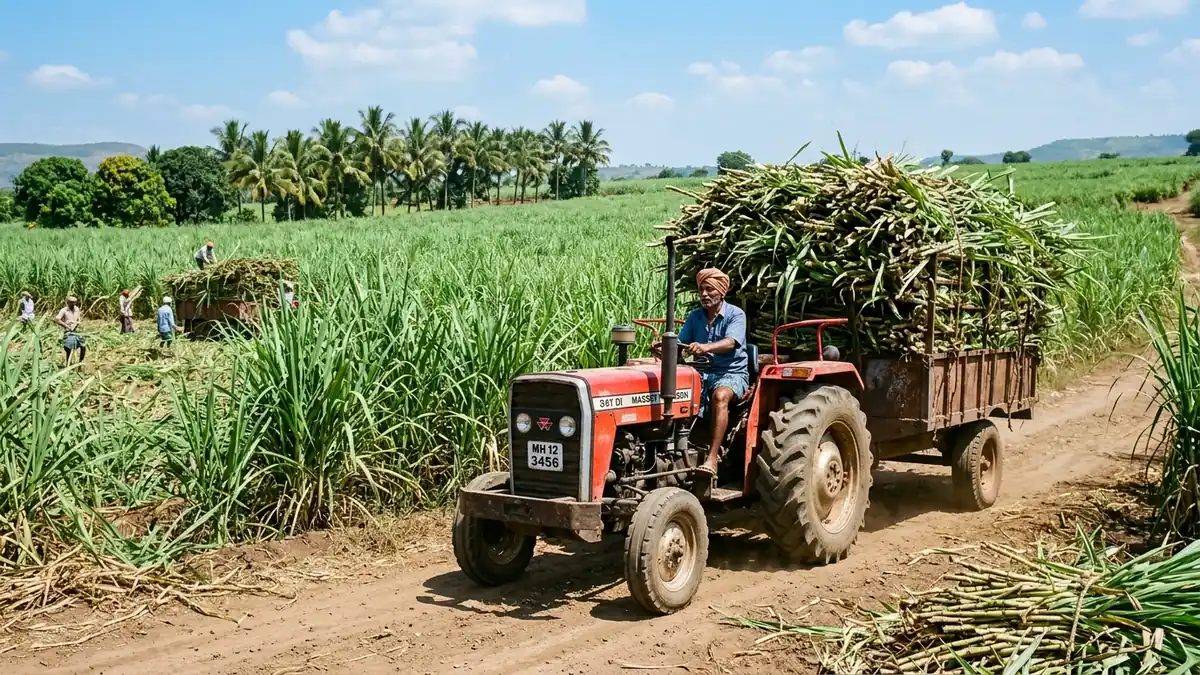
Unlike entirely free agricultural markets, the sugar sector in India is governed by a dual regulatory architecture designed to balance two competing national objectives: ensuring remunerative cane payments to farmers while safeguarding affordable retail prices for 140 crore consumers.
Sugarcane Fair and Remunerative Price (FRP)
Under the Sugarcane (Control) Order, 1966, the central government's Cabinet Committee on Economic Affairs (CCEA) fixes the statutory Fair and Remunerative Price (FRP) that every sugar factory is legally mandated to pay sugarcane farmers within 14 days of cane delivery. For the 2024-25 sugar season, the FRP was fixed at ₹340 per quintal linked to a basic sugar recovery rate of 10.25 percent (with a premium of ₹3.32 per 0.1% increase in recovery). For the 2025-26 season, the CCEA enhanced the FRP to ₹355 per quintal with a proportionate premium of ₹3.46 per 0.1% recovery increase. To protect farmers in drought-prone regions where cane recovery falls below 9.5 percent, a guaranteed minimum floor price of ₹329.05 per quintal is statutorily enforced.
State Advised Price (SAP)
Certain major sugarcane-producing states—most notably Uttar Pradesh, Punjab, and Haryana—fix their own State Advised Price (SAP), which is traditionally higher than the central FRP. For instance, the Uttar Pradesh government mandates an SAP of ₹370 per quintal for early maturing cane varieties and ₹360 per quintal for general varieties. Because cane costs represent nearly 70 to 75 percent of the total cost of producing sugar, higher SAP mandates in Uttar Pradesh result in higher baseline ex-mill sugar prices compared to Maharashtra and Karnataka. Sugarcane growers in western India can explore Maharashtra cane welfare schemes, compute working capital limits on our KCC loan eligibility calculator, and review crop loss guidelines under PM Fasal Bima Yojana.
Minimum Selling Price (MSP) of sugar
To prevent destructive price crashes during bumper harvest seasons that leave mills unable to clear farmer cane arrears, the central government introduced the Sugar Price (Control) Order in 2018, fixing a statutory Minimum Selling Price (MSP) below which no mill can legally sell sugar. The current statutory MSP stands at ₹3,100 per quintal (₹31/kg). The sugar industry, represented by the Indian Sugar & Bio-energy Manufacturers Association (ISMA), has actively petitioned the central government to revise the MSP upward to ₹3,900 to ₹4,100 per quintal to align with rising sugarcane FRPs and factory operational costs.
Monthly domestic sales quota mechanism
The Directorate of Sugar and Vegetable Oils under the Department of Food and Public Distribution regulates domestic open-market supply by allocating a specific monthly dispatch quota to each of the country's 500+ sugar factories. By calibrating monthly supply (typically releasing between 20 to 24 lakh metric tonnes per month depending on festival demand), the government prevents artificial market gluts and dampens speculative hoarding, aligned with official announcements from the Press Information Bureau (PIB).
The Ethanol Blending Programme (E20) and its impact on sugar prices
Historically, the Indian sugar sector was plagued by severe cyclical boom-and-bust patterns: two years of bumper cane production led to massive sugar surpluses, crashing domestic prices, and escalating cane arrears running into tens of thousands of crores, followed by two years of farmer acreage contraction and painful domestic sugar deficits.
This structural volatility has been profoundly altered by the national Ethanol Blending Programme (EBP), which mandates blending 20 percent ethanol with petrol by 2025-26. Under government policy, sugar mills and dedicated distilleries are encouraged to divert excess sugarcane juice, sugar syrup, and B-heavy molasses directly into fuel ethanol production. In an average crushing season, approximately 35 to 45 lakh metric tonnes of potential sugar production is diverted toward green fuel. This diversion absorbs domestic surplus, prevents price crashes, generates steady monthly liquidity for mills, and ensures timely FRP payments directly into farmer bank accounts.
Factors that drive seasonal sugar price fluctuations
While central quotas and minimum price floors provide baseline price stability, daily open-market sugar prices fluctuate based on seasonal, industrial, and global dynamics:
- Festival Season Demand Surges (August to November): Domestic sugar demand peaks during Raksha Bandhan, Ganesh Chaturthi, Navratri, Dussehra, and Diwali. Confectionery manufacturers, dairy cooperatives, and sweet shops increase procurement volumes by 30 to 40 percent. The central government routinely releases higher monthly quotas during these months to prevent consumer price spikes.
- Crushing Season Squeeze and Opening Stocks (October to December): As mills begin seasonal cane crushing operations, cash flow pressures to pay farmers within the mandatory 14-day statutory FRP window often prompt mills to sell their allotted quotas aggressively, temporarily softening ex-mill prices.
- Summer Beverage Demand (March to June): Rising summer temperatures spur nationwide demand for carbonated soft drinks, ice creams, flavored milk, and processed fruit beverages. Large industrial institutional buyers (FMCG conglomerates) contract bulk forward deliveries, keeping wholesale prices buoyant.
- Monsoon Performance in Maharashtra and Karnataka: Sugarcane is a water-intensive 12-to-18-month crop. Deficient monsoon rainfall in the Marathwada, Solapur, or northern Karnataka cane belts directly threatens cane yields, reduces crushing duration, and sparks bullish market sentiment across commodity bourses.
- Global Sugar Prices and Export Policy Restrictions: As the world's second-largest sugar producer, India's export policy significantly impacts international raw and white sugar benchmarks. To prioritize domestic availability and control food inflation, the central government manages export quotas strictly, prohibiting unbridled outward shipments during tight crop years.
Sugarcane farming economics: recovery rates, harvesting costs and farmer income
For millions of farmers in western Maharashtra, western Uttar Pradesh, coastal Andhra Pradesh, and northern Karnataka, sugarcane remains the undisputed king of commercial cash crops due to guaranteed statutory pricing and structured mill tie-ups.
Key economic variables determining sugarcane farm profitability include:
- Average Crop Yield per Acre: Under standard irrigated conditions, popular high-yielding cane varieties (such as Co 0238 in North India, or Co 86032 in Maharashtra and South India) yield between 35 to 55 tonnes per acre.
- Gross Revenue Realisation: At the official FRP/SAP benchmark of ₹340 to ₹370 per quintal (₹3,400 to ₹3,700 per tonne), an acre yielding 45 tonnes of cane generates gross revenue of ₹1,53,000 to ₹1,66,500.
- Cost of Cultivation: Comprehensive cultivation expenses—including seed setts, land preparation, drip irrigation (supported by the PM KUSUM solar pump scheme), NPK and micronutrient fertilizers, and bio-fertilizers under organic farming standards, weed control, and crop protection—average ₹45,000 to ₹60,000 per acre.
- Harvesting and Transport (Toli) Deductions: In states like Maharashtra, sugarcane harvesting and truck/tractor transport to the mill gate is traditionally organized and deducted by the sugar factory (costing roughly ₹650 to ₹800 per tonne), whereas in UP, farmers frequently deliver to local cane purchase centers (Kanta) managed by cooperative societies.
- Net Farmer Profit: After deducting all operational and harvesting outlays, a diligent sugarcane grower secures a net profit margin of ₹65,000 to ₹90,000 per acre over a 12-month cropping cycle. This reliable income stream provides stability unmatched by open-market perishable vegetables.
Frequently asked questions about sugar price and mandi rates
Frequently asked questions
- What is today sugar price in Maharashtra, Uttar Pradesh and Delhi?
- As an indicative November 2026 range, the factory ex-mill sugar price was ₹3,480 to ₹3,620 per quintal in Maharashtra (S-30 grade) and ₹3,720 to ₹3,880 per quintal in Uttar Pradesh (M-30 grade). In Delhi wholesale mandis, sugar trades at ₹3,950 to ₹4,150 per quintal, while retail consumer price averages ₹42 to ₹46 per kilogram. You can track daily wholesale price swings on our today sugar price tracker and check official mill allocations via the DFPD sugar division.
- What is the price of 1 kg sugar in India today?
- In local retail grocery stores and supermarkets, loose white refined sugar sells between ₹42 to ₹46 per kilogram. Branded and packaged sugar packets (1 kg pouches) retail between ₹48 to ₹56 per kg depending on packaging, brand purity, and regional location. Cane growers supplying mills can review farm management on our sugarcane farming guide and check live market prices on our mandi rates portal.
- What is the difference between M-30 and S-30 sugar grades?
- The difference lies in crystal grain diameter. M-30 is medium-grain sugar (1.2–1.7 mm crystals) produced mainly in Uttar Pradesh and preferred in North India. S-30 is small-grain sugar (0.8–1.2 mm crystals) manufactured across Maharashtra and Karnataka, dissolving faster in daily beverages.
- What is the Minimum Selling Price (MSP) of sugar in India?
- The central government statutory Minimum Selling Price (MSP) of sugar is fixed at ₹3,100 per quintal (₹31 per kg) under the Sugar Price (Control) Order. No sugar mill in India is legally permitted to sell sugar below this floor price. For industry FRP press releases, visit the Press Information Bureau (PIB), or calculate farm credit limits with our KCC loan calculator.
- What is the sugarcane Fair and Remunerative Price (FRP) for 2024-25 and 2025-26?
- The central government fixed the sugarcane FRP at ₹340 per quintal for the 2024-25 season and ₹355 per quintal for the 2025-26 season, linked to a basic sugar recovery rate of 10.25 percent, with proportional premiums for higher recovery.
- Why are sugar prices higher in North India than in Maharashtra?
- Maharashtra is India's largest sugar exporter and surplus producer with lower production costs and smaller S-30 crystals. North Indian states consume premium M-30 bold-grain sugar produced under higher State Advised Prices (SAP) in UP, with transport freight adding to retail prices in non-producing zones.
- How does the government control open market sugar prices?
- The Directorate of Sugar under the Department of Food and Public Distribution regulates domestic prices by allocating monthly release quotas to every sugar mill, enforcing the ₹3,100/qtl MSP floor, and diverting surplus sucrose toward the 20% Ethanol Blending Programme (EBP).
- Why do sugar prices increase during festival seasons?
- Domestic sugar consumption jumps by 30 to 40 percent between August and November due to massive commercial procurement by sweet makers (halwais), bakeries, and beverage brands for festivals like Raksha Bandhan, Ganesh Chaturthi, Dussehra, and Diwali.
- How much sugarcane is needed to produce 1 quintal of sugar?
- Based on average Indian sugar recovery rates of 10.0 to 11.0 percent, it takes approximately 900 to 1,000 kilograms (9 to 10 quintals) of harvested sugarcane to produce 100 kilograms (1 quintal) of refined white plantation sugar.
- Can sugarcane farmers sell cane directly in open APMC mandis?
- No. Sugarcane in India is governed by the Sugarcane Control Order, which reserves specific mill command areas (cane reservation zones). Farmers are registered with designated local sugar factories or cooperative societies that purchase cane at statutory FRP or SAP rates.
This article is for general information only and is not financial advice. Loan and scheme eligibility depends on partner and government criteria.