Sugar Price Today: Mandi Rates, 1kg & Quintal Chini Bhav
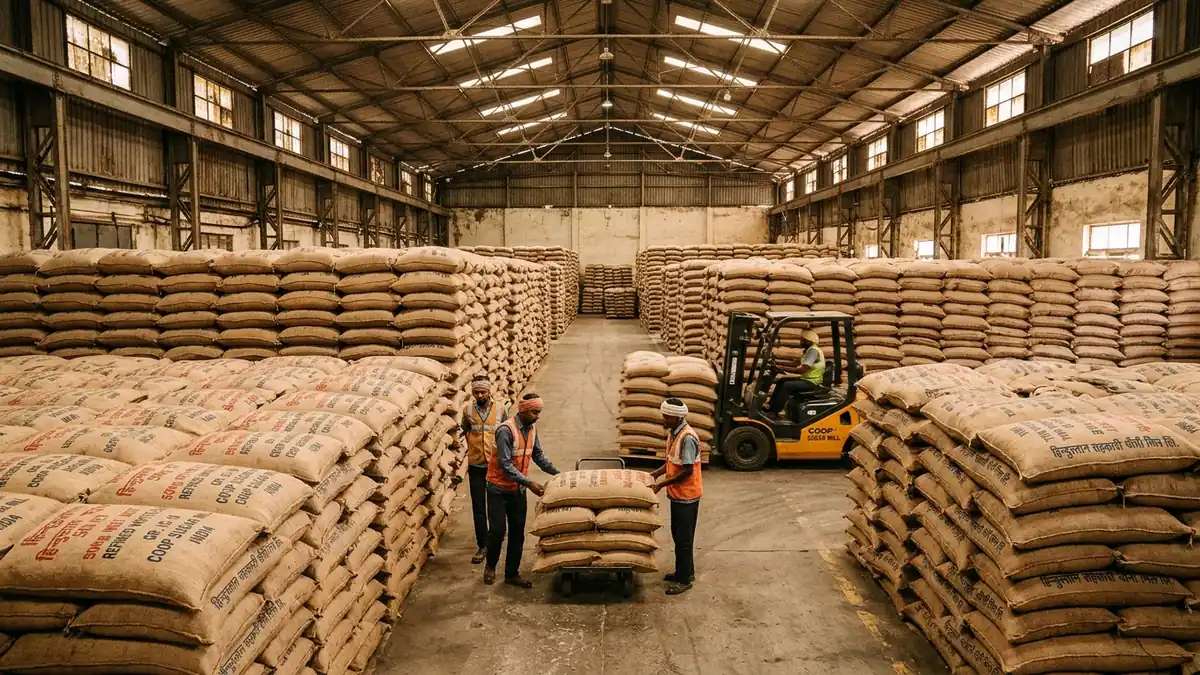
Key takeaways
- Sugar price today benchmarks in Indian wholesale mandis range between ₹3,450 and ₹3,950 per quintal (₹34.50 to ₹39.50/kg) ex-mill, translating to retail consumer prices of ₹42.00 to ₹46.00 per kg at neighborhood kirana stores.
- Commercial sugar is traded under two dominant Indian standards: S-30 (small crystal grain, predominantly produced by cooperative mills in Maharashtra and Karnataka) and M-30 (medium bold crystal grain, favored in North Indian markets like Uttar Pradesh, Delhi, and Punjab).
- Wholesale pricing units: 1 kg retail pack (~₹42–₹46), 1 Standard 50 kg Bori/Bag (~₹1,800–₹1,975), 1 Quintal / 100 kg (~₹3,600–₹3,950), and 1 Truckload (100–200 Quintals / ₹3.60 to ₹7.90 Lakh).
- Ex-mill prices are strictly regulated by the Central Directorate of Sugar & Vegetable Oils (DFPD) through monthly domestic release quotas, preventing price crashes while maintaining adequate consumer retail supplies.
- For broader long-term sugarcane FRP policies, mill byproduct ethanol diversion (EBP 20%), and bagasse cogeneration dynamics, review our comprehensive companion guide on national sugar price economics.
Tracking the sugar price today is indispensable for agricultural traders, confectioners, commercial beverage manufacturers, food processing enterprises, and household consumers across India. Sugar—widely searched as "chini" or "shakkar"—is one of the most heavily consumed culinary and industrial staples in the nation, with India ranking as both the second-largest sugar producer globally and the largest domestic consumer, utilizing over 28 million metric tonnes of refined sugar annually.
Unlike freely deregulated agricultural commodities, domestic sugar pricing operates within a unique dual-policy environment governed by the Essential Commodities Act and the Sugar (Control) Order administered by the Department of Food and Public Distribution (DFPD). Every month, the Central Government allocates strict mill-wise domestic sales quotas to maintain equilibrium between fair sugarcane remunerations paid to cane growers and affordable retail sugar costs for Indian households.
Sugar Price Today by Major Indian Mandi Hubs (Indicative November 2026 Rates)
Daily sugar prices vary across India based on freight distances from primary crushing belts (Maharashtra, Uttar Pradesh, Karnataka, Tamil Nadu, and Gujarat), grain grades (M-30 versus S-30), and state-level transport tolls. The table below details indicative wholesale spot prices per quintal (100 kg) and per standard 50 kg bori across major trading terminals and production centers as of November 2026:
| Mandi / Trading Terminal | State / Region | Grade Traded | Wholesale Rate per Quintal (₹) | Rate per 50 kg Bag (₹) | Market Classification |
|---|---|---|---|---|---|
| Kolhapur Mandi | Maharashtra / South | S-30 (Fine Grain) | ₹3,450 – ₹3,580 | ₹1,725 – ₹1,790 | Primary Production Node |
| Pune Mandi | Maharashtra / Western | S-30 (Fine Grain) | ₹3,520 – ₹3,640 | ₹1,760 – ₹1,820 | Regional Wholesale Hub |
| Muzaffarnagar Mandi | Uttar Pradesh / West UP | M-30 (Medium Grain) | ₹3,720 – ₹3,860 | ₹1,860 – ₹1,930 | Primary Production Node |
| Meerut / Shamli | Uttar Pradesh / West UP | M-30 (Medium Grain) | ₹3,700 – ₹3,840 | ₹1,850 – ₹1,920 | Primary Production Node |
| Vashi Wholesale Terminal | Navi Mumbai / Maharashtra | M-30 & S-30 | ₹3,750 – ₹3,920 | ₹1,875 – ₹1,960 | Premier Terminal Market |
| Naya Bazar / Delhi NCR | Delhi / Consumer Hub | M-30 (Bold Grain) | ₹3,820 – ₹3,980 | ₹1,910 – ₹1,990 | Terminal Consumer Node |
| Kanpur Mandi | Uttar Pradesh / Central | M-30 (Medium Grain) | ₹3,780 – ₹3,900 | ₹1,890 – ₹1,950 | Consuming Transit Hub |
| Kolkata Wholesale | West Bengal / East | M-30 & S-30 | ₹3,920 – ₹4,100 | ₹1,960 – ₹2,050 | Deficit Consumer Zone |
| Belagavi / Belgaum | Karnataka / South | S-30 (Fine Grain) | ₹3,500 – ₹3,620 | ₹1,750 – ₹1,810 | Primary Production Node |
| Ahmedabad APMC | Gujarat / West | S-30 (Fine Grain) | ₹3,620 – ₹3,760 | ₹1,810 – ₹1,880 | Industrial & Consumer Node |
Notice that production centers in Maharashtra and Karnataka (such as Kolhapur and Belagavi) consistently quote lower rates than North Indian markets like Muzaffarnagar, Delhi, or Kolkata. This divergence is driven by differing mill production costs, higher recovery rates in southern sugarcane varieties, and the freight differentials required to truck heavy sugar consignments to eastern and northern deficit zones.
M-30 vs S-30 Sugar Grades: What Distinguishes Commercial Chini
In Indian commodity exchanges and wholesale grain mandis, sugar is graded and sold according to standardized physical specifications established by the Bureau of Indian Standards (BIS) and the Directorate of Sugar. The letter indicates crystal size, while the number reflects visual color and sparkling clarity:
- S-30 Grade Sugar (Small Crystal): The letter "S" designates small grain size (0.60 mm to 0.90 mm crystal diameter). "30" represents the color index measured against standard glass tubes under ICUMSA standards. S-30 is the primary grade produced in Maharashtra, Karnataka, and Andhra Pradesh cooperative mills. It is widely preferred by sweet confectioners (mithai wallahs), commercial bakeries, and ice cream manufacturers due to its rapid dissolution rate.
- M-30 Grade Sugar (Medium Bold Crystal): The letter "M" indicates medium bold crystals (0.90 mm to 1.40 mm crystal diameter). M-30 is predominantly manufactured by private and cooperative mills across Uttar Pradesh, Haryana, and Punjab. North Indian households strongly favor M-30 for everyday table consumption because the larger, lustrous white crystals are visually appealing and resist clumping in humid monsoon storage.
- L-30 and L-31 Grade Sugar (Large Bold Crystal): Features extra-large crystals (exceeding 1.40 mm diameter). It is produced in limited specialty batches, frequently commanding a ₹40 to ₹60 per quintal premium in religious temple towns for prasad offerings and specialized candy making.
- Color and ICUMSA Scale: Both S-30 and M-30 standard plantation white sugars maintain an ICUMSA (International Commission for Uniform Methods of Sugar Analysis) color score of under 100 to 150 IU, ensuring high purity, sparkling brilliance, and sucrose purity exceeding 99.8%.
Commercial Chini Volume Units: 1 kg vs 50 kg Bag vs Quintal Converter
Wholesale sugar trade in India is conducted strictly in quintals (100 kg) and standard 50 kg polypropylene (HDPE) bags or traditional jute bags. Consumers purchasing from retail kirana stores buy loose sugar in 1 kg polybags or branded pre-packed pouches. The table below illustrates the price conversion, trade units, and typical margins across the supply chain:
| Commercial Volume Unit | Quantity (Net Weight) | Wholesale Ex-Mandi Cost (₹) | Est. Retail Cost (₹) | Primary Distribution Channel |
|---|---|---|---|---|
| 1 kg Retail Pouch / Loose | 1 kg (1,000 grams) | ₹36.00 – ₹39.00 | ₹42.00 – ₹46.00 | Kirana stores, Supermarkets, Quick Commerce |
| 5 kg Family Pack | 5 kg Polybag | ₹180.00 – ₹195.00 | ₹215.00 – ₹235.00 | Modern Trade, Cash & Carry Wholesalers |
| 50 kg Standard Bag (Bori) | 50 kg HDPE Bag | ₹1,800 – ₹1,975 | ₹2,100 – ₹2,300 | Wholesale Mandi, Sweet Shops, Caterers |
| 1 Quintal | 100 kg (2 Bags) | ₹3,600 – ₹3,950 | ₹4,200 – ₹4,600 | Standard Mandi Trading & Brokerage Unit |
| 10-Tonne Mini Truckload | 10,000 kg (200 Bags) | ₹3.60 Lakh – ₹3.95 Lakh | ₹4.20 Lakh – ₹4.60 Lakh | Secondary Wholesale Distributors |
| 25-Tonne Heavy Truckload | 25,000 kg (500 Bags) | ₹9.00 Lakh – ₹9.87 Lakh | ₹10.5 Lakh – ₹11.5 Lakh | Inter-State Mill Tenders & Institutional Buyers |
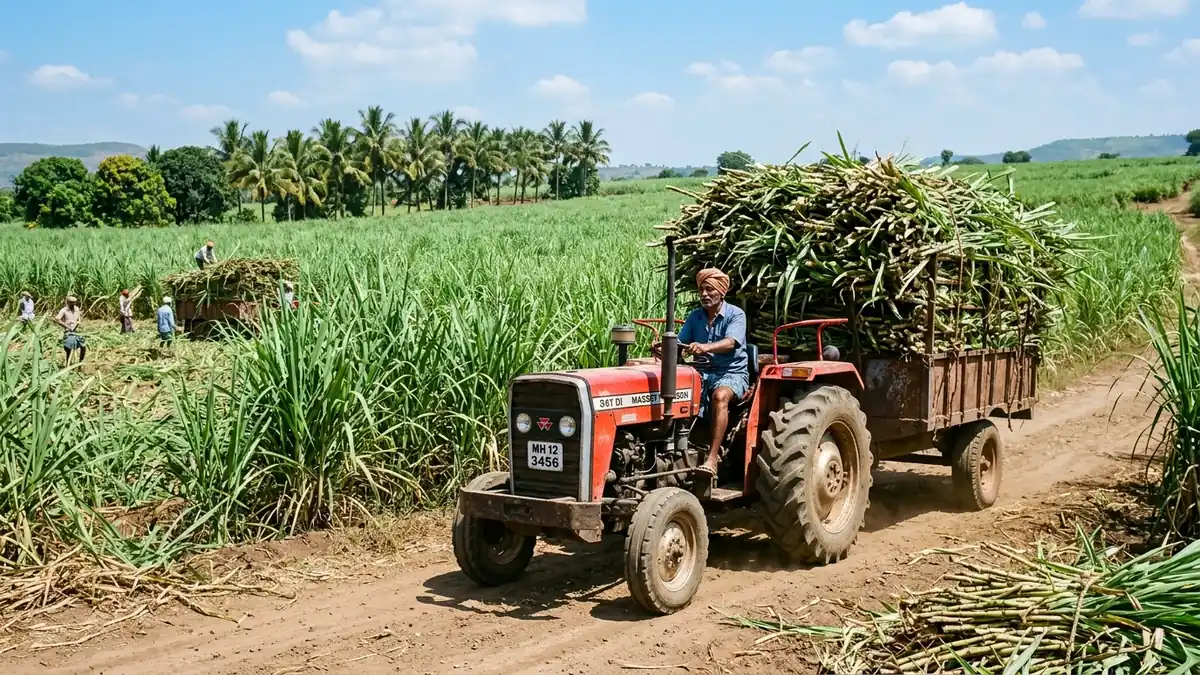
Ex-Mill to Retail: Understanding the Sugar Value Chain Spread
Why does a consumer pay ₹44 per kg at a local grocery shop when a cooperative mill in Kolhapur sells sugar at ₹35.50 per kg? The gap of ₹8.50 per kg is accounted for by essential logistics, packaging, regulatory taxes, and intermediary margins:
| Cost Component / Intermediary Stage | Cost Allocation per kg (₹) | Cumulative Price per kg (₹) | Explanation & Regulatory Factors |
|---|---|---|---|
| Ex-Mill Base Price | ₹35.50 | ₹35.50 | Base price paid to sugar mill under monthly quota tender |
| Goods and Services Tax (GST @ 5%) | ₹1.78 | ₹37.28 | Concessional 5% central & state GST on refined sugar |
| Inter-State Freight & Transit Tolls | ₹1.80 | ₹39.08 | Long-haul truck freight from Western/Southern belts to terminal nodes |
| Mandi Cess, Handling & Unloading | ₹0.50 | ₹39.58 | APMC market fees, loading/unloading labor at wholesale godown |
| Primary Wholesaler & Broker Margin | ₹0.75 | ₹40.33 | Financing cost, warehouse holding expenses, and trade profit |
| Secondary Packaging & Transport to Retailer | ₹1.20 | ₹41.53 | Repackaging into 1kg polybags, inner city delivery logistics |
| Retail Kirana Margin & Overhead | ₹2.47 | ₹44.00 | Local shop rent, electricity, counter labor, and retail shrinkage |
This supply chain spread demonstrates that sugar trading operate on razor-thin wholesale margins of 1.5% to 2.5%, relying on immense turnover volumes to generate returns. Retail grocers earn slightly wider margins (~5% to 7%) to offset store operational expenses, paper/plastic packaging costs, and inventory holding interest.
Core Factors Influencing Daily Sugar Rates in India
Sugar rates do not fluctuate arbitrarily; they respond directly to macroeconomic policies, weather conditions in cane-growing river basins, and global sweetener commodity trends:
- Monthly Domestic Sales Quota: The DFPD issues a binding monthly sales quota to all operational sugar mills in India (typically 2.0 to 2.4 million metric tonnes per month). If the government allocates a higher quota (e.g. ahead of Diwali or Ramadan), spot prices soften as mills compete to exhaust their monthly dispatch quota before the deadline.
- Ethanol Blending Program (EBP 20%): To reduce crude petroleum imports and support cane farmers, India has aggressively expanded its ethanol blending target to 20% by 2025–26. When sugar mills divert B-heavy molasses, sugarcane juice, and syrup toward distillery ethanol production, sugar output contracts by 2.0 to 3.5 million tonnes, providing strong structural support to domestic sugar prices.
- Monsoon Patterns in the Krishna and Gangetic Basins: Sugarcane is a 12-to-18-month water-intensive perennial crop. Adequate monsoon rainfall in Maharashtra’s Marathwada and Western Maharashtra belts, alongside Uttar Pradesh’s irrigated terai regions, directly determines sugarcane yield (tonnes/hectare) and sugar recovery percentage (10.5% to 11.5% sucrose recovery).
- Sugarcane Fair & Remunerative Price (FRP): The Cabinet Committee on Economic Affairs (CCEA) fixes the statutory FRP that mills are legally obligated to pay cane farmers (set at ₹340/quintal at 10.25% recovery for the 2024–25 season). High cane FRP mandates push up mill production costs, creating persistent upward pressure on ex-mill tender rates.
- International Sugar Prices & Export Bans: To ensure domestic food security and tame headline food inflation, the Government of India has maintained calibrated export restrictions. When global New York raw sugar futures or London white sugar futures rise, domestic millers advocate for export quotas, while the government maintains domestic priority to stabilize consumer food baskets.
Related Crop Guides, Machinery and Mandi Intelligence
Navigating commodity volatility requires tracking related agricultural inputs, harvesting tools, and government support schemes. Sugarcane producers and traders can evaluate long-term factory FRP dynamics in our sugar price guide, compare grain harvest logistics in our paddy procurement guide, and track commercial essential oils via our mentha oil rate report.
For operational liquidity, farmers can access low-interest working capital through the Kisan Credit Card (KCC) facility, plan forage production with our jowar grass agronomy guide, calculate balanced NPK doses on our fertilizer calculator, and conduct periodic field nutrient checks with soil testing protocols.
To upgrade field haulage capabilities, evaluate heavy-duty machinery in our Swaraj tractor guide, protect seasonal cane yields under PM Fasal Bima Yojana, install subsidized solar irrigation via the PM KUSUM scheme, adopt sustainable practices under organic farming certification, and track spot prices across 2,800+ APMC mandis on our mandi rates live portal.
Official Government Portals and Sugar Industry References
For authorized daily spot rates, monthly release quota orders, sugarcane FRP statutory notifications, and industry balance sheets, refer to these official portals: check monthly quota dispatches on the Department of Food and Public Distribution (DFPD), track daily mandi bulletins on Agmarknet, monitor retail indices on the Price Monitoring Division (PMD), and study production forecasts from the Indian Sugar & Bio-energy Manufacturers Association (ISMA).
Frequently asked questions
- What is the sugar price today in major Indian wholesale mandis?
- Wholesale sugar fluctuates between ₹3,450 and ₹3,950 per quintal ex-mill. For statutory FRP and long-term regulatory analysis, consult our comprehensive sugar price guide or review monthly mill quota dispatches on DFPD.
- What is the current retail price of 1 kg sugar at local kirana stores?
- At neighborhood retail shops, loose sugar sells between ₹42.00 and ₹46.00 per kg, tracked nationally on the Department of Consumer Affairs portal. Cane growers supplying mills can review farm management on our sugarcane farmers portal.
- How much does a 50 kg sugar bag (bori) cost in the wholesale market?
- A standard 50 kg bag (bori) of refined commercial sugar currently costs between ₹1,800 and ₹1,975 in wholesale mandis, depending on whether it is S-30 fine grain from Maharashtra cooperatives or M-30 medium bold grain from Uttar Pradesh private sugar mills.
- What is the difference between S-30 and M-30 sugar grades?
- The difference lies in crystal grain size and regional production. S-30 consists of small crystals (0.60 to 0.90 mm diameter), dissolves quickly, and is predominantly produced in Maharashtra and Karnataka. M-30 consists of medium bold crystals (0.90 to 1.40 mm diameter), is favored in North Indian households for its lustrous sparkle, and is primarily milled in Uttar Pradesh and Punjab.
- What is the statutory Minimum Selling Price (MSP) for sugar?
- The central government statutory Minimum Selling Price (MSP) is ₹3,100 per quintal. Trade proposals for MSP revision are submitted by the ISMA portal, and daily wholesale movements can be monitored on our live mandi rates tracker.
- How do monthly domestic release quotas affect the sugar price today?
- The Department of Food and Public Distribution (DFPD) strictly limits the quantity of sugar each mill can sell in the domestic open market every month. If the monthly quota is raised (e.g., to 2.4 million tonnes), domestic spot prices soften; if the quota is tightened, prices firm up, safeguarding mill realizations.
- How does ethanol blending (EBP 20%) impact domestic sugar rates?
- Under the Ethanol Blending Program, sugar mills divert sugarcane juice, syrup, and B-heavy molasses directly to bio-ethanol production instead of crystal sugar. Diverting 2.5 to 3.5 million tonnes of sugar equivalent to green ethanol stabilizes the domestic sugar balance sheet, preventing chronic supply gluts.
- What is the Fair and Remunerative Price (FRP) paid for sugarcane?
- The Central Government fixed the sugarcane FRP at ₹340 per quintal for a basic sugar recovery rate of 10.25% for the 2024–25 and 2025–26 crushing seasons. Every 0.1% increase in recovery above 10.25% entitles the farmer to an additional premium of ₹3.32 per quintal.
- What is the GST rate applied on refined sugar transactions?
- Refined sugar attracts a concessional Goods and Services Tax (GST) rate of 5% (comprising 2.5% CGST and 2.5% SGST) across both loose and pre-packaged commercial trading formats in India.
- How long can bulk sugar be stored in warehouses without spoiling?
- Under proper dry warehouse conditions (relative humidity below 65% and temperature between 20°C and 30°C), commercial refined sugar has an indefinite shelf life. However, if exposed to monsoon moisture, it can absorb water, resulting in caking, inversion, and discoloration.
- Why is brown sugar or jaggery more expensive than refined white sugar?
- Traditional raw brown sugar and organic gur/jaggery are produced through specialized batch boiling without chemical sulfur bleaching agents. Lower industrial processing yields, shorter shelf lives, and artisanal production make organic jaggery and brown sugar cost ₹60 to ₹110 per kg at retail.
- Where can I check live, verified daily mandi sugar rates?
- You can monitor verified daily ex-mill tenders and APMC auction rates on the Ministry of Agriculture’s Agmarknet portal (agmarknet.gov.in), the Department of Consumer Affairs daily price bulletins (consumeraffairs.nic.in), and through KisanPe’s live mandi price intelligence tracker.
This article is for general information only and is not financial advice. Loan and scheme eligibility depends on partner and government criteria.