Today Egg Rate: Daily NECC Mandi Price & Wholesale Guide

Key takeaways
- Today egg rate benchmarks across India are determined daily at 5:30 PM by the National Egg Coordination Committee (NECC), balancing seasonal demand, cold-storage movement, and regional layer farm production.
- Indicative November 2026 wholesale egg prices range between ₹4.65 and ₹5.25 per piece at primary production nodes (Namakkal, Barwala, Hyderabad) and ₹5.30 to ₹6.10 per piece in consuming metro terminals (Delhi, Mumbai, Kolkata).
- Egg commercial volume units: 1 Single Piece (50–55g), 1 Tray (30 eggs, ~₹140–₹165), 1 Standard Peti or Carton (210 eggs / 7 trays, ~₹980–₹1,155), and 1 Truckload (700–800 Petis / 1,47,000–1,68,000 eggs).
- Layer farm production break-even cost averages ₹4.10 to ₹4.35 per egg, governed primarily by poultry feed input costs: soybean meal (DOC) at ₹36–₹42/kg and broken maize at ₹21–₹24/kg.
- For broader historical poultry trends and commercial layer flock economics, consult our in-depth companion guides on national egg rate dynamics and regional Barwala poultry markets.
Tracking the today egg rate is crucial for commercial poultry farmers, wholesale egg commission agents, bakery institutional buyers, and retail consumers across India. Egg prices are among the most dynamic commodity prices in the Indian agrarian economy, fluctuating daily based on production cycles in major poultry belts, climate-driven feed consumption patterns, festive seasonal shifts, and inter-state logistics costs.
Unlike grain crops regulated by statutory Minimum Support Prices (MSP), daily egg pricing in India is guided by the National Egg Coordination Committee (NECC), a cooperative body founded in 1982 by Dr. B.V. Rao. Every evening, NECC regional zonal committees analyze daily arrivals, unsold floor inventory, cold-chain capacity, and wholesale off-take to publish benchmark farm-gate and wholesale egg rates. Progressive farmers and poultry entrepreneurs rely on this benchmark to protect their margins against exploitative trader cartels.
Today Egg Rate by Major Indian Mandi Hubs (Indicative November 2026 Rates)
India produces over 370 million eggs per day, with production concentrated in southern and northern production clusters. Prices vary significantly between surplus production hubs (such as Namakkal in Tamil Nadu, Barwala in Haryana, and Hyderabad in Telangana) and high-density consuming metropolitan consuming centers (such as Delhi NCR, Mumbai, Kolkata, and Bengaluru). The table below details indicative daily wholesale price ranges per 100 eggs, per 30-egg tray, and per 210-egg commercial peti across major trading zones:
| Mandi / Trading Zone | State / Region | Rate per 100 Eggs (₹) | Rate per Tray (30 Eggs) | Rate per Peti (210 Eggs) | Market Classification |
|---|---|---|---|---|---|
| Barwala Mandi | Haryana / North Hub | ₹480 – ₹515 | ₹144 – ₹154.50 | ₹1,008 – ₹1,081.50 | Surplus Production Node |
| Namakkal Hub | Tamil Nadu / South Hub | ₹465 – ₹500 | ₹139.50 – ₹150.00 | ₹976.50 – ₹1,050.00 | Surplus Production Node |
| Hyderabad Hub | Telangana / Deccan | ₹470 – ₹505 | ₹141.00 – ₹151.50 | ₹987.00 – ₹1,060.50 | Surplus Production Node |
| Delhi NCR Terminal | Delhi / Consumer Hub | ₹525 – ₹560 | ₹157.50 – ₹168.00 | ₹1,102.50 – ₹1,176.00 | Terminal Consumer Node |
| Mumbai Terminal | Maharashtra | ₹535 – ₹575 | ₹160.50 – ₹172.50 | ₹1,123.50 – ₹1,207.50 | Terminal Consumer Node |
| Kolkata Wholesale | West Bengal | ₹540 – ₹585 | ₹162.00 – ₹175.50 | ₹1,134.00 – ₹1,228.50 | High-Deficit Consumer Zone |
| Bengaluru Mandi | Karnataka | ₹490 – ₹525 | ₹147.00 – ₹157.50 | ₹1,029.00 – ₹1,102.50 | Consuming Metro Node |
| Ahmedabad Mandi | Gujarat / West | ₹505 – ₹540 | ₹151.50 – ₹162.00 | ₹1,060.50 – ₹1,134.00 | Transit / Industrial Node |
| Kanpur / Lucknow | Uttar Pradesh / Central | ₹520 – ₹555 | ₹156.00 – ₹166.50 | ₹1,092.00 – ₹1,165.50 | Deficit Consumer Zone |
| Patna Mandi | Bihar / East | ₹535 – ₹570 | ₹160.50 – ₹171.00 | ₹1,123.50 – ₹1,197.00 | Deficit Consumer Zone |
Notice that production centers like Namakkal and Barwala consistently quote lower rates than destination terminals like Delhi and Kolkata. The spread of ₹50 to ₹70 per 100 eggs (₹0.50 to ₹0.70 per piece) covers inter-state refrigerated road transit, diesel toll charges, egg crate breakage during transit (typically factored at 1.0% to 1.5%), loading labor, and secondary distributor wholesale margins.
How NECC Determines the Daily Egg Rate: The Advisory Price Mechanism
The National Egg Coordination Committee operates through an institutional three-tier structure designed to establish transparent price discovery for India’s decentralized poultry sector. Every afternoon between 3:30 PM and 5:00 PM, local zonal committees in over 28 major egg-producing zones conduct telephonic conferences with local commercial farmers, commission agents, cold-storage managers, and retail associations.
The committee evaluates five core macroeconomic and operational parameters before releasing the suggested price at 5:30 PM daily:
- Daily Farm Arrivals & Flock Culmination: Total volume of fresh eggs laid by commercial layer strains (BV-300, Bovans White, Hy-Line, Lohmann) versus older flocks scheduled for culling (culled layer meat birds).
- Local Cold-Storage Inventory: Unsold stock held in cold-storage units. When regional storage inventories exceed 4 to 5 days of normal dispatch volume, NECC often trims prices slightly to stimulate rapid liquidations.
- Inter-State Freight & Transit Outflow: Quantity of 210-egg petis loaded onto refrigerated trucks destined for high-demand northern consumption centers like Delhi, Jammu, and Srinagar from Haryana or southern hubs.
- Poultry Feed Input Costs: Current spot prices of soybean meal (DOC), yellow maize, broken rice, dicalcium phosphate (DCP), and amino acid premixes (lysine and DL-methionine). When feed inputs escalate, NECC works to establish farm-gate rates above farm break-even points.
- Seasonal & Religious Calendar Factors: Demand fluctuations during Shravan, Navratri, Karthika Masam, and summer heatwaves (which depress consumer intake) versus winter surges and festival baking peaks.
It is important to understand that NECC rates represent "suggested producer prices". In active trading, spot market transactions may take place at a premium or discount (known in trade circles as the "minus" or "plus" rate) depending on urgent farm clearance requirements and day-of-the-week retail off-take.
Egg Commercial Units: Piece vs Tray vs Peti vs Truckload Converter
In the Indian wholesale egg trade, transactions do not take place in dozens (which is predominantly a Western retail measure). Commercial transactions in mandis and poultry contracts operate on standard standardized units: piece, paper tray, peti (wooden crate or corrugated carton), and full truckloads (FCL). Understanding these conversions is essential for negotiating transparent mandi contracts:
| Commercial Unit | Quantity (Eggs) | Net Weight (Approx) | Indicative Wholesale Cost (₹) | Primary Market Use |
|---|---|---|---|---|
| 1 Single Piece | 1 Egg | 50 – 58 grams | ₹4.80 – ₹5.40 (Wholesale) | Consumer Retail / Kirana shops |
| 1 Dozen Pack | 12 Eggs | 600 – 700 grams | ₹72.00 – ₹84.00 (Retail) | Supermarket & Kirana Retail |
| 1 Standard Tray | 30 Eggs (5x6 grid) | 1.55 – 1.75 kg | ₹144.00 – ₹162.00 | Local Wholesalers, Bakeries, Canteens |
| 1 Commercial Peti / Box | 210 Eggs (7 Trays) | 10.8 – 12.2 kg | ₹1,008 – ₹1,134 | Inter-Mandi Wholesale Trading Standard |
| 1 Mini Carton / Half Peti | 105 Eggs (3.5 Trays) | 5.4 – 6.1 kg | ₹504 – ₹567 | Small Eateries & Quick Service Rest. |
| 1 Commercial Truckload | 50,400 – 1,68,000 Eggs | 2.6 – 8.8 Metric Tonnes | ₹2.40 Lakh – ₹8.90 Lakh | Inter-State Logistics & Food Processors |
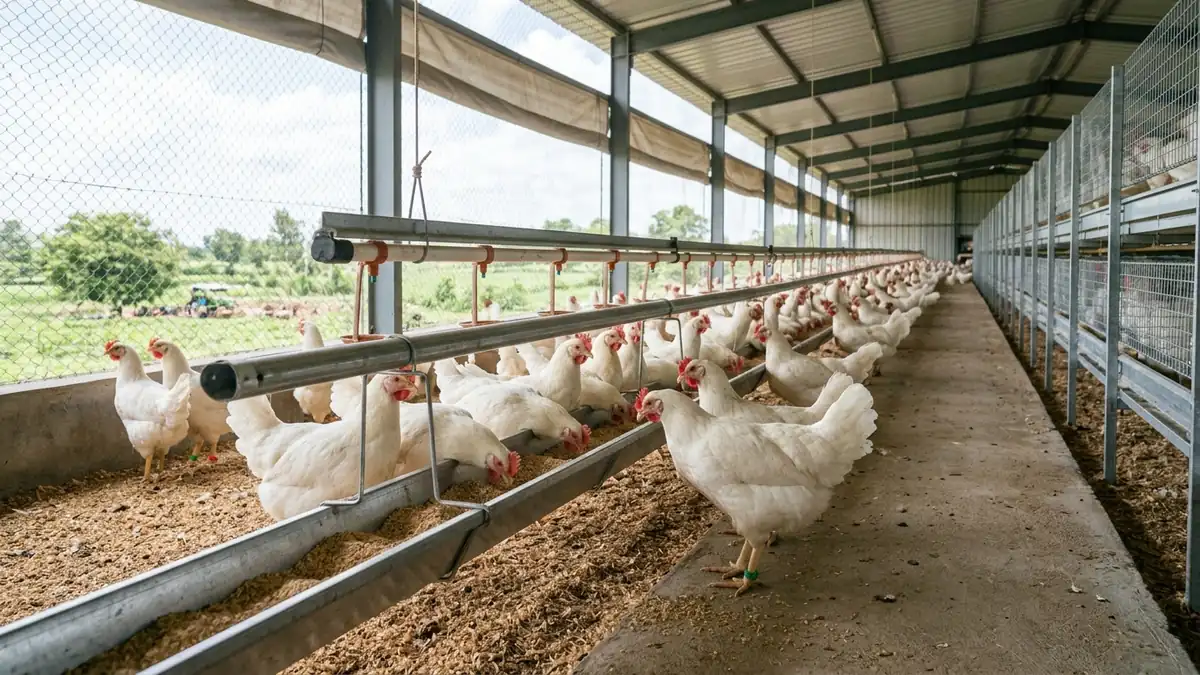
Commercial Layer Economics: Cost of Production and Break-Even Analysis
To understand why the today egg rate fluctuates, one must examine the cost of egg production on a commercial layer farm. A commercial layer bird (e.g. BV-300 strain) enters lay at approximately 18 to 20 weeks of age and lays for approximately 52 to 72 weeks, producing around 310 to 330 Grade-A eggs during her productive commercial lifecycle.
Feed represents 75% to 80% of total recurring production expenses. A laying hen consumes approximately 110 to 115 grams of nutritionally balanced commercial mash or crumble daily. The table below outlines the itemized cost breakdown required to produce one table egg on a well-managed 50,000-bird automated commercial layer farm in 2026:
| Cost Component | Daily / Periodic Input Value | Cost Allocation per Egg (₹) | Share of Total Production Cost |
|---|---|---|---|
| Layer Poultry Feed (Mash/Pellet) | 110g intake @ ₹30.50/kg feed cost | ₹3.35 | 78.8% |
| Pullet Chick Amortization | ₹260 chick reared to 18 weeks over 320 eggs | ₹0.48 | 11.3% |
| Labor, Shed Power & Bio-Security | Automated feeding, ventilation & manure belts | ₹0.16 | 3.8% |
| Vaccines, Medicines & Electrolytes | Marek, ND-IB, IBD, vitamins & minerals | ₹0.12 | 2.8% |
| Egg Packaging, Trays & Peti Cartons | Molded paper trays, strapping & peti boxes | ₹0.08 | 1.9% |
| Mortality Risk & Unforeseen Depreciation | Standard 0.5% monthly flock attrition | ₹0.06 | 1.4% |
| Total Break-Even Cost per Egg | Farm-Gate Net Production Cost | ₹4.25 | 100.0% |
When the farm-gate today egg rate drops below ₹4.20 per piece (as can happen during temporary seasonal demand slumps or severe summer heatwaves), layer farmers incur direct operational cash losses. Conversely, when winter demand lifts farm-gate rates to ₹5.20 to ₹5.60 per egg, farmers generate healthy profits of ₹0.95 to ₹1.35 per egg, allowing them to service capital loans, reinvest in environment-controlled (EC) sheds, and hedge against high summer feed raw material spikes.
White Eggs vs Brown Eggs: Pricing, Nutrition and Market Realities
A common question searched by consumers and egg retailers is the price differential between commercial white eggs and brown eggs. In retail supermarkets, brown eggs often command a premium of 30% to 60%, selling at ₹9.00 to ₹12.00 per piece compared to ₹6.50 to ₹7.50 for standard white eggs. However, the scientific and agricultural realities behind this pricing gap are driven by avian genetics and feed intake rather than superior nutritional density:
- Breed Genetics Determine Shell Color: Commercial white eggs are laid by White Leghorn-derived strains (e.g. BV-300, Hy-Line W-36), which have white feathers and white earlobes. Brown eggs are produced by heavier dual-purpose or brown layer strains (e.g. Rhode Island Red, BV-380, Lohmann Brown) with red or brown earlobes.
- Higher Feed Intake in Brown Layers: Brown layer birds have a significantly heavier body frame (1.9–2.1 kg at peak lay) compared to white layers (1.4–1.6 kg). Consequently, a brown hen consumes 120 to 128 grams of feed daily to produce an egg, versus 110 grams for a white hen. This higher Feed Conversion Ratio (FCR) makes brown egg production intrinsically more costly.
- Nutritional Equivalence: Rigorous biochemical assays conducted by the National Institute of Nutrition (NIN, ICMR) confirm that standard white and brown eggs possess identical macronutrient profiles: ~6.2 to 6.5 grams of high-biological-value protein, ~4.8 grams of lipids, 185 mg of cholesterol, and identical concentrations of Vitamin A, B12, and selenium when raised on comparable feeds.
- Enriched Designer Eggs: Premium prices are justified only for authentic designer eggs—such as Omega-3 enriched eggs (achieved by blending flaxseed meal and fish oil into the hen ration) or herbal lutein-enriched eggs for retinal health.
Egg Freshness Testing and Proper Storage Guidelines
Because eggs are perishable biological commodities without an artificial preservative barrier, maintaining quality from the poultry farm to the dining table requires strict adherence to temperature and handling protocols. The natural bloom or cuticle on an unwashed egg shell provides an initial bacterial barrier against Salmonella enterica penetration.
Commercial guidelines for assessing egg quality and maximizing shelf life include:
- The Water Float Test: Place an egg in a bowl of cold tap water. A freshly laid egg (1–7 days old) will sink to the bottom and lie completely flat on its side because its internal air cell is minimal. A slightly older egg (10–18 days old) will tilt or stand upright on one end as moisture evaporates through the porous shell and the air cell expands. An egg that floats completely to the water surface is deteriorated with an oversized air chamber and should be discarded.
- Haugh Unit Measurement: In institutional poultry research and export testing, egg internal albumen quality is measured in Haugh Units (HU). Grade-AA eggs possess a Haugh rating above 72, featuring a firm, raised yolk and a thick gelatinous albumen envelope.
- Cold-Chain Temperature Management: Commercial eggs stored at ambient summer temperatures (32°C to 40°C) lose quality more in 3 days than refrigerated eggs do in 3 weeks. Layer farms and mandis recommend storing table eggs at 12°C to 15°C with 70% to 80% relative humidity for long-term wholesale holding (up to 30 days), and below 4°C in household domestic refrigerators.
- Do Not Wash Before Storage: Washing eggs under cold running water strips away the protective cuticle layer and opens the 7,000 to 17,000 microscopic pores in the shell, pulling surface bacteria and moisture into the albumen.
Poultry Farm Infrastructure, Feed Agronomy and Risk Management
Managing a competitive commercial layer unit requires balancing feed grain economics, veterinary hygiene, and energy costs. Farmers looking to compare regional pricing can consult our comprehensive national egg rate guide alongside daily market arrivals in our Barwala egg rate report. Producing high-energy fodder on adjoining farmland using our jowar grass agronomy guide and testing field soil profiles via soil testing protocols significantly lowers commercial feed expenses.
In addition, layer farmers can optimize input costs with our digital fertilizer calculator, explore solar shed electrification under the PM KUSUM solar pump scheme, adopt bio-secure litter compost standards under organic farming certification, protect farm assets through PM Fasal Bima Yojana, and track grain prices across 2,800+ APMC mandis on our live mandi rates portal.
Official Government Portals and Poultry Industry References
For authorized daily auction updates, poultry disease surveillance bulletins, layer flock credit guidelines, and statutory animal welfare norms, refer to these verified institutional portals: check daily farm-gate quotes on the National Egg Coordination Committee (NECC) Official Portal, review central livestock development schemes on the Department of Animal Husbandry and Dairying (DAHD), track daily agricultural market bulletins via Agmarknet, and study avian nutrition research from the ICAR - Central Avian Research Institute (CARI).
Frequently asked questions
- What is the today egg rate in major Indian wholesale mandis?
- As of November 2026 indicative ranges, wholesale egg rates hover between ₹4.65 and ₹5.15 per egg in major production zones (Namakkal, Barwala, Hyderabad), translating to ₹140–₹155 per 30-egg tray and ₹980–₹1,080 per 210-egg commercial peti. In consuming metro hubs like Delhi, Mumbai, and Kolkata, wholesale rates range from ₹5.25 to ₹5.85 per egg due to freight, toll, and breakage margins.
- What time does NECC release the daily egg price?
- The National Egg Coordination Committee releases its official daily suggested egg rates every evening at 5:30 PM IST on the official NECC website. You can also review national production hub benchmarks in our egg rate price guide.
- How many eggs are in one commercial peti or carton?
- In the Indian commercial wholesale egg trade, one standard peti (wooden crate or heavy corrugated carton) contains exactly 210 eggs. This is arranged in 7 molded paper trays stacked vertically, with each tray holding 30 eggs in a 5x6 egg indentation grid.
- Why do egg prices fluctuate every few days?
- Egg prices fluctuate continuously due to dynamic shifts in poultry feed costs (specifically soybean DOC and maize prices), weather-induced bird laying rates (heat stress lowers production), inter-state transport logistics, regional religious fasting periods (such as Shravan or Navratri), and winter consumer demand spikes.
- How is the break-even production cost of an egg calculated?
- The production cost of a commercial table egg in India averages ₹4.10 to ₹4.35 per piece. Feed represents roughly 78% of this cost; farmers can simulate batch margins on our poultry profit calculator and monitor feed grain spot quotes on the mandi rates live portal.
- Are brown eggs more nutritious than white eggs?
- No. Rigorous nutritional testing by the National Institute of Nutrition (ICMR) confirms that standard white and brown eggs possess identical nutritional values: approximately 6.3 grams of protein, identical vitamin concentrations, and similar lipid levels. Brown eggs cost more because brown layer hens are physically heavier and consume 10% to 15% more feed per egg laid.
- How can a consumer or trader test egg freshness at home or in the godown?
- The most reliable non-destructive test is the water float test. Place the egg in a bowl of cold tap water. A fresh egg lies flat on the bottom. An egg that tilts upward is 1 to 2 weeks old but safe to eat. An egg that floats completely to the water surface has developed a large internal air pocket from moisture evaporation and decomposition, and should not be consumed.
- Can farmers obtain bank loans or KCC credit for commercial egg farming?
- Yes. Commercial poultry layer farming qualifies for concessional credit under the Kisan Credit Card (KCC) scheme at 4% effective interest, while automated shed construction qualifies for capital subsidies under central animal husbandry schemes.
- What is the standard shelf life of commercial table eggs in India?
- At ambient room temperatures during winter (18°C to 22°C), unwashed commercial eggs maintain prime quality for 14 to 21 days. In extreme summer heat (over 35°C), ambient quality degrades within 7 days. Under proper refrigeration (below 4°C with 75% relative humidity), eggs retain quality and safety for 4 to 6 weeks.
- What is the difference between NECC farm-gate rate and consumer retail price?
- The NECC rate is the farm-gate price paid to poultry producers. The consumer retail price is ₹1.00 to ₹1.75 higher per piece to cover inter-state refrigerated transport, loading labor, 1–1.5% shell breakage, mandi commission fees, and local kirana store retail overheads.
- What is the role of cold storage in stabilizing daily egg rates?
- Cold storage facilities buffer seasonal supply gluts. When local supply temporarily outstrips daily consumption, surplus eggs are transferred to temperature-controlled godowns (12°C to 15°C). When festivals or winter demand spikes occur, stored eggs are released, preventing price spikes for consumers while protecting farmers from distressed fire sales.
- Where can I verify daily live egg rates directly from official sources?
- You can check daily egg rates on the official NECC portal at e2necc.org, the Ministry of Agriculture’s Agmarknet livestock bulletins at agmarknet.gov.in, and through daily updates on KisanPe’s poultry market intelligence network.
This article is for general information only and is not financial advice. Loan and scheme eligibility depends on partner and government criteria.