Barwala Egg Rate: NECC Anda Price per Tray and 100 Eggs
Key takeaways
- The indicative Barwala wholesale egg rate (November 2026) is about ₹5.85 per piece, ₹175.50 per standard 30-egg tray, ₹585.00 per 100 eggs, and ₹1,228.50 per standard 210-egg commercial peti according to the National Egg Coordination Committee (NECC) Barwala Zone.
- Barwala (Panchkula-Hisar poultry belt, Haryana) is Asia's second-largest egg-producing cluster after Namakkal, housing over 1.8 crore commercial layer birds and producing approximately 1.20 to 1.35 crore eggs daily.
- Delhi Gazipur poultry wholesale mandi trades at a consistent transport and handling premium of ₹0.45 to ₹0.60 per egg over Barwala farm-gate rates, quoting ₹6.35 per piece (₹190.50 per tray).
- Layer poultry feed expenses account for roughly 72% of total egg production cost; current yellow maize rates (₹2,350/quintal) and soya DOC (₹4,100/quintal) establish a break-even cost of production (COP) of ₹4.65 to ₹4.90 per egg.
- Winter peak demand (November to February) historically drives Barwala egg rates 20% to 25% higher, reaching seasonal highs of ₹6.20 to ₹7.10 per piece compared to summer troughs of ₹4.40 to ₹4.95 per piece.
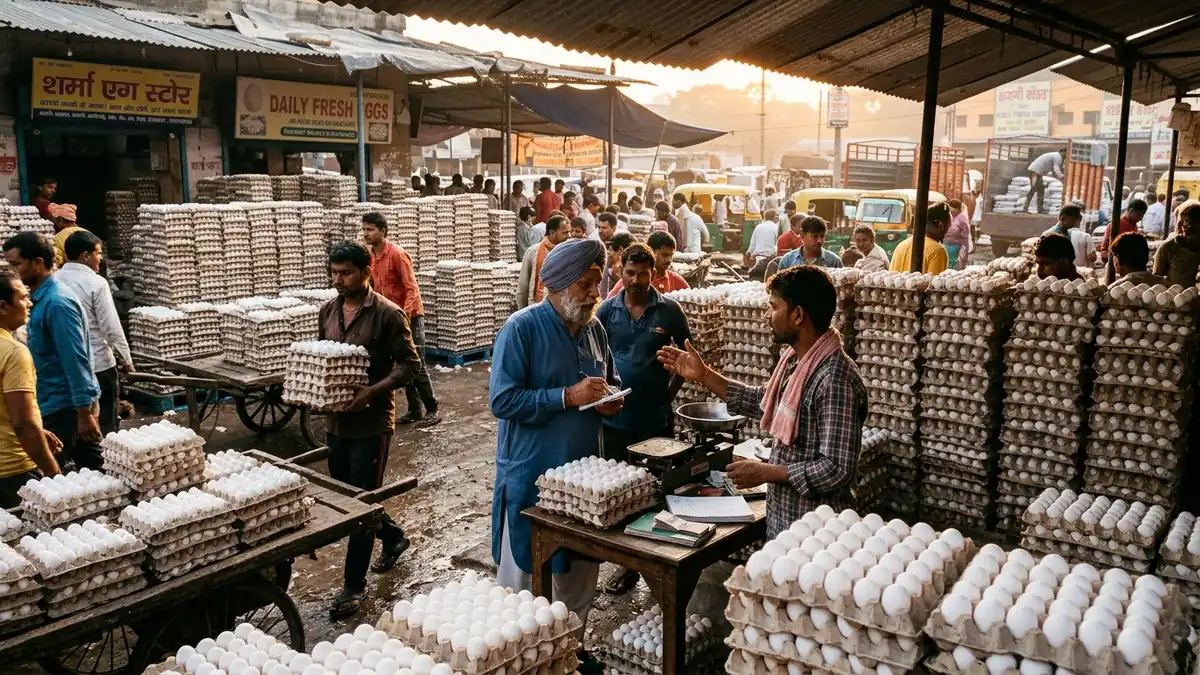
Today Barwala egg rate (बरवाला अंडा भाव) benchmarks at ₹5.85 per single piece at wholesale farm-gate rates, translating to ₹175.50 per standard 30-egg tray, ₹585.00 per 100 eggs, and ₹1,228.50 per standard commercial peti (210 eggs / 7 trays) as established by the official National Egg Coordination Committee (e2necc.com) Barwala Zonal Committee, benchmarked alongside our national egg rate today directory. In downstream consumer retail markets across Delhi NCR, Haryana, Punjab, and western Uttar Pradesh, retail counter prices range between ₹7.00 and ₹8.50 per egg (₹210 to ₹250 per tray), incorporating local transport logistics, wholesale margin spreads, and shopkeeper handling expenses.
Situated in the Panchkula district of Haryana (with secondary poultry concentrations in Hisar and Ambala), Barwala represents the undisputed epicentre of North India's table egg industry (explore setup parameters in our commercial poultry farm guide). Often hailed alongside Namakkal as the dual powerhouse of India's poultry economy, daily prices track closely with our today egg rate price index. The daily "Barwala CC Rate" (Coordination Committee Rate) announced every afternoon at 1:00 PM dictates wholesale purchasing prices across Delhi Gazipur mandi, Jammu, Srinagar, Ludhiana, Chandigarh, Saharanpur, and as far east as Patna and Muzaffarpur.
Whether you operate a commercial layer poultry farm, manage a wholesale distribution agency, or trade eggs, model operational margins with our poultry profit calculator and track daily APMC wholesale prices on our mandi commodity rates tracker. This comprehensive daily guide details verified Barwala egg prices across all packaging formats, provides historical price trends, breaks down commercial layer feed economics, and explains the logistical link between Barwala farms and Northern consumption metros.
Barwala egg rate: indicative wholesale prices by packaging unit
Commercial egg trading in North India transacts across four standardized packaging configurations (working capital funded through the Kisan Credit Card (KCC) scheme): single piece, 30-egg pulp tray, 100-egg wholesale century, and 210-egg master carton. The table below outlines the official 2026 wholesale benchmark rates for Barwala alongside prevailing retail rates across Haryana and Delhi NCR:
| Packaging Configuration | Quantity (Eggs) | Barwala Wholesale Rate (₹) | Delhi Mandi Landing Rate (₹) | Retail Consumer Price (₹) | Market Suitability |
|---|---|---|---|---|---|
| Single Piece (प्रति अंडा) | 1 Egg | ₹5.85 | ₹6.35 | ₹7.50 – ₹8.50 | Retail groceries, daily consumption, dairy booths |
| Standard Paper Tray (अंडा ट्रे) | 30 Eggs | ₹175.50 | ₹190.50 | ₹225.00 – ₹250.00 | Households, gym dieticians, local bakeries |
| Wholesale Century (सैकड़ा भाव) | 100 Eggs | ₹585.00 | ₹635.00 | ₹750.00 – ₹820.00 | Caterers, restaurants, street vendors, small bakers |
| Commercial Master Carton (पेटी भाव) | 210 Eggs (7 Trays) | ₹1,228.50 | ₹1,333.50 | ₹1,550.00 – ₹1,720.00 | Semi-wholesalers, institutions, inter-district traders |
| Bulk Wholesale Crate (बड़ा बॉक्स) | 350 Eggs (Custom) | ₹2,047.50 | ₹2,222.50 | ₹2,600.00 – ₹2,850.00 | Direct farm-to-mandi wholesale refrigerated trucks |
Prices above reflect Grade-A clean shell white table eggs (average weight 52 to 56 grams). Extra-large jumbo eggs (>58 grams) command a wholesale premium of ₹10 to ₹15 per tray, while pullet or undersized eggs (<48 grams) trade at a discount of ₹15 to ₹25 per tray.
Barwala vs other major Indian egg production & consumption centres
Egg rates in India function within an integrated national supply grid governed by production hubs (Barwala, Namakkal, Ajmer, Hosapete) and consumption sinks (Delhi, Mumbai, Kolkata, Bengaluru). Because eggs are perishable and costly to transport, wholesale price differentials track freight and mandi arrivals reported on the official Agmarknet portal (agmarknet.gov.in).
| Regional Trading Hub | Zone Classification | Rate per Piece (₹) | Rate per 100 Eggs (₹) | Rate per Tray (30 Eggs) | Spread vs Barwala (₹) |
|---|---|---|---|---|---|
| Barwala (Haryana) | North Primary Layer Hub | ₹5.85 | ₹585.00 | ₹175.50 | Benchmark (Base) |
| Delhi (Gazipur Mandi) | North Mega Consumption Hub | ₹6.35 | ₹635.00 | ₹190.50 | +₹0.50 (Freight & Mandi Fee) |
| Namakkal (Tamil Nadu) | South Primary Layer Hub | ₹5.60 | ₹560.00 | ₹168.00 | -₹0.25 (Lower Southern Feed Costs) |
| Ajmer (Rajasthan) | West Production Hub | ₹5.78 | ₹578.00 | ₹173.40 | -₹0.07 (Regional Parity) |
| Ludhiana (Punjab) | North Production / Consumption | ₹5.92 | ₹592.00 | ₹177.60 | +₹0.07 (Local Dairy Demand) |
| Kolkata (West Bengal) | East Deficit Consumption Hub | ₹6.60 | ₹660.00 | ₹198.00 | +₹0.75 (Long-Distance Transit) |
| Mumbai (Maharashtra) | West Commercial Metro | ₹6.85 | ₹685.00 | ₹205.50 | +₹1.00 (High Urban Demand & Taxes) |
| Srinagar (J&K) | High-Altitude Winter Hub | ₹6.90 | ₹690.00 | ₹207.00 | +₹1.05 (Hilly Transit & Heating) |
As demonstrated in the comparison table, Barwala rates are exceptionally competitive compared to consuming metros. However, Namakkal in South India typically trades ₹0.20 to ₹0.30 below Barwala because southern layer farms enjoy localized feed milling (compare integrated livestock economics in our commercial dairy farming guide).
Profile of Barwala: Asia’s second-largest layer poultry powerhouse
To understand why Barwala wields such extraordinary influence over North Indian food prices, one must examine the scale of its poultry infrastructure. Stretching across the foothills of the Shivalik range in Panchkula district—primarily encompassing the rural belts of Barwala, Raipur Rani, Mauli, and Alipur—this cluster is home to more than 150 large-scale automated and semi-automated commercial layer farms.
- Layer Bird Population: The Barwala poultry corridor maintains a standing flock of 1.8 to 2.2 crore commercial layer hens, monitored under biosecurity advisories from the Department of Animal Husbandry and Dairying (dahd.nic.in).
- Daily Output: Between 1.20 crore and 1.35 crore fresh table eggs are produced, graded, packed, and loaded onto trucks every 24 hours.
- Direct Employment: The local poultry ecosystem directly employs over 45,000 workers across farm labor, feed milling, egg collection, tray manufacturing, transport trucking, and veterinary services.
- Feed Inflow: Barwala layer farms consume over 2,200 metric tonnes of feed daily, sourcing grain and oilmeal ingredients linked with agronomic standards in our paddy and cereal crop guide.
- Cold Storage Resilience: The region boasts specialized egg cold rooms capable of storing up to 15 crore eggs during temporary demand slumps or festival fasting periods, preventing catastrophic market crashes.
The NECC Barwala price-fixing mechanism: how daily rates are determined
Unlike grain or pulses whose prices are established through regulated APMC auctions, commercial table egg prices in India are guided by the National Egg Coordination Committee (NECC). Established in 1982 under the visionary leadership of Dr. B.V. Rao, the NECC was created to prevent cartelization by unscrupulous wholesale egg traders who routinely exploited unorganized farmers.
In the Barwala zone, the daily egg price determination process follows a rigorous, multi-parameter consultative sequence every trading day:
- 10:30 AM – Morning Inflow Assessment: Farm supervisors assess overnight egg lay percentages, cracked egg ratios, and immediate shed clearances across Panchkula and Ambala layer farms.
- 11:30 AM – Outstation Dispatch Tracking: Regional dispatch managers calculate the number of commercial trucks loaded and rolling towards key destinations: Delhi Gazipur, Jammu-Srinagar highway, UP, and Bihar.
- 12:15 PM – Cold Storage Stock Audit: The local committee reviews inventory levels in regional egg cold rooms. If cold rooms are exceeding 75% capacity, price reduction pressures mount; conversely, empty cold rooms trigger price hikes.
- 1:00 PM – Zonal Committee Meeting & Declaration: The NECC Barwala Zonal Committee—comprising elected poultry farmer representatives, trade leaders, and NECC coordinators—evaluates prevailing feed prices, weather forecasts, and demand signals to declare the official "Barwala Egg Rate".
- 1:15 PM – Instant Digital Dissemination: The declared rate is transmitted immediately via WhatsApp networks, the official NECC portal, and our real-time KisanPe mandi rates dashboard, establishing the benchmark for transactions.
Layer feed economics: feed conversion ratio & break-even cost of production
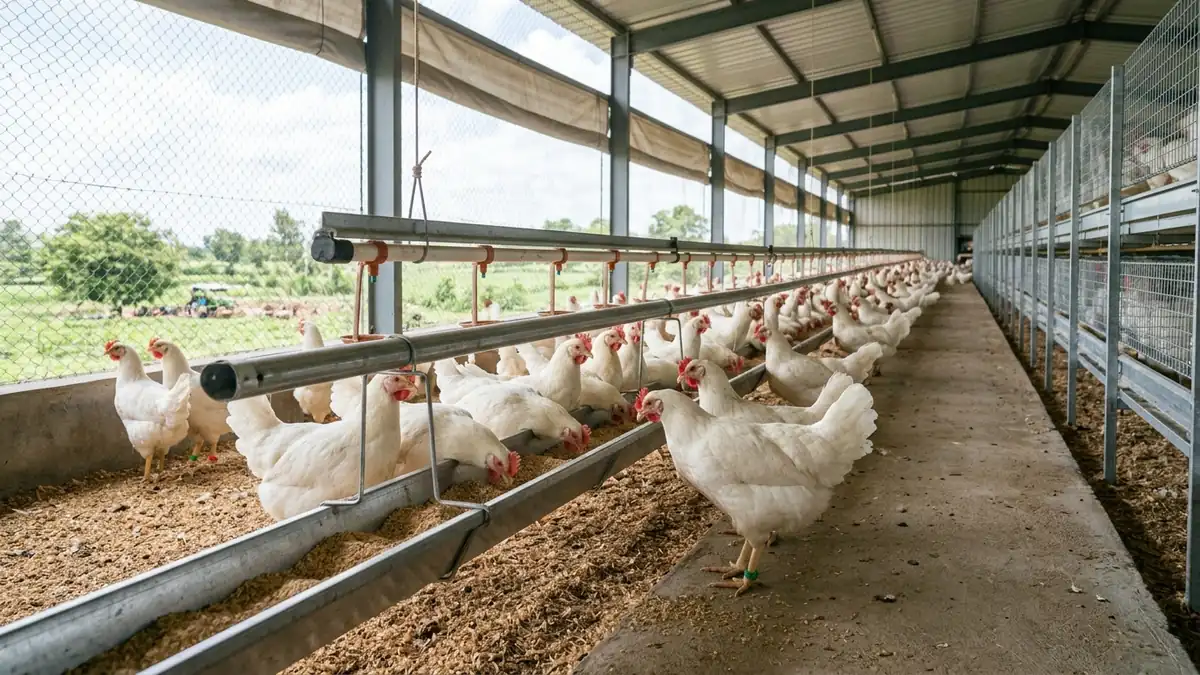
Commercial layer farming is a high-volume enterprise where feed expenses account for 70% to 75% of operating outlays (evaluate feed grain cost variations with our crop fertilizer and input calculator). A high-producing commercial layer hen (such as BV-300) consumes roughly 110 to 115 grams of nutritionally balanced compound mash feed daily to produce one egg every 24 to 26 hours.
The nutritional composition of standard layer feed and current 2026 wholesale ingredient costs in Haryana include:
| Feed Ingredient | Dietary Inclusion (%) | Wholesale Rate (₹ / Qtl) | Nutritional Purpose in Layer Diet |
|---|---|---|---|
| Yellow Maize (मक्का) | 50% – 55% | ₹2,350 | Primary metabolizable energy (2,750 kcal/kg) and yolk pigment |
| Soybean Meal DOC (सोया डीओसी) | 20% – 25% | ₹4,100 | High-digestibility crude protein (46-48%) and amino acid balance |
| De-oiled Rice Bran (DORB) | 10% – 12% | ₹1,450 | Crude fiber and cost-effective bulk filler |
| Calcite Powder / Limestone Grit | 8% – 10% | ₹450 | Critical calcium source (38% Ca) for rigid eggshell formation |
| Dicalcium Phosphate (DCP) | 1.2% – 1.5% | ₹3,800 | Bioavailable phosphorus for skeletal support and metabolic health |
| Synthetic Amino Acids & Premixes | 1.0% – 1.5% | ₹18,000 | DL-Methionine, L-Lysine, choline chloride, vitamins AD3E, trace minerals |
Based on these raw material rates, the finished cost of compounding 1 kilogram of high-quality layer mash feed in Barwala is approximately ₹26.50 to ₹28.20. With an average flock Feed Conversion Ratio (FCR) of 1.45 kg of feed per dozen eggs (roughly 120 grams per egg), the direct feed cost per egg stands at ₹3.25 to ₹3.45. When factoring in day-old chick depreciation, biosecurity, and labor, calculate overall farm profitability using our farm crop income calculator, where Barwala break-even COP averages ₹4.65 to ₹4.85 per egg.
Consequently, when the Barwala egg rate benchmarks above ₹5.50 per piece, farmers realize healthy operating profits of ₹0.65 to ₹1.20 per egg, translating to monthly net revenues exceeding ₹10 Lakh on a standard 50,000-bird layer farm. Producers can buffer seasonal working capital constraints through customized farmer loans.
Seasonal price volatility: winter peaks, summer drops & festival cycles
Egg prices exhibit marked seasonal seasonality across North India, dictated by human nutritional habits, ambient temperatures, and socio-religious festivals:
- Winter Protein Peak (November to February): Demand surges across North India as temperatures decline. Plan heating and shed ventilation against weather drops with our 7-day agricultural weather forecast, as rates frequently reach ₹6.10 to ₹7.10 per piece.
- Spring Stabilization (March to April): Moderate temperatures maintain stable production and steady urban demand. Prices typically hover in the comfortable ₹5.30 to ₹5.80 range.
- Summer Slump (May to July): Extreme heat waves (42°C to 47°C across the northern plains) depress consumer egg demand due to dietary perceptions of eggs being "hot foods". Concurrently, heat stress reduces hen feed intake, highlighting the importance of risk management covered in our PMFBY crop and agricultural insurance guide.
- Sawan & Shravan Month (July–August): Widespread vegetarian fasting observance across Northern and Central India significantly dampens retail sales, requiring farmers to redirect surplus eggs into cold storage.
- Navratri & Festive Rebound (October–November): While the 9-day Navratri festival causes a sharp 7 to 10-day price dip, rates rebound aggressively immediately after Dussehra, commencing the winter bull run.
Egg grading standards, shelf life & cold storage management
Modern layer farms in Barwala utilize automated electronic grading conveyors, with equipment capital financed through our farm machinery loan EMI calculator. Under Bureau of Indian Standards (BIS: IS 1038) and AGMARK poultry norms, table eggs are categorized by weight and internal freshness:
- Grade A (Extra Large / Large): Clean sound shell, air cell depth < 3.0 mm, egg weight above 53 grams. Suitable for retail cartons and export markets.
- Grade B (Medium): Egg weight between 45 and 52 grams, sound shell, minor cosmetic markings. Common in institutional catering and bakeries.
- Pullet / Small Eggs: Weight under 44 grams produced by young pullets (18 to 22 weeks of age). Sold at discounted rates.
Fresh table eggs maintain freshness for 10 to 14 days at room temperature. Constructing modern poultry sheds and cold rooms requires clear land documentation verified via Bhulekh land records.
- Official National Egg Coordination Committee (NECC) Portal
- Department of Animal Husbandry and Dairying (DAHD), Govt of India
- Agmarknet Directorate of Marketing & Inspection Daily Mandi Prices
- All India Egg Rate Today & City-Wise NECC Mandi Prices
- Commercial Poultry Farm Setup, Shed Design & Subsidy Guide
- Daily APMC Mandi Rates & Wholesale Agricultural Bhav
- Sabji Mandi Today Wholesale Vegetable Rates & Auction Timings
- Muhana Mandi Jaipur Wholesale Vegetable & Fruit Bhav
- Kisan Credit Card (KCC) Loan Limit Calculator
- Fertilizer Dosage & Subsidized Cost Calculator
- Commercial Dairy Farming & Indigenous Cattle Breeds Guide
- Gir Cow Price, Milk Yield and A2 Ghee Business Guide
- Paddy Cultivation, Seed Treatment and Mandi MSP Guide
- Today Sugar Price & Ex-Mill APMC Mandi Rates
- John Deere 60 HP Tractor Price List & Specs Guide
- Swaraj 744 FE Tractor Specs & Subsidy Loan Guide
Frequently Asked Questions: Barwala Egg Rate Today & Market Dynamics
Frequently asked questions
- What is the wholesale price of 1 egg in Barwala today?
- The indicative Barwala wholesale egg rate (November 2026) is about ₹5.85 per piece according to the National Egg Coordination Committee (NECC) Barwala Zonal Committee. Check real-time daily zonal rates on the NECC Barwala Zonal portal (e2necc.com) or our today egg rate daily tracker.
- What is the price of a 30-egg tray in Barwala today?
- A standard 30-egg paper tray trades at ₹175.50 at wholesale rates in Barwala (indicative, November 2026). Compare tray and crate benchmarks in our national egg rate price guide and evaluate farm margins with our poultry profit calculator.
- What is the price of 100 eggs (सैकड़ा भाव) in Barwala today?
- The wholesale rate for 100 eggs in Barwala is ₹585.00 today. Wholesale buyers and institutional caterers purchasing in bulk cartons pay this direct benchmark rate.
- What is the price of 1 peti (carton) of eggs in Barwala?
- A standard commercial master carton (पेटी) containing 210 eggs (7 paper trays of 30 eggs each) is priced at ₹1,228.50 at Barwala wholesale rates.
- What time is the daily Barwala egg rate announced by NECC?
- The official Barwala NECC egg rate is announced daily between 1:00 PM and 1:30 PM after the Zonal Coordination Committee completes its review of morning production, cold storage stocks, and outstation truck dispatches.
- Why is Barwala egg rate cheaper than Delhi egg rate?
- Delhi Gazipur mandi rates include transportation freight from Haryana (approx. ₹0.30 per egg), transit breakage allowance (₹0.05), Delhi APMC market entry fees, and unloading labor (₹0.15). Consequently, Delhi trades ₹0.45 to ₹0.60 higher than Barwala farm-gate rates.
- How many eggs are produced in Barwala daily?
- The Barwala and Raipur Rani poultry belt in Panchkula district houses over 1.8 crore commercial layer birds and produces between 1.20 crore and 1.35 crore eggs daily, making it Asia's second-largest layer hub.
- What is the cost of producing one egg on a poultry farm in Barwala?
- In 2026, the average break-even cost of production (COP) in Barwala is between ₹4.65 and ₹4.90 per egg, with feed accounting for 72% of operational costs. Explore commercial poultry management in our commercial poultry farm guide and calculate flock returns with our farm income calculator.
- When do egg prices reach their highest levels in Barwala?
- Egg prices peak during the winter months (November to February) due to surging protein consumption and heightened demand from bakery and street food sectors, frequently rising above ₹6.20 to ₹7.10 per egg.
- How does Barwala egg rate compare with Namakkal egg rate?
- Barwala and Namakkal are India's twin poultry benchmark hubs, with Namakkal trading ₹0.20 to ₹0.30 lower due to local feed sourcing. Track live multi-market price trends on our mandi commodity rates tracker.
- What is the difference between CC rate and NECC rate in Barwala?
- "CC Rate" refers to the Coordination Committee rate announced locally by Barwala poultry producers, which serves as the official zonal input for the National Egg Coordination Committee (NECC) national price bulletin.
- How can farmers and traders track real-time Barwala egg rates on mobile?
- Farmers can check daily verified Barwala NECC egg rates on KisanPe Mandi Rates or via the official NECC India mobile portal. Official animal husbandry guidelines are available on the DAHD animal husbandry portal (dahd.nic.in), with working capital support accessible via our KCC poultry working capital loan.
This article is for general information only and is not financial advice. Loan and scheme eligibility depends on partner and government criteria.