Gur Mandi Guide: Muzaffarnagar Jaggery Price & FSSAI Grade
Key takeaways
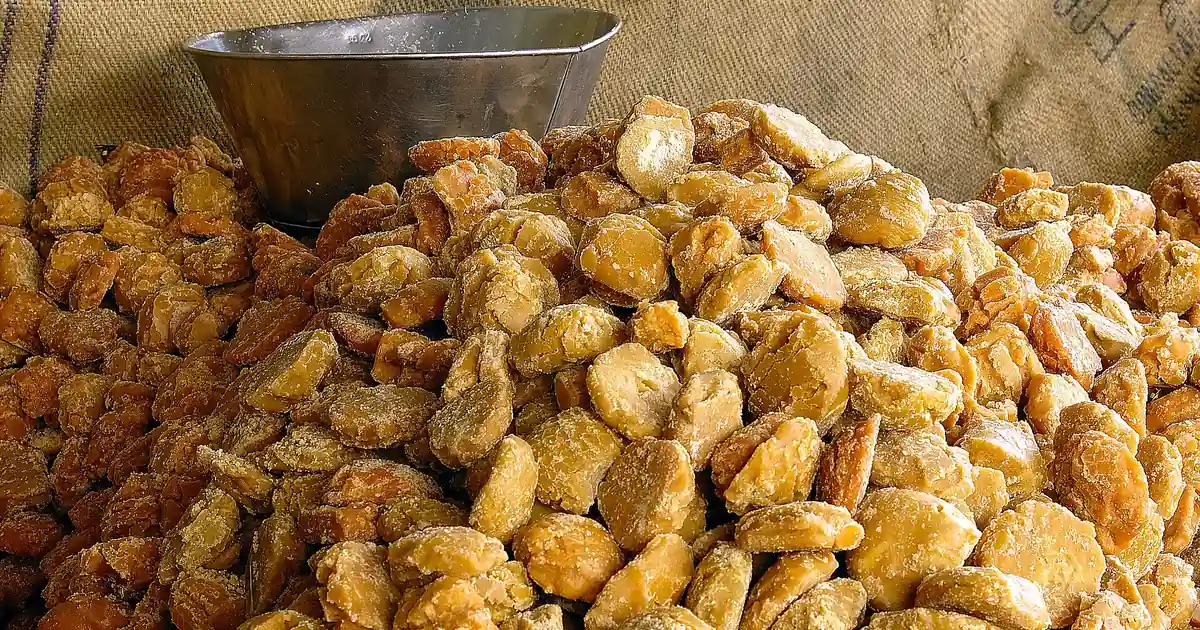
- India Global Jaggery Leadership (PIB / APEDA): India produces more than 70% of the world’s sugarcane jaggery (gur), led by anchor wholesale trading mandis in Muzaffarnagar & Hapur (Uttar Pradesh), Kolhapur (Maharashtra), and Anakapalle (Andhra Pradesh).
- Sugarcane FRP Anchors Floor Production Cost (PIB): Official Fair & Remunerative Price (FRP) for sugarcane fixed at a 10.25% basic recovery rate sits at ₹340/quintal (SS 2024-25) and ₹355/quintal (SS 2025-26), establishing the baseline raw-material floor beneath kolhu jaggery crushing.
- Decoding Gur Mandi Units — Quintal vs Pansera vs 1 Kg: APMC mandis report wholesale gur prices per quintal (100 kg), Muzaffarnagar/UP physical auctions also benchmark traditional 5-kg Pansera units, while 1 kg jaggery price at retail equals wholesale ₹/kg (₹/qtl ÷ 100) plus moisture loss, grading, food-grade wrapping, and GST/freight.
- Mandatory FSSAI Quality Benchmarks: Statutory Cane Jaggery regulations cap moisture at ≤7.0% by mass, enforce ≥70.0% sucrose and ≥90.0% total sugars (invert), cap reducing sugars at ≤20.0%, and limit acid-insoluble ash (≤0.3%–0.5%) and extraneous matter (≤1.5%–2.0%).
- GI Tagging & ODOP Export Boost: Recognized under GI registries and Uttar Pradesh ODOP / PMFME programmes, certified chemical-free Muzaffarnagar Gur and Kolhapuri Gul have expanded direct APEDA-backed exports across international specialty markets.
Checking the genuine gur mandi benchmark before selling boiled cane blocks off a rural kolhu or sourcing wholesale jaggery price lots requires separating daily APMC modal arrivals from retail 1 kg jaggery price markups and artificial bleaching discounts. According to Government of India releases via Press Information Bureau (PIB), India produces over 70% of global jaggery, converting fresh autumn-winter sugarcane juice into non-centrifugal natural sweetener prized by confectioners, winter households, Ayurvedic processors, and specialty exporters.
Across India, wholesale gud price discovery revolves around three historic physical hubs: Muzaffarnagar New Mandi (alongside Hapur and Shamli in Western UP), Kolhapur in Maharashtra’s Panchganga river basin, and Anakapalle in coastal Andhra Pradesh. Before dispatching loaded tractor-trolleys to commission yards, inspect live statutory arrival registers on Agmarknet and e-NAM, open KisanPe’s Mandi Rates hub, review white-sugar mill parity in our Sugar Price Today guide and Aaj Ka Chini Ka Rate tracker, and follow clean auction reading methods in our Mandi Verification Guide.
Major Indian Gur Mandi Hubs: Muzaffarnagar, Kolhapur & Anakapalle Compared
Unlike refined white crystal sugar where all factories produce near-identical ICUMSA grades, natural cane jaggery carries distinct regional shapes, sucrose-to-molasses textures, and Geographical Indication (GI) heritage. Consequently, checking only one state’s headline creates confusion when comparing solid golden Chaku bricks against round dark fermented feed grades or GI-tagged Kolhapuri Gul:
| Primary Gur Mandi Hub | Key Catchment Belt | Signature Jaggery Forms & Recognition | Official Price Discovery & Verification Source |
|---|---|---|---|
| Muzaffarnagar & Hapur (Western UP) | Muzaffarnagar, Shamli, Bijnor, Meerut, Baghpat, Hapur | Chaku slabs, Laddoo spheres, Peda, Khurpa, Shakkar powder; GI & UP ODOP flagship | Agmarknet UP APMC feeds, e-NAM auctions & Muzaffarnagar Mandi arrival bulletins |
| Kolhapur Market (Maharashtra) | Panchganga river basin, Sangli, Satara cane belt | Traditional chemical-free light red-brown Kolhapuri Gul dhep blocks (GI-tagged) | Maharashtra APMC daily modal logs via Agmarknet & KisanPe Mandi Rates hub |
| Anakapalle Gur Mandi (Andhra Pradesh) | Visakhapatnam / Anakapalle coastal cane clusters | Trapezoid lumps, moulded cubes & seasonal liquid panakam grades | AP Regulated Market daily arrivals & APEDA southern exporter parity checks |
| Nizamabad, Mandya & Erode Mandis | Telangana, Southern Karnataka & Cauvery basin | Regional pan jaggery blocks & organic farm-crushed specialty cane jaggery | e-NAM online bidding & regional state marketing board portals |
Notice how strongly GI certification and Uttar Pradesh’s One District One Product (ODOP) framework have lifted market reach for clean small-scale processors. Under APEDA (apeda.gov.in) export facilitation highlighted by PIB, local Farmer Producer Organizations (FPOs) such as Muzaffarnagar agro FPOs have shipped multi-tonne consignments of traceable GI-tagged Muzaffarnagar jaggery directly overseas alongside traditional Kolhapur shipments—proving that documented chemical-free processing earns wider institutional demand than anonymous wet heaps.
Understanding 1 Kg Jaggery Price vs Pansera (5 Kg) & Quintal Quotes
One of the quickest ways buyers and new sellers misread jaggery price per kg online is mixing up three completely different weight quotes used inside North Indian mandis versus household grocery apps. When reading APMC arrival reports on Agmarknet, wholesale auction numbers are standardized uniformly in Rupees per Quintal (100 kg)—so dividing the reported modal quintal price by 100 immediately shows the loose ex-mandi base price for 1 kg jaggery before mandi commission, burlap sack tare, and inter-state transport.
- Quintal (100 kg): Standard statutory unit displayed on Agmarknet, e-NAM, and FPO invoice ledgers across UP, Maharashtra, Karnataka, and Andhra Pradesh.
- Pansera / Dhari (5 kg): Traditional North Indian physical trading benchmark in Muzaffarnagar and Hapur for solid Chaku and cold-storage lots—multiplying any quoted Pansera rate by 20 converts directly into standard quintal terms.
- Why Retail Jaggery Price 1 Kg Differs From Mandi Wholesale: Packed jaggery price 1 kg bricks or powdered shakkar pouches on retail shelves absorb ~2%–4% moisture shrinkage curing losses, dust sieving, vacuum/HDPE moisture-barrier packaging, FSSAI lab batch testing, wholesale distributor margin, and retail logistics—explaining why consumer 1 kg packs consistently retail well above bare kolhu auction modal rates.
Sugarcane FRP Floor Costs (₹340–₹355/qtl) & Mill vs Kolhu Economics
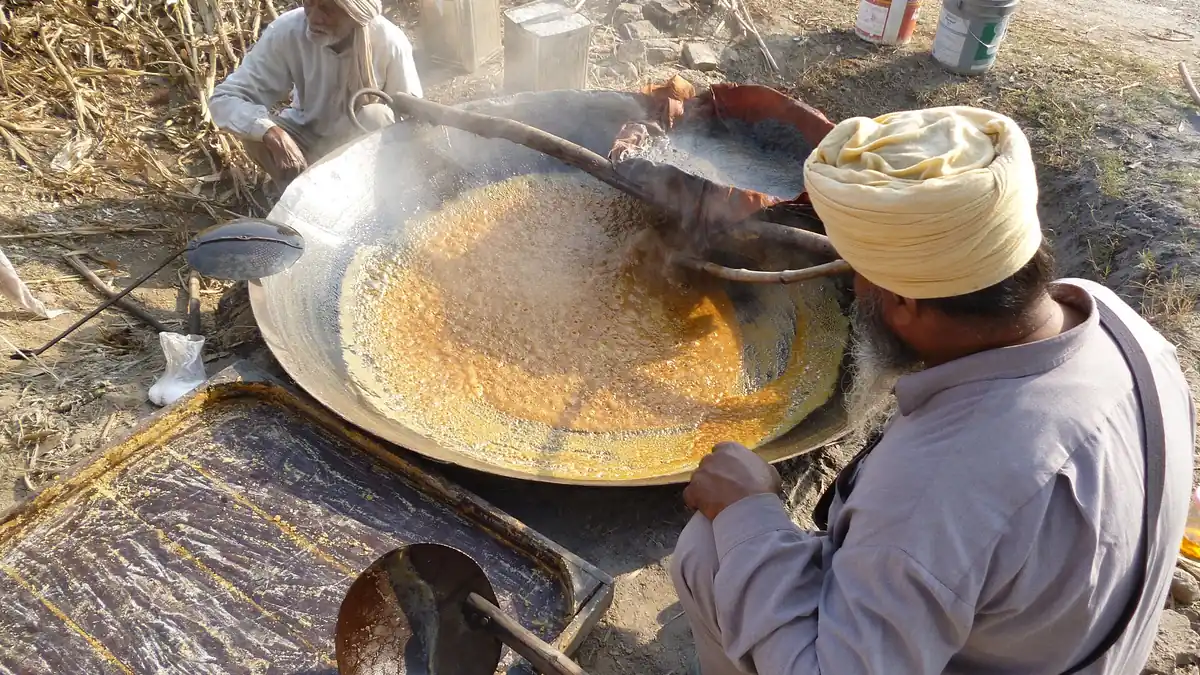
Every autumn crushing season, gur mandi supply hinges tightly on competition between organized white-sugar mills and village kolhu / bhatti crushers buying raw cane stalks. According to PIB Cabinet approvals, the Government of India fixed the national Fair and Remunerative Price (FRP) of sugarcane linked to a 10.25% basic sugar recovery rate at ₹340 per quintal for Sugar Season 2024-25 and raised it to ₹355 per quintal for Sugar Season 2025-26.
When village farmers harvest early-winter cane (October–November) testing lower juice sucrose (~8.5%–9.5% jaggery yield), crushing 100 kg of standing cane yields noticeably fewer kilograms of finished gur and requires extra bagasse fuel to boil off watery juice—pushing processor raw-cane cost per kg of finished gur higher. Conversely, crisp frost-sweetened January–March cane harvests raise recovery past 11%–12%, hardening solid gur blocks cleanly while reducing fuelwood cost per quintal. Growers balancing cane delivery between state-advised mill parchi slips and kolhu sales can cross-check consumer sweetener trends via our Chini Ka Rate Today page and Sugar Rate Per Kg analysis, while protecting standing cane yields against red rot with our Sugarcane Red Rot Guide and Sempra Motha Herbicide Manual.
Mandatory FSSAI Cane Jaggery Standards: Moisture ≤7.0% & No Harsh Bleaches
In past decades, some rural boilers chased artificially pale white gur appearances by dumping heavy doses of sodium hydrosulphite (hydros / rangkat) into simmering pans—leaving bitter chemical aftertastes and risking safety seizure under food laws. Today, clean processors aiming for premium packaged jaggery price shelves, corporate spice buyers, and export shipments under APEDA and PMFME subsidies must meet strict analytical parameters regulated by the Food Safety and Standards Authority of India (FSSAI):
| FSSAI Analytical Parameter (Cane Jaggery / Gur) | Official Statutory Limit | Why It Matters in Mandi Grading & Storage |
|---|---|---|
| Moisture Content | Not more than 7.0% by mass (Max) | Moisture above 8%–10% causes rapid syrup weeping (liquefaction), mould growth & cold-storage blackening |
| Sucrose Content | Not less than 70.0% by mass (Min) | Measures mature crystalline cane sweetness vs immature frost-bitten early-season juice |
| Total Sugars (as invert sugar) | Not less than 90.0% by mass (Min) | Confirms pure natural cane energy density free from starch/chalk filler dilution |
| Reducing Sugars | Not more than 20.0% by mass (Max) | Excess invert sugar creates soft sticky hygroscopic lumps that melt inside humid monsoon air |
| Sulphated Ash & Acid-Insoluble Ash (HCl) | Sulphated Ash ≤4.0% | Acid-Insoluble ≤0.3%–0.5% | Detects burnt ash contamination, limestone lime excess, or soil grit left during crushing |
| Extraneous & Water-Insoluble Matter | Not more than 1.5%–2.0% by mass (Max) | Reflects crisp juice clarification using natural okra stem (deola / sukhlai) mucilage instead of dirt |
Chaku, Laddoo, Peda & Khurpa Grades: Keeping Gur Crisp in Cold Storage
Walking through Muzaffarnagar Nai Mandi sheds or Kolhapur auction floors reveals strict mechanical categorization that buyers evaluate immediately before bidding:
- Chaku / Brick Slab Grade: Square-cut golden-amber slabs poured on smooth stone cooling pans—valued highest by North Indian wholesale wholesalers and cold-store stockists holding supplies safely through summer.
- Laddoo & Peda Moulded Grades: Hand-rolled medium rounds (laddoo) or flat palm cakes (peda) popular across UP, Delhi, Haryana, and Rajasthan household markets due to easy portioning.
- Khurpa & Pansera Grades: Harder low-moisture scraped pan grades well suited for multi-month ambient and cold-room holding with minimal syruping.
- Natural Deola Clarification Over Hydros: Research promoted via ICAR sugarcane engineering institutes demonstrates that clarified cane juice boiled gently with natural wild okra (Hibiscus ficulneus / deola) extract removes floating scum cleanly while meeting strict FSSAI ash/moisture tolerances—earning higher institutional repeat orders than chemical-bleached lots.
Post-Harvest Cold Storage, PMFME Grants & Cane Farm Credit Planning
Because peak sugarcane crushing floods North Indian kolhu units between December and March, holding well-cured low-moisture (<7%) Chaku or powder/cube packs inside ventilated cold stores (sealed cleanly inside moisture-barrier lined poly-woven bags before April humidity rises) helps processors catch firmer summer and early-festive demand cycles without melted syrup losses. Rural entrepreneurs upgrading boiling furnaces, stainless-steel cooling vats, or vacuum-pack cubes can check micro-processing grant support promoted under PIB PMFME / ODOP releases alongside DA&FW farmer producer advisories.
For cane cultivators managing annual ratoon nutrition, pre-crush irrigation, and seasonal transport costs, budget working capital safely through KisanPe’s KCC Calculator, protect standing sugarcane fields against lodging winds or unseasonal rain under PMFBY Crop Insurance, verify clean mandi pricing across KisanPe Mandi Ka Bhav guide, monitor harvest rain risk on KisanPe Weather hub, and coordinate improved high-sucrose variety kits via your district Krishi Vigyan Kendra (KVK).
Frequently asked questions
- Where can farmers and traders check verified daily gur mandi rates across Muzaffarnagar, Kolhapur, and Anakapalle?
- Verify official daily Minimum, Maximum, and Modal wholesale jaggery (gur) quotes across Muzaffarnagar, Hapur, Kolhapur, Anakapalle, and other regulated APMC yards on Agmarknet (agmarknet.gov.in) and electronic national auctions on e-NAM. Compare regional market guides cleanly on KisanPe Mandi Rates and our Mandi Verification Guide.
- How is jaggery price per kg calculated from wholesale quintal and 5 kg Pansera quotes?
- Regulated mandis quote wholesale jaggery in ₹ per quintal (100 kg), while UP physical trade often references traditional 5 kg Pansera slabs (1 quintal = 20 Panseras). Divide the Agmarknet quintal price by 100 to find the loose wholesale 1 kg jaggery price—retail consumer packs cost higher due to moisture shrinkage, sorting, food-grade wrapping, GST, and freight. Compare white-sugar benchmarks via our Sugar Price Today guide and Mandi Ka Bhav hub.
- Why do Muzaffarnagar, Kolhapur, and Anakapalle jaggery prices differ from each other?
- Each major jaggery hub crafts distinct sugarcane cultivar textures and market forms: Muzaffarnagar (UP ODOP & GI-tagged) leads high-volume northern Chaku, Laddoo, and export FPO blocks (APEDA), GI-tagged Kolhapuri Gul earns specialty light-amber regional demand, and Anakapalle anchors southern block and cube trade (PIB). Inspect regional cane agronomy via KVK centres.
- What are the mandatory FSSAI moisture and sucrose standards for commercial cane jaggery?
- Per FSSAI (fssai.gov.in) Cane Jaggery standards on dry mass basis, moisture must not exceed 7.0%, sucrose must be at least 70.0%, total sugars (as invert) at least 90.0%, reducing sugars capped at 20.0%, sulphated ash ≤4.0%, acid-insoluble ash ≤0.3%–0.5%, and extraneous matter ≤1.5%–2.0%. Keeping moisture below 7% prevents monsoon liquefaction; check humidity alerts on KisanPe Weather hub.
- How does the Government of India Sugarcane FRP affect floor gur prices?
- According to PIB notifications, the central Fair & Remunerative Price (FRP) of sugarcane at a 10.25% basic recovery rate was set at ₹340/qtl (SS 2024-25) and ₹355/qtl (SS 2025-26). Because sugar mills and kolhu crushers compete for standing field cane, elevated FRP floors and rising crushing energy costs directly lift the baseline cost of raw cane juice entering jaggery pans—also explore sugar market parity on Chini Ka Rate Today.
- Why does India lead global jaggery production and how do ODOP and GI tags help farmers?
- India accounts for over 70% of global jaggery production (PIB). Linking Geographical Indication (GI) authenticity for Muzaffarnagar Gur and Kolhapuri Jaggery with UP ODOP branding, PMFME modern processing subsidies, and APEDA export channels lets rural FPOs sell traceable chemical-free jaggery directly overseas instead of relying purely on low-margin bulk scrap lots (DA&FW).
- How can small kolhu units make golden crisp jaggery without harmful chemical bleaches?
- Research highlighted by ICAR advises harvesting mature healthy cane (manage diseases cleanly via our Sugarcane Red Rot guide), filtering raw cold juice finely, and clarifying simmering foam with natural okra/wild hibiscus stem mucilage (deola / sukhlai) rather than heavy synthetic hydros bleaching—preserving natural minerals while meeting strict FSSAI standards.
- Why does high moisture jaggery melt during monsoon storage and how can stockists prevent it?
- Excess reducing sugars (>20%) and un-dried moisture above 7%–8% cause jaggery slabs to absorb ambient monsoon humidity and soften into dark wet syrup. Curing low-moisture winter Chaku / Khurpa blocks thoroughly before storing in vapour-barrier poly-lined gunny bags inside dry cooled rooms protects firm texture smoothly—track rain spikes via KisanPe Weather alerts and plan farm seasonal liquidity on our KCC Calculator.
- Can sugarcane and jaggery growers use KCC loans and PMFBY protection?
- Yes—eligible cane farmers finance annual planting, ratoon hoeing, and weed management (e.g., Sempra herbicide guidelines) cleanly through Kisan Credit Card limits (KCC Calculator) while covering standing notified cane acreage against drought, wind lodging, or hail storms under PMFBY supported by DA&FW guidelines.
- Muzaffarnagar aur desh ki gur mandi mein aaj ka gud price aur 1 kg jaggery rate kaise check karen?
- Kisan bhai aur vyapari Muzaffarnagar, Hapur, Kolhapur aur Anakapalle mein rozana ka gur mandi bhav official Agmarknet (agmarknet.gov.in) aur e-NAM portal par dekh sakte hain. Agmarknet par dikhne wale quintal (100 kg) bhav ko 100 se bhag dene par thok 1 kg gud price nikal aata hai—chaku/laddoo quality aur chini parity dekhne ke liye Mandi Rates hub aur Aaj Ka Chini Ka Rate dekhen.
This article is for general information only and is not financial advice. Loan and scheme eligibility depends on partner and government criteria.