Tractor Images India 2026: 25-75 HP Photos & Model Specs
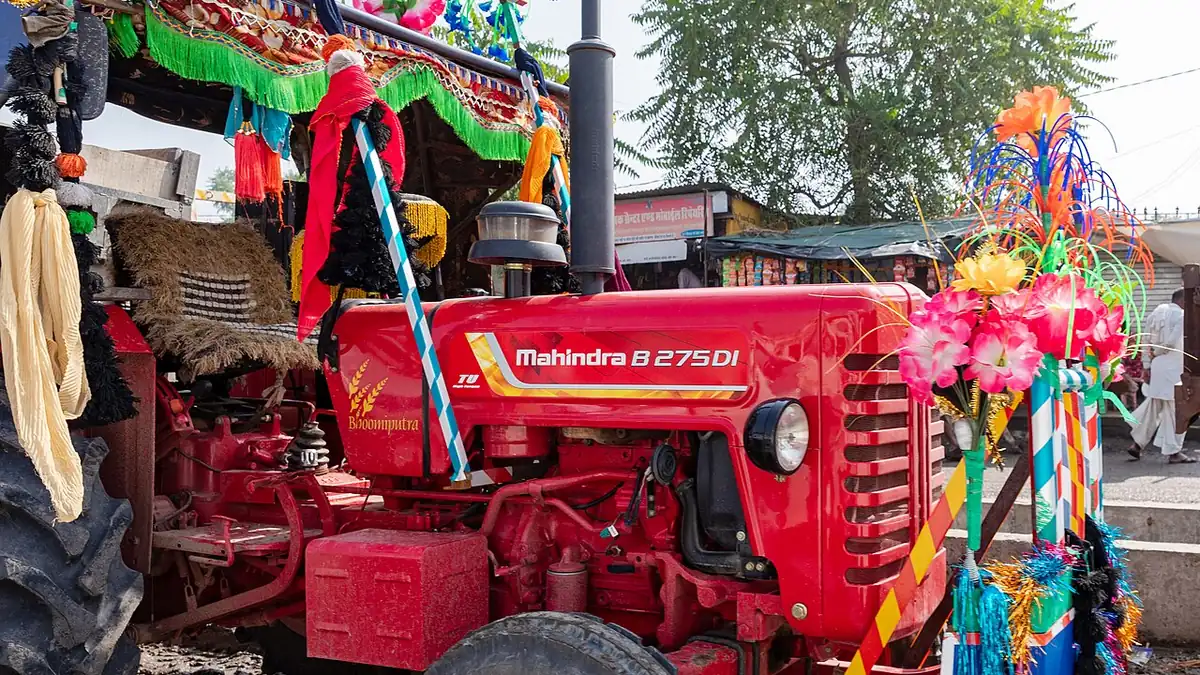
Key takeaways
- Farmers browsing tractor images across 20 HP to 75 HP classes should evaluate physical tractor proportions alongside actual technical specs: wheelbase length, front-axle ground clearance, 2WD vs 4WD tyre sizing, and 3-point hitch strength.
- India's agricultural tractor fleet spans five visual/power tiers: 20–28 HP narrow orchard mini tractors (3–4 ft track width), 30–40 HP value utility tractors (Swaraj 735 / Sonalika DI 35), 45–50 HP all-rounders (Swaraj 744 / Mahindra 575 / Farmtrac 60), 55–60 HP commercial heavyweights (Arjun 605 / Farmtrac 6055 / John Deere 5310), and 65–75+ HP 4WD estate tractors.
- Always inspect actual field photos for real tyre lug profiles (12.4x28 vs 14.9x28 vs 16.9x28 rear lugs), cooling grille dust screens, operator flat-platform ergonomics, and roll-over bar (ROPS) readiness.
- Before booking any model seen online, cross-check its CFMTTI Budni commercial test rating and tractor parity on agrimachinery.nic.in and cfmtti.dacnet.nic.in.
- Compare transparent pricing, EMI plans, and CHC subsidies across brands cleanly using KisanPe's interactive Tractor Directory and Tractor Comparison hub.
Whether you are comparing 4WD planetary front axles before investing ₹8+ lakh in a farm tractor or checking compact orchard chassis widths for narrow sugarcane rows, viewing genuine field tractor images side-by-side with technical specifications tells a far truer story than glossy studio brochures! Physical wheel spacing, hood slant visibility toward front loader arms, exhaust muffler routing, and 3-point hydraulic linkage geometry directly control daily comfort across 1,000+ annual field hours. Before visiting any district dealership showroom, explore verified photographic comparisons across India's 20 HP to 75 HP segments backed by CFMTTI Budni and Agrimachinery SMAM testing disclosures alongside KisanPe's complete Tractor Directory, our live side-by-side Tractor Comparator, Swaraj 744 FE/XT profiles, and Mahindra Arjun Novo 605 reviews. Verify related KisanPe comparisons and official portal references via compact tractor specs, Indo Farm 4175 DI.
1. Visual & Technical Buyer Guide: Indian Tractor Categories (20–75 HP)
When growers browse all tractor photo galleries online, glossy red, blue, green, and orange hoods look surprisingly alike until paired against real rear-tyre diameter (12.4x28 vs 16.9x28), PTO horsepowers, and hydraulic lifting benchmarks! Use this structured 2026 visual-to-spec matrix to match chassis dimensions straight to your primary soil duty:
| Tractor Visual & HP Class | Key Field Visual Cues (Photos & Chassis) | Standard Rear Tyre & Lift Spec | Popular Indian Models | Indicative Ex-Showroom Band (Nov 2026) |
|---|---|---|---|---|
| Mini / Narrow Orchard (20–28 HP 4WD) | Slim ~3–3.8 ft track width, short hood, vertical muffler | 8.00x18 or 8.3x20 · 750–900 kg lift | Mahindra JIVO, Swaraj Target, Kubota A211N | ₹4.10 Lakh – ₹5.85 Lakh (compact tractor specs) |
| Value Utility (35–42 HP 2WD) | Single-piece nose grill, open shift deck, ~1,900 mm wheelbase | 12.4x28 or 13.6x28 · 1,000–1,650 kg lift | Swaraj 735 FE, Mahindra 275/475, Sonalika DI 35 | ₹5.45 Lakh – ₹6.75 Lakh (Swaraj 735 guide) |
| Core All-Rounder (45–50 HP 2WD/4WD) | Heavy front weights, dual/dry air cleaner, big fenders | 14.9x28 heavy tread · 1,700–2,000 kg lift | Swaraj 744 XT, Mahindra 575 DI, Sonalika 745, Farmtrac 60 | ₹6.75 Lakh – ₹8.35 Lakh (Farmtrac specs) |
| Commercial Heavy Utility (55–60 HP) | Long 4-cyl hood, wide flat floor platform, planetary rear axle | 16.9x28 wide rear radial/lug · 2,000–2,500 kg lift | Arjun Novo 605, John Deere 5310, Farmtrac 6055, Indo Farm 3055 | ₹8.40 Lakh – ₹11.90 Lakh (heavy 4x4 models) |
| Estate & Scraper Flagship (65–75 HP 4WD) | Standard factory ROPS/canopy, twin assist rams, jumbo radiator | 16.9x30 oversize rear · 2,400–2,600+ kg lift | Indo Farm 4175 DI, New Holland Workmaster, John Deere 5075E | ₹11.80 Lakh – ₹15.50+ Lakh (Indo Farm 4175 DI) |
Notice how stepping cleanly across HP categories shows instantly inside real tractor photo comparisons—from compact low-profile grape/pomegranate orchard machines (mini tractor guide) right up to rugged twin-ram 55–60 HP super-seeder units (Happy Seeder pairings)! Explore detailed individual brand portfolios cleanly on Mahindra 575 DI, Sonalika DI 745 III, Farmtrac 60 Powermaxx, Solis 4WD tractors, and Powertrac utility tractors.

2. What to Inspect Visually Inside Any Tractor Image Before Buying
Beyond admiring attractive paintwork when checking tractor images hd online, experienced rural mechanics zoom directly into five functional visual zones that decide uptime, comfort, and safety over a 15-year ownership span:
- 1. Front Axle Geometry (2WD Straight vs 4WD Epicyclic Portal): Look at front wheel hubs in photos! Sealed bevel-gear/planetary 4WD front axles sit cleaner with huge under-axle ground clearance for tall sugarcane inter-cultivation and flooded wetland paddy puddling without snapping kingpins.
- 2. Operator Deck Ergonomics (Side-Shift vs Center-Shift & Flat Floor): Inspect the driver footwell in dashboard pictures! Older center-shift gear levers crowd riders' ankles and heat knees across 10-hour June days, whereas modern side-shift flat-platform decks let operators mount cleanly with ample airflow.
- 3. Dry Dual-Element Air Cleaner & Cooling Radiator Mesh: Look behind the front grill for removable fine-mesh chaff screens and elevated snorkel pre-cleaners—crucial when powering dusty wheat straw reapers or multi-crop threshers!
- 4. Rear 3-Point Linkage, Twin Assist Hydraulic Rams & DCV Valves: Zoom straight into the back housing! Look for thick lower draft links, stabilizer bars, factory Auxiliary Control Valves (DCV spools) for tipping trailers or laser buckets, and high ground-clearance hitch hooks.
- 5. Safety ROPS Frame, Heat Shields & Dual-Braking Pedals: Check official MoRTH Parivahan safety lighting, wide independent/lockable brake pedals for sharp field turns, and reinforced trailer tow-eye hooks for safe road haulage.
3. Comparing Implements in Action: Rotavators, Seed Drills & Combines
Farmers searching visual galleries frequently want to picture how exact implements sit mounted behind different HP frames! Always verify PTO horsepower stability alongside hydraulic lift ratings before buying heavy rear attachments:
- 5-ft vs 7-ft Rotary Tillers: A nimble 35–42 HP machine (Swaraj 735) handles a 5-foot rotavator cleanly, while heavy 7-foot or 8-foot tillers demand 50+ PTO HP and deep-lugging 4-cylinder frames like the Arjun Novo 605 or Farmtrac 6055.
- 9-Row & 11-Row Seed Drills / Zero-Till Seeders: Inspect seed-fertilizer box clearance on precision seed drills so filled seed hoppers never strike rear cab fenders during steep bund crossings.
- Tractor-Mounted Combine Attachments: Converting a standard 55–65 HP tractor into a full seasonal combine farm machine demands heavy front-bumper weights, sturdy side-mount brackets, and adequate cooling airflow.

4. Financing, SMAM Grants & Second-Hand Photo Inspection Tips
Once shortlisting two or three favorite tractors from field photographs and spec cards, calculate realistic 5-year EMI repayments easily using KisanPe's Tractor Loan EMI Calculator, prepare verified KYC & Khatauni files with our loan document checklist, and check if your FPO or Custom Hiring Centre (CHC) qualifies for 40%–50% SMAM capital subsidies via agrimachinery.nic.in (SMAM portal steps & state tractor subsidy overview).
Planning to evaluate pre-owned tractors via online classified photos? Always ask sellers for clear sunlit close-ups of four tell-tale areas: rear tyre lug shoulder depth (retreaded tyres crack fast!), steering tie-rod joints, front oil sump / rear axle oil seals for black sludge leaks, and clean legible chassis plate + hour-meter photos verified against Vahan RC records following our second-hand tractor audit checklist! Keep seasonal crop finance organized via Kisan Credit Card accounts and explore active machinery aids inside KisanPe's subsidy hub.
5. Seasonal Care, Tyre Ballasting & Photo Documentation for Insurance
Taking clean tractor photo documentation is not solely for online classified reselling—maintaining crisp high-resolution photographs of your brand-new tractor's engraved chassis serial plate, engine block number, front bumper, rear 3-point linkage, and tyres saves tremendous friction during comprehensive motor insurance claims, bank KCC/machinery loan physical verification inspections (geotagged SMAM joint verification photos!), and theft police reports! Furthermore, monitor visual tyre lug deflection cleanly before heavy rabi tillage: adjust rear wheel track tread widths accurately inside wheel rim bolts when shifting from 75-cm sugarcane/cotton ridging into wide wheat seed-drills, inspect front axle kingpin grease nipples visually every 50 working hours, and park rigs under shaded tin sheds whenever unused over humid monsoon weeks so UV sunlight never dry-rots costly radial sidewalls. Pair photographic dealership checks seamlessly with physical test drives under loaded cultivators so every rupee matches verified performance!
Young mechanics, agricultural students, and machinery buyers browsing high-resolution gallery catalogues online should also pay attention to rear implement matching and hitch geometry visible in clear side-profile photographs. Before pairing any 40–55 HP rig with heavy rotavators, multi-row zero-till drills, or hydraulically lifted reversible MB ploughs, verify visually whether the dealer factory build includes dual-spool auxiliary hydraulic valves (DCV), telescoping lower draft link arms, and factory-fitted front suitcase ballast weights needed to keep front steer wheels grounded on slopes! Comparing real farm action photos alongside official state testing reports from CFMTTI Budni and manufacturer brochures inside KisanPe's tractor comparison directory ensures every buyer distinguishes glossy showroom paintwork from true PTO horsepower, planetary hub toughness, and ergonomic operator visibility during dusty harvest operations. Additionally, storing compressed landscape field photos alongside annual RC tax receipts, third-party liability certificates, and service booklet scans in one village smartphone folder makes quick pre-sale valuations or Custom Hiring Centre asset audits seamless for progressive farming households nationwide.
6. Frequently Asked Questions on Indian Tractor Photos & Models
Get crisp answers on identifying tractor HP categories visually, checking 4WD vs 2WD chassis cues, evaluating tyre lug sizes, and inspecting second-hand tractor photos safely.
Frequently asked questions
- How can farmers tell a tractor's HP category by looking at tractor images?
- Examine three visual cues: rear tyre dimensions (12.4x28 / 13.6x28 for 35–42 HP vs 14.9x28 / 16.9x28 on 48–60 HP tractors), engine hood length (shorter 3-cylinder blocks vs elongated 4-cylinder noses), and rear assist hydraulic rams. Compare exact measurements across models on our Tractor Comparator.
- What is the visual difference between a 2WD and 4WD tractor in field photos?
- A 2WD tractor features small slender ribbed front steering tyres (~6.00x16 or 7.50x16) on a slim tubular beam axle, whereas a 4WD tractor mounts thick lugged agricultural tread tyres on the front axle driven by heavy sealed hub-reduction housings (see 4WD utility specs).
- Which brand tractor images and models are most popular in India in 2026?
- India's top agricultural fleet centers around Mahindra (575 DI, Arjun Novo 605), Swaraj (Swaraj 744 FE/XT & 735 FE), Sonalika (745 RX / 750), Farmtrac (Farmtrac 45 & 60), John Deere, Eicher, and Kubota, spanning 20 HP to 75+ HP.
- Why should buyers check CFMTTI test data alongside tractor gallery photos?
- Showroom photos highlight fresh paint and LED headlamps, whereas official CFMTTI Budni commercial test reports hosted via Agrimachinery.nic.in prove actual measured PTO kW power, torque backup, fuel consumption (SFC), and hydraulic lift strength under real dynamometer load.
- What tyre photo checks matter most when buying a second-hand tractor online?
- Zoom closely into rear lug corners for uneven bevel wear or sidewall weather cracks, verify matching front/rear brand pairs, and inspect rear rim bolt holes for oval elongation caused by loose lug haulage—read full checks in our used tractor inspection guide.
- Which tractors work best in compact orchard photography rows under 4 feet wide?
- Narrow-track 20–28 HP 4WD sub-compacts like the Mahindra JIVO 245, Swaraj Target, and Kubota A211N fit cleanly between close grape/pomegranate trellises—browse compact options in our small tractor guide.
- Can rural Custom Hiring Centres claim government subsidies on tractors shown here?
- Eligible FPOs, cooperatives, and rural CHCs qualify for 40%–50% SMAM grants on approved tractor-implement machinery banks through Agrimachinery DBT portals—review step-by-step norms in our SMAM subsidy guide.
- Why do heavy 55–60 HP tractors show factory canopy frames (ROPS) in modern photos?
- Roll-Over Protective Structures (ROPS) and safety belts anchored per MoRTH & ISO standards shield operators cleanly during heavy trolley slope haulage and deep tillage overturning hazards.
This article is for general information only and is not financial advice. Loan and scheme eligibility depends on partner and government criteria.