Tractor Trali: Size Dimensions, SMAM Subsidy & RTO Guide
Key takeaways
- A tractor trali (agricultural trailer) must match your tractor HP class, BIS IS 8213 chassis standards, and Central Motor Vehicles Rules (CMVR Rule 93) width and length limits before hitting public roads.
- Under the Revised SMAM Guidelines (October 2026), individual 50%-category farmers qualify for up to ₹75,000 subsidy on a trailer/trolley up to 3-ton capacity and ₹1,00,000 on up to 5-ton capacity (40% group: ₹60,000 and ₹80,000).
- CMVR Rule 93 caps agricultural tractors at 2.6 m overall width and 6.5 m length (3.8 m height), while a power tiller coupled with a trailer is capped at 1.7 m width and 6.0 m overall length.
- Hydraulic tipping tralis tested under IS 8213 and IS 12371 connect via a ring-type drawbar hitch (IS 11270) and require at least 300 mm ground clearance to clear muddy farm bunds.
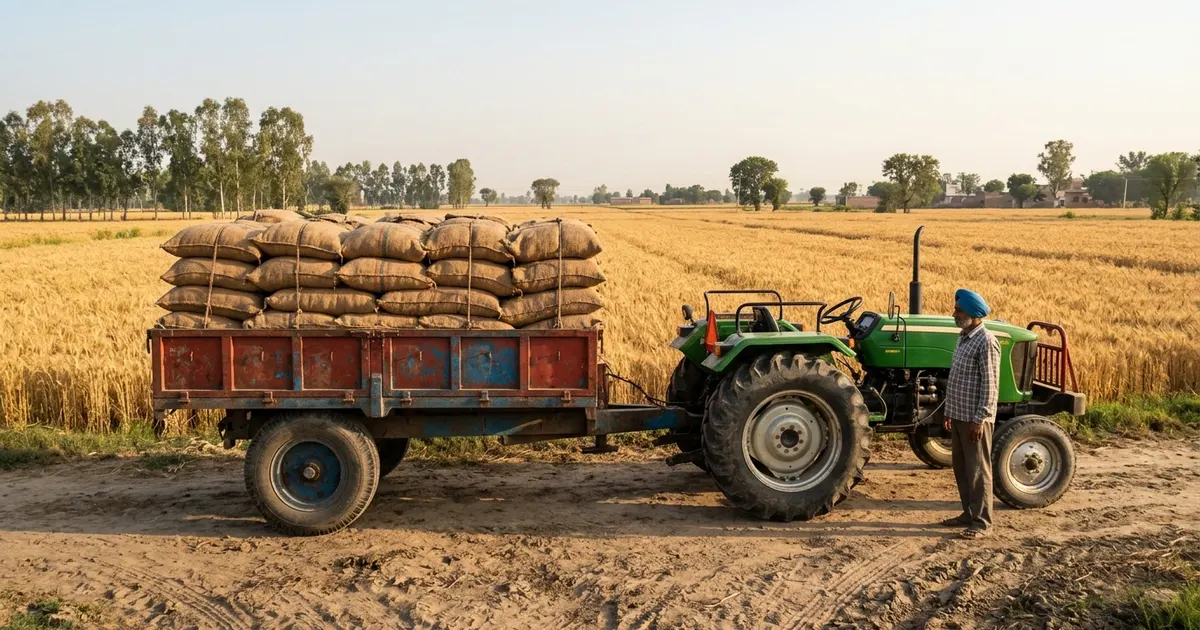
A tractor trali (also spelled tractor trolley or written in Hindi as ट्रैक्टर ट्राली) is the most heavily worked haulage implement on Indian farms, carrying harvested wheat, paddy, sugarcane, cotton, farmyard manure, and irrigation pipes between field bunds and regulated APMC mandis. While buyers often focus first on dealer quotes—covered in detail in our dedicated tractor trolley price list and ex-factory rate guide—selecting the wrong trali length, axle rating, or chassis sheet thickness causes broken axles, tractor front-end lift on inclines, and RTO registration rejection.
This technical guide focuses specifically on tractor trali size matching, BIS structural standards, CMVR Rule 93 RTO compliance, and SMAM October 2026 subsidy caps. Using official guidelines from the Ministry of Agriculture & Farmers Welfare (farmech.dac.gov.in) and transport regulations published via the Ministry of Road Transport & Highways (MoRTH) and Parivahan Sewa, farmers can verify every mechanical and legal checkpoint before ordering a new trali.
Official SMAM 2026 subsidy limits for tractor trali, loaders & track trolleys
Many farmers assume government mechanization grants cover only tillers or harvesters, yet the Revised SMAM Operational Guidelines (October 2026) explicitly fund agricultural trailers, tractor-mounted loaders, and track trolleys. Under Category (H) for tractors of above 20 to 35 BHP and Category (G) for power tillers / below 20 BHP units, small and marginal farmers, SC/ST farmers, women farmers, and North-Eastern or Himalayan growers receive 50% subsidy (other general farmers 40%) subject to Annexure-I caps.
| SMAM Implement Category | Power Class (Annexure-I) | Max Subsidy (50% Group) | Max Subsidy (40% Group) |
|---|---|---|---|
| Trailer / Trolley (up to 3 Ton capacity) | Tractor above 20–35 BHP | ₹0.75 lakh (₹75,000) | ₹0.60 lakh (₹60,000) |
| Trailer / Trolley (up to 5 Ton capacity) | Tractor above 20–35 BHP | ₹1.00 lakh (₹1,00,000) | ₹0.80 lakh (₹80,000) |
| Tractor Trailer Fitted Loader | Tractor above 20–35 BHP | ₹0.25 lakh (₹25,000) | ₹0.20 lakh (₹20,000) |
| Track Trolley | Engine/Power Tiller / <20 BHP | ₹2.10 lakh (₹2,10,000) | ₹1.68 lakh (₹1,68,000) |
Source: Official subsidy caps from Revised SMAM Guidelines (October 2026); apply online only through agrimachinery.nic.in or your state DBT portal and review our state-by-state tractor subsidy guide and krishi yantra directory.
Tractor trali size chart in feet: matching bed dimensions to tractor HP
Local workshops across Punjab (Moga, Ludhiana), Haryana (Fatehabad, Karnal), Uttar Pradesh (Meerut, Muzaffarnagar), Madhya Pradesh (Indore, Vidisha), and Rajasthan fabricates trali beds in standardized foot-and-inch grids so grain sacks stack tightly without shifting. Pairing a 12×6 ft heavy trailer to a 30 HP tractor strains the clutch and brakes on rural slopes, whereas hauling a tiny 8×5 ft trailer behind a 52 HP tractor wastes diesel per quintal moved.
| Trali Size (Length × Width × Side Height) | Axle & Tipping Setup | Recommended Tractor Class | Typical Farm Haulage Use |
|---|---|---|---|
| 8 × 5 × 1.75 ft (~2.44 × 1.52 m) | 2-Wheel Single Axle (Non-Tipping / Tipping) | 20 – 35 HP (Compact / Mini) | Orchard harvest, manure, fodder & narrow bunds |
| 9 × 5.5 × 2.0 ft (~2.74 × 1.68 m) | 2-Wheel Hydraulic Single-Ram | 35 – 42 HP Utility Tractors | Grain sacks (3–5 Tonnes), sand & soil leveling |
| 10 × 6 × 2.0–2.5 ft (~3.05 × 1.83 m) | 2-Wheel Heavy Single / Dual Tyre Hydraulic | 45 – 50 HP Tractors | Wheat & paddy mandi loads, straw & brick haulage |
| 12 × 6 × 2.5–3.0 ft (~3.66 × 1.83 m) | 4-Wheel Turn-Table / Tandem Hydraulic | 50 – 65+ HP Heavy Tractors | High-volume sugarcane stalks, bulk grain & commercial |
Source: Dimensional envelope matched against Bureau of Indian Standards IS 8213 trailer guidelines and tractor towing compatibility. Compare prime mover specs in our mini tractor guide (15–30 HP), Swaraj 744 FE 48 HP guide, Swaraj 744 XT 46–50 HP guide, Swaraj 855 FE 52 HP guide, and Eicher tractor lineup.
2-wheel vs 4-wheel & hydraulic tipping vs non-tipping tractor trali
Indian farmers choose primarily between two axle layouts: the 2-wheel semi-mounted trali and the 4-wheel balanced turn-table trali. In a 2-wheel trali, roughly 25–30% of trailer weight rests on the tractor’s rear drawbar hitch, which actually boosts rear tyre traction in wet sandy fields and allows rapid reversing into tight mandi bays. However, overloading a 2-wheel trali behind a lightweight tractor can lift the front steering wheels uphill.
By contrast, a 4-wheel trali supports 100% of its vertical payload across front and rear axles via a rotating front turn-table steering ring. While reversing a 4-wheel trailer takes practice, it eliminates vertical drawbar strain on the tractor’s rear axle housing when transporting 8 to 12 tonnes of bulk sugarcane or wet paddy along paved highways.
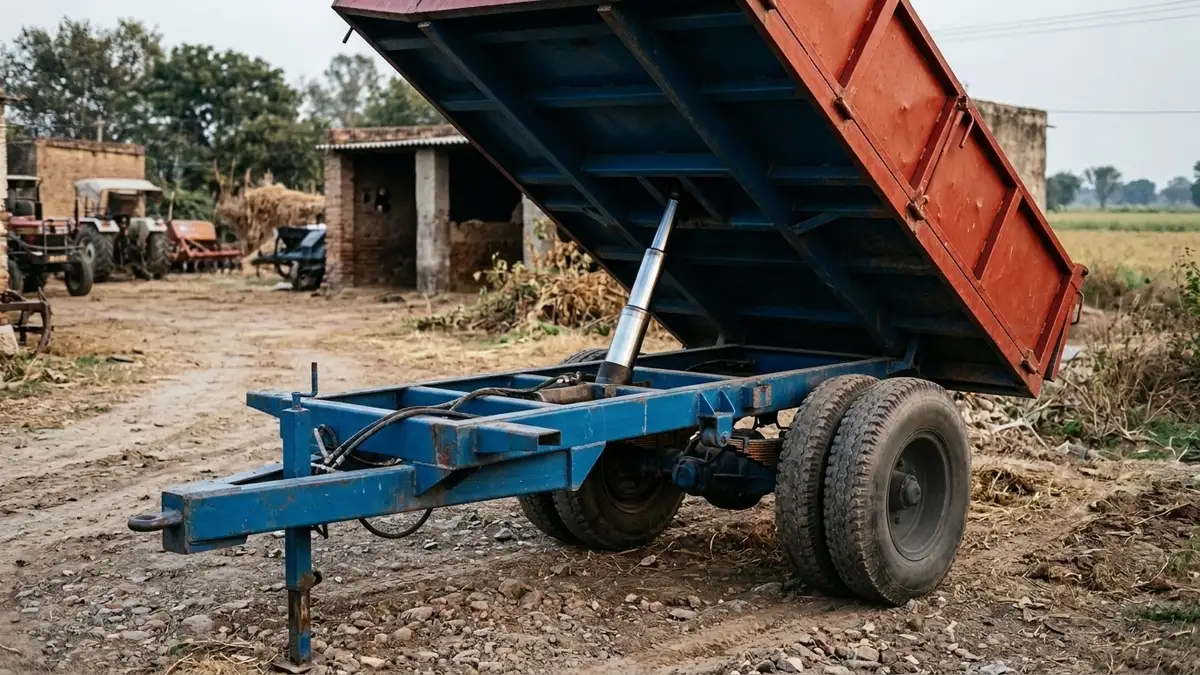
- Hydraulic Single-Side / Rear Tipping Trali: Uses a single-acting telescopic hydraulic cylinder (governed by BIS IS 12371) plugged into the tractor’s auxiliary spool valve (QRC coupler), dumping a 5-tonne grain or gravel load in under 60 seconds without manual shovel labor.
- Non-Tipping Mechanical Trali: Welded directly to the chassis frame with hinged drop-down side and tail gates; cheaper to buy and lighter in unladen weight, ideal for sacked wheat and paddy deliveries.
- Power Tiller Trailer (Track / Mini): Narrower 1.5–1.7 m track trailers tailored for power tillers navigating steep terrace hills and banana or tea plantations.
- Complementary Tractor Implements: Farmers financing a trali alongside field implements should review implement matching in our rotavator price and HP guide and farm equipment schemes overview.
BIS IS 8213 construction rules, axle strength & pre-buy weld inspection
Whenever you order a subsidy-eligible tractor trali or inspect a local fabrication unit, look past fresh red or blue paint and examine structural steel specs checked during FMTTI commercial testing under BIS IS 8213 (agricultural tractor trailers), IS 12371 (telescopic tipping rams), and IS 11270 (ring-type drawbar hitches).
- Minimum Ground Clearance: IS 8213 testing evaluates minimum axle/chassis clearance (≥300 mm) so loaded trailers do not belly-out across raised field bunds or deep harvest ruts.
- Chassis & Cross-Member Channel: Heavy-duty 5-ton+ tipping tralis use continuous rolled ISMC 125 or ISMC 150 mild steel C-channels with gusseted cross-ribs spaced every 18–24 inches underneath the floor pan.
- Floor & Side Sheet Thickness: Look for 8-gauge or 10-gauge (3.15–4.0 mm) floor plates and 12-gauge or 14-gauge (2.0–2.5 mm) corrugated side sheets that resist bulging under dense wet soil or grain.
- Hub, Bearing & Tyre Rating: Inspect forged square axles (75×75 mm or 90×90 mm), tapered roller wheel bearings, and ply ratings (9.00-16 or 10.00-20 heavy agricultural/truck tyres) matching rated Gross Vehicle Weight.
- Ring-Type Drawbar Eye (IS 11270): Ensure a forged swiveling drawbar eye with a locking safety pin and secondary tow chain—never rely on worn mild-steel flat plates welded onto the tongue.
CMVR Rule 93 dimensions, Parivahan RTO registration & road safety rules
Many rural disputes arise when police or RTO inspectors intercept unregistered trailers carrying produce onto state highways. Under the Central Motor Vehicles Rules, 1989 (CMVR) published by MoRTH and administered through Parivahan Sewa, trailers coupled to motor vehicles for public road haulage require formal RTO registration and safety fitments.
During registration (recorded in Form 23 / Form 29 / Form 30), the Regional Transport Office records the trailer’s overall length, width, height, axle count, tyre size, unladen weight, and Gross Vehicle Weight (GVW) certified under CMVR Rule 126. Under CMVR Rule 93 (Agriculture Category A), agricultural tractors are capped at 2.6 metres maximum width, 6.5 metres maximum length, and 3.8 metres maximum height, while a power tiller coupled with a trailer is capped at 1.7 metres width, 6.0 metres overall length, and 2.0 metres height.
- Retro-Reflective Safety Tapes & Lights: Fit amber side reflectors, red rear retro-reflective strips, and a 7-pin wiring harness linking trailer brake/tail indicators to the tractor dashboard—crucial during foggy night mandi runs.
- Avoid Illegal Overhangs: CMVR strictly restricts lateral or rear cargo overhangs beyond the certified trailer bed; overflowing straw or cane bundles must stay within the 2.6 m legal width envelope.
- Separate Registration & Insurance: Ensure your trali carries its own stamped chassis plate, GST invoice, Form 21/22 sale compliance from an approved manufacturer, and valid third-party insurance endorsement alongside your tractor.
Smart buying, mandi haulage ROI & agricultural loan planning
Owning a properly sized hydraulic trali pays off fastest during peak harvest windows when hiring outside transport costs steep per-trip fees. Farmers hauling wheat, paddy, or oilseeds directly to APMC yards can monitor gehu ka rate mandi trends, follow paddy procurement schedules, and compare regional arrivals on our daily mandi rates tracker so loads roll out on peak bidding days.
For smallholders upgrading both tractor and trailer together, check dealer comparisons across Mahindra tractor price lists, Sonalika tractor models, and John Deere tractors. Before signing a dealer loan, compute monthly or half-yearly harvest EMIs using our tractor & implement EMI calculator, check institutional eligibility via our farm loan eligibility checker, and explore structured rural credit options on our farmer loans advisory hub.
Frequently asked questions
- What is the difference between tractor trali and tractor trolley?
- Tractor trali (ट्रैक्टर ट्राली) and tractor trolley refer to the exact same agricultural haulage trailer hitched behind a farm tractor. Buyers searching "tractor trali" usually look for regional foot-based bed sizes (8×5 ft to 12×6 ft), hydraulic jack capacity, RTO norms, and complete tractor trolley price lists across Indian states.
- How much government subsidy is given on a tractor trali under SMAM 2026?
- Under the Revised SMAM Guidelines (October 2026) Annexure-I, small, marginal, SC/ST, women, and NE/Himalayan farmers get 50% subsidy (other farmers 40%) up to ₹75,000 for a trailer/trolley up to 3-ton capacity (40% group: ₹60,000) and ₹1,00,000 for up to 5-ton capacity (40% group: ₹80,000) when applied via agrimachinery.nic.in.
- What are the standard tractor trali sizes in feet for a 45–50 HP tractor?
- A 45 to 50 HP tractor—such as models compared in our Swaraj 744 FE guide—pairs best with a 10×6 ft (approx. 3.05 × 1.83 m) hydraulic 2-wheel or 4-wheel trali having 2 to 2.5 ft side walls, hauling roughly 5 to 8 tonnes safely across rural roads and mandi ramps.
- Is RTO registration mandatory for an agricultural tractor trali in India?
- Yes. Under the Motor Vehicles Act and Central Motor Vehicles Rules (CMVR) administered via Parivahan Sewa and MoRTH, trailers pulled by tractors on public roads require RTO registration (recording dimensions, axle count, tyre size, and GVW in Form 23), valid number plates, reflectors, and insurance.
- What are the CMVR Rule 93 maximum width and length limits for tractor trailers?
- Under CMVR Rule 93 (Agriculture Category A), an agricultural tractor is limited to 2.6 m maximum width, 6.5 m length, and 3.8 m height, while a power tiller coupled with a trailer cannot exceed 1.7 m width, 6.0 m length, and 2.0 m height. General road-going tractor-trailer combinations cannot exceed 2.6 m width.
- Should farmers buy a hydraulic tipping trali or a non-tipping trali?
- A hydraulic tipping trali (using an IS 12371 single-acting telescopic cylinder) costs more upfront than a fixed non-tipping trali, but unloads bulk grain, sand, or compost in under 60 seconds using the tractor’s spool valve—saving steep daily unloading labor charges during peak harvest arrivals.
- What is BIS IS 8213 for an agricultural tractor trali?
- IS 8213 is the Bureau of Indian Standards specification checked by FMTTIs (listed on farmech.dac.gov.in) for agricultural trailers. It covers 2-wheel and 4-wheel designs, minimum ground clearance (≥300 mm), steel sheet gauge thickness, safety markings, and drawbar ring hitches (IS 11270).
- Can I finance a tractor trali with a bank tractor loan?
- Yes. Commercial and cooperative banks frequently bundle an agricultural trali as an approved implement inside a composite tractor term loan. You can calculate combined monthly or harvest-linked repayments with our tractor loan EMI calculator and check state tractor subsidy eligibility.
- Tractor trali par SMAM yojana mein kitni subsidy milti hai?
- Revised SMAM Guidelines October 2026 ke anusar 3 ton tak ki trali par chhote-seemant, SC/ST aur mahila kisano ko ₹75,000 tak (50%) aur samanya kisano ko ₹60,000 tak (40%) subsidy milti hai. 5 ton tak ki trali par yeh seema ₹1,00,000 (50% group) aur ₹80,000 (40% group) hai.
- Chhote 25–35 HP tractor ke liye kaun si trali size sabse achhi rehti hai?
- 25 se 35 HP ke chhote ya mini tractor ke liye 8×5 feet ya 9×5.5 feet ki 2-wheel trali (3 se 4.5 ton kshamta) sabse surakshit rehti hai, kyunki badi 12×6 ft trali chadhayi par tractor ka agla hissa utha sakti hai aur clutch par zyada load daalti hai.
This article is for general information only and is not financial advice. Loan and scheme eligibility depends on partner and government criteria.