Gehu Ka Rate: Wheat Mandi Bhav, MSP & Price Across India

Key takeaways
- Indicative wholesale gehu ka rate across primary Indian APMC mandis (November 2026) trades between ₹2,460 and ₹2,740 per quintal for standard mill-quality wheat.
- For the 2025-26 Rabi marketing season (RMS 2026-27), the Government of India has approved the Minimum Support Price (MSP) for wheat at ₹2,425 per quintal, providing a guaranteed floor price for farmers.
- In Madhya Pradesh, premium GI-tagged Sehore Sharbati wheat commands a significant market premium, with aaj ka gehun ka rate trading between ₹3,400 and ₹4,150 per quintal in specialized mandis.
- In Uttar Pradesh, the gehu ka rate today across key processing hubs like Agra, Aligarh, and Kanpur settles between ₹2,480 and ₹2,700 per quintal under strong flour mill procurement.
- Under statutory Food Corporation of India (FCI) procurement specifications, wheat must contain less than 12% moisture, under 0.75% foreign matter, and less than 2% damaged grains for 100% MSP payout.
Indicative wholesale gehu ka rate across primary agricultural APMC mandis in India (November 2026) ranges between ₹2,460 and ₹2,740 per quintal for standard commercial mill-quality wheat as of 23 November 2026. In leading consumption and processing centers, the open-market gehun ka rate maintains a steady premium over the Central Government Minimum Support Price (MSP) of ₹2,425 per quintal. For cultivators inquiring gehun ka rate kya hai across Uttar Pradesh mandis, the gehu ka rate today settles between ₹2,480 and ₹2,700 per quintal across Agra, Aligarh, and Kanpur milling hubs, while premium golden Sharbati wheat from Madhya Pradesh commands ₹3,400 to ₹4,150 per quintal.
Wheat (Triticum aestivum), universally known across North and Central India as gehu or gehun, represents the staple backbone of national food security. Cultivated across more than 31 million hectares with national annual production exceeding 112 million metric tonnes, wheat is the premier Rabi winter cereal crop. Concentrated across the irrigated green belts of Uttar Pradesh, Madhya Pradesh, Punjab, Haryana, Rajasthan, and Bihar, wheat marketing operates through a dual-channel structure: direct government procurement at MSP through the Food Corporation of India (FCI) and state agencies (Markfed, Pungrain, HAFED), alongside dynamic commercial trading in regulated APMC mandis where private roller flour mills, biscuit manufacturers, and institutional food processors bid daily.
Gehu ka rate across major states: UP, MP, Punjab, Haryana, and Rajasthan
Domestic wheat pricing exhibits distinct regional characteristics determined by local flour mill density, arrival volumes, transportation logistics, and grain quality varieties (such as durum pasta wheat in Central India versus bread wheat in the Indo-Gangetic plains).
Below is an indicative price summary for standard commercial mill-quality wheat across major agricultural state mandis as of November 2026. Prices reflect physical spot transactions per quintal (100 kg) for Fair Average Quality (FAQ) grade grain.
| State / Agricultural Zone | Key APMC Mandis | Min Rate (INR/qtl) | Max Rate (INR/qtl) | Modal Rate (INR/qtl) | Dominant Wheat Variety |
|---|---|---|---|---|---|
| Madhya Pradesh (Malwa / Sehore) | Sehore, Ujjain, Dewas | ₹2,650 | ₹4,100 | ₹2,820 | Sharbati & Lok-1 Premium |
| Madhya Pradesh (Nimar / Central) | Hoshangabad, Vidisha, Harda | ₹2,500 | ₹2,850 | ₹2,680 | Lok-1 & Mill Quality |
| Uttar Pradesh (Braj / West) | Agra, Aligarh, Mathura | ₹2,520 | ₹2,720 | ₹2,620 | HD-2967, PBW-502 |
| Uttar Pradesh (Central / Awadh) | Kanpur, Lucknow, Hardoi | ₹2,480 | ₹2,680 | ₹2,580 | Mill Grade FAQ |
| Uttar Pradesh (Eastern Hub) | Varanasi, Gorakhpur, Basti | ₹2,460 | ₹2,640 | ₹2,540 | Commercial Milling Wheat |
| Rajasthan (Hadoti Belt) | Kota, Baran, Bundi | ₹2,550 | ₹2,800 | ₹2,680 | Raj-4037, Sharbati Mixed |
| Rajasthan (Shekhawati / Jaipur) | Jaipur, Chomu, Sikar | ₹2,520 | ₹2,750 | ₹2,640 | Kalyansona, HD-3086 |
| Punjab (Central Grain Belt) | Khanna, Ludhiana, Rajpura | ₹2,425 | ₹2,600 | ₹2,520 | HD-3086, DBW-187 (Karan Vandana) |
| Haryana (Karnal / Kurukshetra) | Karnal, Sirsa, Kaithal | ₹2,425 | ₹2,620 | ₹2,540 | DBW-222, WH-1105 |
| Gujarat (Saurashtra / North) | Rajkot, Gondal, Unjha | ₹2,550 | ₹3,100 | ₹2,750 | Durum (T. durum) Pasta Wheat |
| Bihar (Mithila / Magadh) | Gulabbagh, Patna, Muzaffarpur | ₹2,450 | ₹2,620 | ₹2,520 | Local Commercial Mill Grade |
Source: Indicative daily spot market prices compiled from Agmarknet (agmarknet.gov.in), State Agricultural Marketing Boards, and Food Corporation of India market reports, November 2026.
Farmers tracking agricultural market fluctuations can also check daily updates across our commodity intelligence guides, including [sarso ka bhav](/blog/sarso-ka-bhav/), [paddy procurement guidelines](/blog/paddy-procurement/), [cotton market rate today](/blog/cotton-market-rate-today/), [DAP fertilizer price](/blog/dap-fertilizer/), and [Saaf fungicide usage](/blog/saaf-fungicide/).
Sharbati gehun vs mill quality: why Sehore wheat commands ₹4,000+ per quintal
A notable phenomenon in Indian grain markets is the wide price divergence between standard milling wheat and premium Sharbati wheat. In markets like Sehore, Vidisha, and Ganjbasoda in Madhya Pradesh, the aaj ka gehun ka rate for genuine Sharbati trades between ₹3,400 and ₹4,150 per quintal—representing an extraordinary premium of ₹1,000 to ₹1,700 per quintal over standard commercial grains.
Sharbati wheat (C-306 variety and its pedigree descendants), officially recognized with a prestigious Geographical Indication (GI) tag for the Sehore region of Madhya Pradesh, possesses distinct agronomic and culinary superiority:
- Rainfed Clay Soil Cultivation: Sharbati is cultivated predominantly in the deep black cotton soils (vertisols) of the Malwa plateau under rainfed or single-irrigation conditions, which concentrates grain proteins and sugars.
- High Grain Luster & Weight: The grains are bold, hard, heavy, and have a distinct translucent amber-golden shine without chalkiness.
- Naturally Sweet Taste (Sharbati): High natural sugar content (glucose and sucrose) gives rotis made from Sharbati flour a distinctly sweet taste and soft texture that stays pliable for up to 24 hours.
- High Gluten Strength & Protein: Protein levels range between 13.5% and 14.5%, significantly higher than standard bread wheat (10.5% to 11.5%), driving insatiable consumer demand in metro retail flour markets (Delhi, Mumbai, Bengaluru).
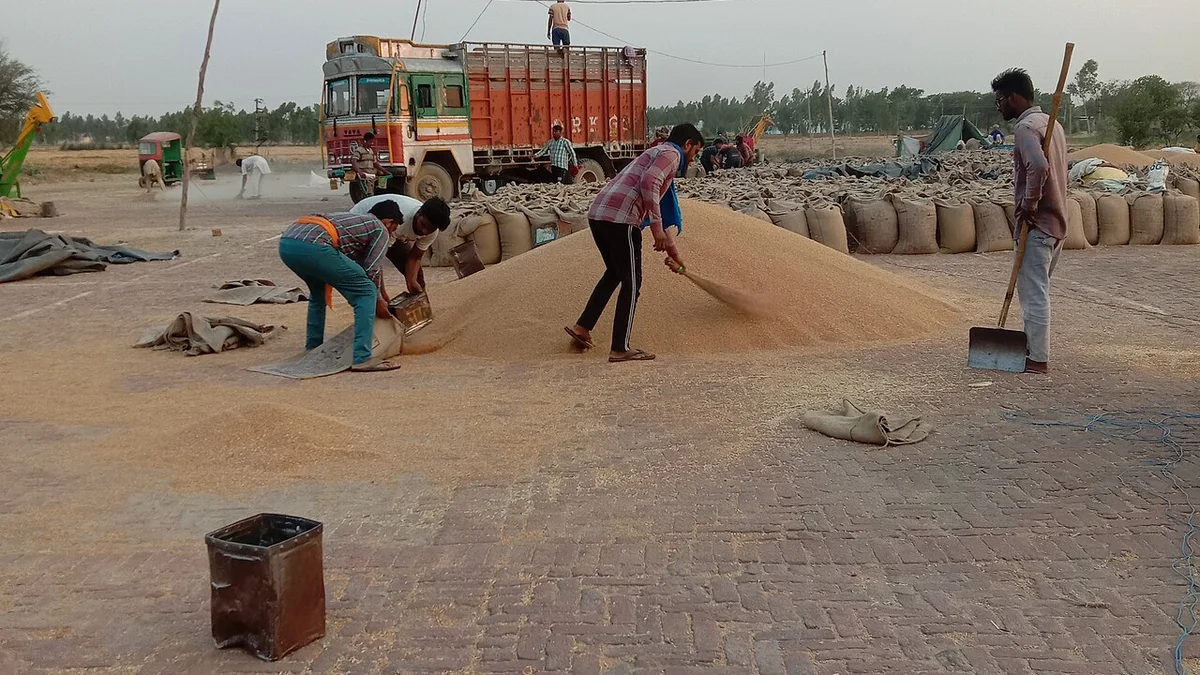
Government MSP benchmarks, FCI procurement, and FAQ quality standards
The Minimum Support Price (MSP) established by the Central Government serves as the statutory safety net preventing grain distress sales during peak harvest gluts. For the 2025-26 Rabi Marketing Season (RMS 2026-27), the Cabinet Committee on Economic Affairs (CCEA) approved an MSP of ₹2,425 per quintal for wheat, reflecting an increase of ₹150 per quintal over the prior season.
During the official procurement window (spanning March 15 to June 30 across states), the Food Corporation of India (FCI), along with state procurement agencies (Pungrain, Markfed, PSWC in Punjab; HAFED in Haryana; UP Food & Civil Supplies; MP Civil Supplies Corporation), establishes over 20,000 direct purchase centers. Payment is directly transferred via Aadhaar-linked Public Financial Management System (PFMS) into farmers’ bank accounts within 48 to 72 hours of weighment.
To avoid rejection or price deductions at government procurement centers, wheat produce must comply with statutory Uniform Specifications (FAQ standards) issued by the Department of Food and Public Distribution (DFPD):
- Moisture Content: Maximum permissible limit is 12.0 percent. Wheat containing between 12.1% and 14.0% moisture is accepted subject to proportional value cuts. Produce exceeding 14.0% moisture is rejected outright.
- Foreign Matter: Inactive foreign matter (dust, chaff, stones) must not exceed 0.75 percent by weight.
- Other Foodgrains (Admixture): Maximum 2.0 percent by weight.
- Damaged Grains: Maximum 2.0 percent by weight (including fungal infected, insect damaged, or sprouted grains).
- Slightly Damaged Grains: Maximum 4.0 percent by weight.
- Shrivelled & Immature Grains: Maximum 6.0 percent by weight.
Market dynamics driving daily gehun ka bhav fluctuations
Open-market gehun ka bhav in private APMC mandis fluctuates daily based on domestic demand-supply fundamentals, buffer stock releases by the government, and weather risks during grain filling:
- Open Market Sale Scheme (OMSS): To stabilize domestic retail flour (atta) prices, the Central Government periodically releases wheat from FCI buffer reserves into the open market via electronic weekly auctions (OMSS-D). High OMSS releases cap open-market mandi price spikes.
- Terminal Heat Risk During Grain Filling: In February and March, sudden unseasonal heatwaves (temperatures exceeding 35°C during milking and dough stages) can cause premature grain shrivelling, reducing national harvest yields and triggering immediate bullish rallies in mandi rates.
- Flour Mill & Industrial Processor Demand: India’s organized roller flour mills, bread manufacturers, and biscuit confectionery giants purchase millions of tonnes directly from mandis between July and January as local village supplies diminish.
- Government Buffer Stock Levels: The central pool buffer norm requires maintaining specific minimum stock reserves (approx. 21.4 million tonnes on July 1 and 13.8 million tonnes on January 1). When government reserves tighten, private traders bid aggressively.
Post-harvest grain storage, moisture management, and holding strategies
Harvesting wheat using combine harvesters often results in grain moisture levels between 13% and 16%, particularly in early morning harvesting or following late spring showers. To realize maximum market value or store wheat safely on the farm:
- Sun Drying to 10-11% Moisture: Before bagging or delivering to mandis, spread wheat on clean plastic tarpaulins in full sunlight for 2 to 3 days. Properly dried grain makes a sharp clicking sound when bitten between front teeth, confirming moisture under 11%.
- Airtight Hermetic Storage: To prevent devastating insect pests—such as the lesser grain borer (Rhyzopertha dominica) and rice weevil (Sitophilus oryzae)—store dried grain in sealed metal bins (Kothis) or multi-layer hermetic bags (PICS bags) without requiring toxic chemical fumigation.
- Seasonal Price Arbitrage: Historical price analysis demonstrates that wheat prices in October-December trade ₹180 to ₹350 per quintal higher than peak harvest prices in April-May. Farmers with proper on-farm storage or access to WDRA-registered warehouse receipt loans can capture this seasonal holding margin.
Official regulatory portals and grain marketing resources
To track verified daily arrivals and wholesale price trends across Indian grain terminals, growers can cross-examine real-time mandi price feeds on the Agmarknet Directorate of Marketing & Inspection. For statutory public procurement operations, the Food Corporation of India (FCI) publishes comprehensive procurement quotas, procurement centre allocations, and moisture deduction formulas. The Commission for Agricultural Costs & Prices (CACP) documents baseline production economics and MSP recommendations, while the Department of Food and Public Distribution (DFPD) oversees statutory uniform grain quality specifications across all state purchasing agencies.
Strategic farm planning, equipment matching, and financial tools
Farmers seeking comprehensive market analytics can explore our real-time mandi rates & market intelligence platform to compare wheat arrivals against complementary commodities such as sarso ka bhav, paddy procurement guidelines, cotton market rate today, and onion price trends. Proper input management during the sowing phase also relies on timely procurement of DAP fertilizer, disease management using Saaf fungicide, and pest suppression with broad-spectrum insecticides.
Modern mechanization significantly reduces post-harvest handling losses and speeds up land preparation for subsequent crops. Cultivators can review tractor specifications and competitive quotes across models such as the Sonalika tractor price list, Kubota 50 HP tractor specs, Mahindra tractor price list, and compact mini tractor models. Matching these prime movers with essential implements—including a heavy-duty rotavator, versatile power tiller, or high-pressure spray machine—optimizes diesel efficiency and field turnaround times.
To finance equipment upgrades and operational crop expenses, growers can utilize our intuitive financial calculators, including the tractor loan EMI calculator and the Kisan Credit Card (KCC) loan calculator. Explore our online agricultural loan eligibility checker and structured farmer loans assistance, or consult the interactive farm loan eligibility checker for customized credit evaluations.
Maximizing farm profitability also involves leveraging key central and state welfare initiatives. Browse the central and state government schemes directory, learn how to secure subsidized solar irrigation via the PM Kusum solar pump yojana, verify instalment records on the PM Kisan Samman Nidhi portal, match landholding eligibility through our AI scheme finder, and safeguard seasonal yields with PMFBY crop insurance. For complete mobile convenience, install the KisanPe super app for Android and discover why Indian farmers trust KisanPe for dependable agricultural intelligence. Learn more about KisanPe mission or reach our agronomist helpdesk via contact support.
For additional commodity tracking across agricultural markets, evaluate daily market summaries on sugar price, egg rate, mentha oil rate, and avocado price. Consult legal guidelines on terms of service and privacy policy.
Frequently asked questions about gehu ka rate and wheat marketing
Frequently asked questions
- What is the current gehu ka rate in India in 2026?
- In November 2026, the indicative gehu ka rate across primary Indian APMC mandis ranges between ₹2,460 and ₹2,740 per quintal for standard commercial mill-grade wheat. Premium varieties like Madhya Pradesh Sharbati wheat command ₹3,400 to ₹4,150 per quintal due to high natural protein and sweetness. Farmers can check verified daily wholesale arrivals and price fluctuations via our real-time mandi intelligence platform.
- What is the official Minimum Support Price (MSP) for wheat in 2025-26?
- The Central Government has fixed the Minimum Support Price (MSP) for wheat at ₹2,425 per quintal for the 2025-26 Rabi Marketing Season (RMS 2026-27), representing an increase of ₹150 per quintal over the prior year based on recommendations from the Commission for Agricultural Costs & Prices (CACP). The Food Corporation of India (FCI) and state agencies procure grain at this guaranteed floor price.
- What is the prevailing gehu ka rate today in Uttar Pradesh mandis?
- The gehu ka rate today in Uttar Pradesh ranges from ₹2,480 to ₹2,720 per quintal across major wholesale markets. Western UP mandis—such as Agra, Aligarh, and Mathura—trade between ₹2,520 and ₹2,720 per quintal under steady flour mill buying, while central and eastern UP mandis average ₹2,480 to ₹2,650 per quintal.
- Why does Sharbati gehu command a higher price than normal wheat?
- Sharbati gehun commands ₹3,400 to ₹4,150 per quintal (₹1,000 to ₹1,700 more than normal wheat) because it is grown in the mineral-rich black soils of the Sehore region under rainfed conditions. The grain has a golden luster, heavy grain weight, high protein content (13.5%–14.5%), and natural sugars that keep rotis soft and sweet.
- What is the maximum moisture content allowed for wheat procurement at MSP?
- Under statutory Department of Food and Public Distribution (DFPD) Uniform Specifications enforced by FCI, the maximum permissible moisture content for wheat procurement is 12.0 percent. Wheat with moisture between 12.1% and 14.0% is accepted subject to value deductions, while grain exceeding 14.0% moisture is rejected at procurement centers.
- What quality parameters must wheat meet to qualify for FCI procurement?
- To meet FCI Fair Average Quality (FAQ) standards, wheat must have: moisture below 12%, foreign matter below 0.75%, other foodgrain admixture below 2%, damaged grains below 2%, slightly damaged grains below 4%, and shrivelled/immature grains below 6% by weight.
- Which months offer the best prices for selling stored wheat?
- Wheat prices historically hit seasonal lows during the peak harvest glut between April and May. Mandi prices begin firming up from July onwards and reach seasonal peaks between October and January as local farm stocks deplete and commercial flour mills bid aggressively.
- How should farmers store wheat on the farm to prevent insect weevil damage?
- Wheat should be sun-dried until moisture drops below 10% to 11%. Store clean grain in airtight metal bins (Kothis) or multi-layered hermetic PICS bags on raised wooden pallets away from damp walls. Keeping grain airtight deprives storage pests (weevils and grain borers) of oxygen, preserving grain quality without chemical fumigation.
- Can farmers get bank loans by storing wheat in accredited warehouses?
- Yes. Farmers storing wheat in WDRA-accredited state or Central Warehousing Corporation (CWC) godowns receive an electronic Negotiable Warehouse Receipt (e-NWR). Commercial and cooperative banks provide pledge loans covering up to 70% to 75% of the grain valuation at concessional interest rates. Cultivators can calculate seasonal credit limits using our Kisan Credit Card (KCC) loan calculator or verify lending limits via the agricultural loan eligibility checker.
- What is the difference between bread wheat and durum pasta wheat?
- Bread wheat (Triticum aestivum) is standard gehu used for making chapatis, rotis, and bread flour. Durum wheat (Triticum durum), grown widely in Central India and Gujarat, has extremely hard, glassy amber grains high in gluten strength, used primarily for semolina (suji), pasta, macaroni, and noodles.
- How do Open Market Sale Scheme (OMSS) releases affect gehu mandi bhav?
- Under OMSS, the central government auctions surplus wheat from FCI buffer reserves to private flour mills during off-season months. High OMSS auction quantities increase market supply and cool down retail atta prices, dampening open-market mandi price spikes.
- Where can farmers check certified daily APMC wheat mandi rates online?
- Farmers can monitor certified daily arrivals, modal prices, and minimum/maximum rates across all notified APMC mandis nationwide on the Ministry of Agriculture’s Agmarknet portal and through the dedicated KisanPe mobile app dashboard.
This article is for general information only and is not financial advice. Loan and scheme eligibility depends on partner and government criteria.