Onion Price Today 2026: APMC Mandi Bhav & 1kg Rates
Key takeaways
- Indicative wholesale onion prices across primary APMC mandis in India (November 2026) range between ₹1,850 to ₹3,400 per quintal depending on quality grade, bulb diameter, and arrival moisture content.
- Benchmark Lasalgaon and Pimpalgaon APMC mandis in Nashik, Maharashtra record modal wholesale prices between ₹2,100 to ₹3,150 per quintal for premium Garva (Rabi stored) and fresh Kharif arrivals.
- Consumer retail onion prices across major metropolitan consumption hubs currently trade between ₹32 to ₹48 per 1 kg loose, with premium graded, mesh-bagged onions selling at ₹52 to ₹60 per kg in modern supermarkets.
- Price trends are heavily dictated by crop seasonality: Kharif (harvested October–December), Late Kharif/Rangada (January–March), and Rabi/Garva (April–June), with Rabi accounting for over 70 percent of annual production and storage reserves.
- The Central Government stabilizes domestic onion prices through buffer stock procurements managed by NAFED and NCCF, alongside strategic market interventions including Minimum Export Price (MEP) adjustments and retail subsidized distribution.
Indicative wholesale onion prices across major agricultural produce market committees (APMC) in India (November 2026) fluctuate between ₹1,850 and ₹3,400 per quintal, reflecting steady post-monsoon arrivals and the transition between stored Rabi buffer stocks and early Kharif crop harvests as of 23 November 2026. In terminal consumer markets, the average onion price per kg trades between ₹32 and ₹48 per kilogram in standard neighborhood wet markets, while sorted 1 kg onion retail packs in organized supermarkets command ₹50 to ₹60 per kg. Known colloquially across north and central India as pyaj ka rate, onion market rates remain one of the most closely watched food inflation metrics by agricultural economists, wholesale traders, and household consumers alike.
Onion (Allium cepa) is a staple culinary foundation across Indian households and an essential commercial cash crop for millions of smallholder farmers in Maharashtra, Madhya Pradesh, Karnataka, Gujarat, and Rajasthan. However, the domestic onion market is characterized by extreme price volatility driven by weather-induced harvest disruptions, perishability, seasonal supply gaps, and logistical intermediaries. Whether you are a cultivator tracking daily mandi realisations before loading trucks for sabji mandi wholesale auctions, a bulk restaurant procurement manager, or a consumer seeking transparent grocery price data, understanding the dynamics behind daily onion prices is crucial. This comprehensive guide details daily mandi bhav across India’s primary agricultural hubs, breaks down the retail price buildup per kilogram, outlines seasonal harvest cycles, and analyzes government market intervention measures.
Wholesale onion price by state: APMC mandi rates across India
India’s wholesale onion trading ecosystem centers around prominent primary producing districts—most notably the Nashik belt in Maharashtra, which accounts for over one-third of the nation’s total output—and major secondary terminal distribution mandis across Delhi NCR, West Bengal, Karnataka, and Tamil Nadu. Wholesale mandi prices are quoted in rupees per quintal (100 kilograms) and are determined through open outcry auctions or electronic e-NAM bidding based on bulb size, skin integrity, dryness, and rot percentage.
Below is an indicative snapshot of wholesale modal onion prices across India’s leading APMC mandis as recorded during the current marketing season. Wholesale buyers should note that modal prices represent the rate at which the maximum volume of produce changed hands on a given trading day.
| State / APMC Market Hub | Primary Variety / Grade | Min Price (Rs/Qtl) | Max Price (Rs/Qtl) | Modal Bhav (Rs/Qtl) | Equivalent Wholesale (Rs/Kg) |
|---|---|---|---|---|---|
| Maharashtra (Lasalgaon APMC) | Nashik Red / Garva | 1,650 | 3,350 | 2,650 | 26.50 |
| Maharashtra (Pimpalgaon Baswant) | Red Medium / Pol | 1,700 | 3,400 | 2,720 | 27.20 |
| Maharashtra (Pune / Gultekdi) | Super & Golta Mix | 1,800 | 3,200 | 2,550 | 25.50 |
| Maharashtra (Solapur APMC) | Local Red / White | 1,500 | 2,900 | 2,300 | 23.00 |
| Delhi NCR (Gazipur Sabji Mandi) | Graded Nashik / Rajasthan | 2,400 | 3,850 | 3,100 | 31.00 |
| Delhi NCR (Azadpur APMC Terminal) | Grade A Medium Bulbs | 2,500 | 3,950 | 3,200 | 32.00 |
| Madhya Pradesh (Indore Choithram) | Malwa Red Special | 1,750 | 3,100 | 2,450 | 24.50 |
| Madhya Pradesh (Neemuch Mandi) | Local Desi Red | 1,600 | 2,950 | 2,350 | 23.50 |
| Karnataka (Yeshwanthpur, Bengaluru) | Bellary / Hubballi Red | 2,200 | 3,600 | 2,900 | 29.00 |
| Rajasthan (Muhana Mandi, Jaipur) | Alwar Fresh Kharif Red | 1,900 | 3,300 | 2,600 | 26.00 |
| West Bengal (Koley Market, Kolkata) | Transit Inward Nashik | 2,600 | 4,100 | 3,450 | 34.50 |
| Tamil Nadu (Koyambedu, Chennai) | Bellary Red / Dindigul Shallot | 2,450 | 3,800 | 3,150 | 31.50 |
Source: Indicative daily modal price ranges aggregated from Directorate of Marketing and Inspection (Agmarknet), State Agricultural Marketing Boards, and local APMC market notices, November 2026.
Notice how wholesale modal rates in transit destination markets like Kolkata, Delhi, and Chennai command a premium of ₹500 to ₹900 per quintal over origin mandis like Lasalgaon and Solapur. This difference reflects freight tariffs, interstate transit tolls, handling and loading charges, and standard transit weight shrinkage due to natural moisture loss. For growers tracking alternative agricultural markets, consult our comprehensive analyses on mentha oil rate, mentha oil rate today, and cotton market rate today.
Onion 1kg price: retail consumer rates across metro and tier-1 cities
While commercial traders and aggregators evaluate prices in quintals or metric tonnes, ordinary households and kitchen managers track the onion 1kg price. The retail price per kilogram incorporates the wholesale acquisition cost plus multiple distribution layers: interstate transport, city APMC loading/unloading levies, wholesaler margins, local semi-wholesaler markups, neighborhood cart vendor expenses, and spoilage allowances.
Under normal supply conditions, the consumer onion price per kg trades at a 30 to 50 percent markup over local wholesale mandi bhav. However, during localized shortfalls or excessive rainfall in harvesting belts, retail spreads can widen significantly as vendors factor in shelf-life shrinkage. The table below outlines the retail 1 kg onion price range across major Indian cities.
| City / Metropolitan Region | Loose Wet Market Rate (Rs/Kg) | Organized Supermarket (Rs/Kg) | Quick Commerce Delivery (Rs/Kg) | Predominant Market Source |
|---|---|---|---|---|
| Mumbai & Navi Mumbai | 32 - 38 | 40 - 46 | 42 - 50 | Nashik & Ahmednagar Mandis |
| Delhi NCR (Noida, Gurgaon) | 35 - 42 | 44 - 52 | 45 - 55 | Nashik, Alwar & Neemuch APMC |
| Bengaluru Urban | 34 - 40 | 42 - 48 | 44 - 52 | Bellary, Chitradurga & Hubli |
| Hyderabad & Secunderabad | 32 - 38 | 38 - 45 | 40 - 48 | Kurnool & Mahbubnagar Hubs |
| Kolkata & Howrah | 38 - 46 | 48 - 56 | 50 - 58 | Inward transit via Maharashtra / MP |
| Chennai Metropolitan | 36 - 44 | 45 - 54 | 48 - 58 | Dindigul, Bellary & Nashik Red |
| Ahmedabad & Surat | 30 - 36 | 36 - 44 | 38 - 48 | Bhavnagar, Mahuva & Junagadh |
| Jaipur & Ajmer | 32 - 38 | 40 - 48 | 42 - 50 | Muhana Mandi & Alwar belts |
| Lucknow & Kanpur | 34 - 40 | 42 - 50 | 44 - 52 | Gazipur transit & MP arrivals |
| Patna & Gaya | 36 - 44 | 45 - 52 | 46 - 54 | Nasik arrivals & local Chhapra belts |
Source: Department of Consumer Affairs (DOCA Price Monitoring Cell) daily retail commodity reports, November 2026.
When ordering through instant grocery apps (such as Blinkit, Zepto, or Instamart), consumers typically pay a modest convenience premium of ₹4 to ₹8 per kg above wet market pyaj ka rate. This covers micro-warehouse sorting, grading, anti-microbial wash, breathable perforated packaging, and rapid doorstep delivery logistics. For farmers planning diversified field operations alongside onion rotations, exploring high-value alternatives like avocado price trends, kaju price dynamics, and anjeer price benchmarks provides helpful economic perspective.
Understanding onion varieties and commercial grading specifications
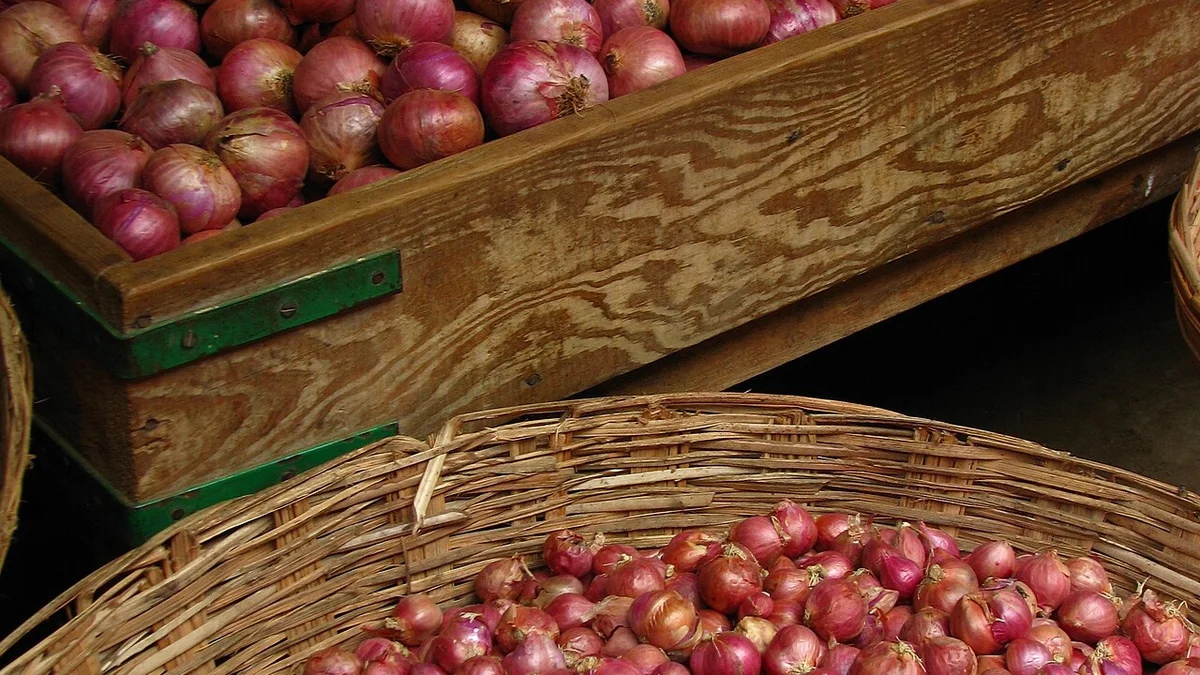
Not all onions fetch the same price in the agricultural market. In wholesale trade, commodities are separated based on bulb diameter, color intensity, pungency, dry outer tunic thickness, and intended consumption channel. Familiarity with these grades enables growers to secure maximum auction bids and helps commercial buyers purchase the correct grade for their operational needs.
1. Commercial bulb size classification
- Special / Super Quality (55 mm to 80 mm+ diameter): Large, uniform, firm bulbs with dry, intact reddish skin and negligible neck thickness. These bulbs represent the top 15 to 20 percent of mandi arrivals and command premium rates from hotel chains, caterers, and export packing houses.
- Medium / General Grade (40 mm to 55 mm diameter): The standard commercial grade preferred by urban households and neighborhood retail vendors. They offer balanced portion size, minimal peeling waste, and robust shelf stability.
- Golta / Small Grade (30 mm to 40 mm diameter): Medium-small round bulbs commonly purchased for curries, gravies, and restaurant cooking. They sell at a 15 to 25 percent discount compared to Super Grade bulbs.
- Golti / Pickling Grade (20 mm to 30 mm diameter): Smallest button bulbs used predominantly in vinegar pickling, food processing industries, or lower-income culinary markets.
- Chhata / Reject Grade: Deformed, double-bulb (split), bruised, or sprouting specimens sold at substantial discounts (up to 50 percent below modal rates), primarily channeled into municipal animal feed blending or local roadside eateries.
2. Major agronomic varieties cultivated in India
Indian farmers cultivate specific cultivars suited to varying soil types and climate zones. Prominent varieties developed by the Indian Council of Agricultural Research (ICAR) and the National Horticultural Research and Development Foundation (NHRDF) include:
- Bhima Super & Bhima Red: High-yielding red varieties characterized by deep attractive color, moderate pungency, and adaptability to both Kharif and late Kharif sowing across Maharashtra, Karnataka, and Gujarat.
- Bhima Dark Red: Rich crimson bulbs widely preferred by North Indian retail mandis like Azadpur and Gazipur, offering excellent market eye appeal.
- Bhima Kiran & Bhima Shakti: Specifically bred Rabi season varieties with dense internal rings and thick outer protective scales, engineered for extended 5 to 6-month storage in farm-level structures.
- Agrifound Dark Red & Light Red: NHRDF standards recognized for uniform globular shape, strong flavor profile, and wide ecological tolerance from Punjab to Bihar.
- White Onion (Bhima Shweta / Agrifound White): High total soluble solids (TSS 12-14%) cultivars cultivated predominantly in Bhavnagar and Mahuva (Gujarat) for dehydration, onion flake processing, and industrial powder manufacturing.
- Bangalore Rose & Bellary Red: Renowned round-flat bulbs with high dry-matter content, cultivated intensively in Karnataka and largely directed toward maritime export markets in Malaysia, Singapore, and Sri Lanka.
Cultivators seeking complete seed sourcing and package of agronomic practices can refer to our companion agronomy guide on onion seeds cultivation and nursery management.
Crop seasonality: why pyaj ka rate fluctuates throughout the year
Unlike grain staples such as wheat or rice that can be preserved in standard Central Warehousing Corporation silos for years, onions are semi-perishable bulbs with high initial moisture (80 to 85 percent). In India, production is divided across three distinct agricultural cropping seasons, each playing a distinctive role in price discovery throughout the calendar year.
| Cropping Season | Nursery / Transplanting | Harvesting Window | Share of National Output | Storage Potential & Market Role |
|---|---|---|---|---|
| Rabi (Garva / Unhali) | Nov - Dec transplanting | March to May | 65% - 70% | High (5-6 months); forms national buffer reserves |
| Kharif (Pol / Rainy) | July - August transplanting | October to December | 15% - 20% | Very low (15-30 days); high moisture, sold immediately |
| Late Kharif (Rangada) | Sept - Oct transplanting | January to March | 12% - 15% | Moderate (30-45 days); bridges Kharif-Rabi transition |
Source: National Horticulture Board (NHB) Horticultural Statistics Division, Crop Season Calendar.
The seasonal price trajectory explained
- April to June (Peak Glut & Lowest Prices): The bumper Rabi crop arrives in massive quantities. Daily arrivals at Lasalgaon often cross 30,000 to 50,000 quintals per day. Wholesale prices hit their lowest levels of the year. Farmers store approximately 60 to 70 percent of their harvest in ventilated on-farm storage sheds (known as kanda chawls).
- July to September (Gradual Hardening): Fresh arrivals cease entirely. The nation consumes stored Rabi onions. As storage progresses, natural desiccation, sprouting, and fungal rotting cause cumulative physical weight losses of 25 to 35 percent. Mandi prices begin an upward trajectory to compensate for storage shrinkage.
- October to December (Vulnerable Supply Gap & Price Spikes): Stored Rabi reserves deplete to critical lows while fresh Kharif arrivals begin trickling in. If late monsoon rains, cyclonic weather, or flash floods damage standing Kharif fields in Maharashtra or Karnataka, market supplies contract abruptly, causing sharp upward price spikes in consumer markets.
- January to March (Stabilization): Late Kharif (Rangada) arrivals flood northern and western mandis in full volume. Supply shortfalls ease, and wholesale prices moderate down toward normal historical baselines.
Proper farm equipment and seed bed preparation are essential for maximizing crop yields across both Kharif and Rabi cycles. Learn more about effective soil tillage with our guide on rotavator implements and compact farm tractors like the mini tractor and mini tractor price list.
Government price stabilization: buffer stocks, NAFED & export policies
Because onion constitutes a significant weight in the Consumer Food Price Index (CFPI) and represents an emotionally resonant kitchen staple for Indian voters, the Central Government closely monitors wholesale and retail price fluctuations through an active policy intervention toolkit.
1. Strategic buffer stock procurement (NAFED and NCCF)
Under the Price Stabilization Fund (PSF) administered by the Department of Consumer Affairs, the government mandates central agencies—chiefly the National Agricultural Cooperative Marketing Federation of India (NAFED) and the National Cooperative Consumers Federation of India (NCCF)—to procure between 3 to 5 lakh metric tonnes of Rabi onion directly from farmers and farmer producer organizations (FPOs) during the peak April-June harvest.
These buffer stocks serve two complementary economic purposes:
- Farmgate Price Protection: Purchasing large volumes during harvest gluts prevents distressed farmgate sales below production costs when mandi yards are overwhelmed with supply.
- Targeted Market Release: During festive autumn supply crunches (September–November), the buffer stock is systematically dispatched by rail rake to major consuming metropolitan centers and retailed at subsidized rates (typically ₹25 to ₹35 per kg) through mobile vans and cooperative retail outlets (Kendriya Bhandar, Safal, and NCCF vans).
2. Trade policy levers: MEP and export duties
To balance foreign exchange earnings for exporters against domestic food affordability, the Directorate General of Foreign Trade (DGFT) adjusts foreign trade regulations in response to domestic price signals:
- Minimum Export Price (MEP): Setting a high floor price (e.g., $550 to $800 per metric tonne) below which overseas exports are prohibited, ensuring that only high-premium foreign buyers purchase Indian onions.
- Export Duties: Imposing customs export levies (such as 20% to 40% ad valorem duty) to slow overseas shipments during domestic shortages without outright prohibition.
- Export Bans & Open License Windows: During severe domestic inflationary crises, exports are paused completely under DGFT notifications, only to be reinstated as duty-free open general licenses once the new harvest reaches terminal mandis.
Farmers registered for central welfare support can also check their financial installment updates through our guides on pm kisan status check, pm kisan installment date, and state portals like the mp kisan portal.
Post-harvest storage: how kanda chawls protect farmer realisations
For an onion farmer, timing market sales is just as critical as maximizing field yield. Selling the entire Rabi harvest in April guarantees the lowest annual price. Conversely, storing onions until August or October can double net revenues—provided storage losses are kept within manageable thresholds.
Traditional cold storage facilities (used for potatoes and apples) are poorly suited for standard onions due to high humidity, which triggers rapid root sprouting and fungal rotting upon retrieval. Instead, Indian farmers rely on scientific naturally ventilated structures known as Kanda Chawls (ventilated onion storage godowns).
Key principles of effective onion storage
- Curing & Neck Closure: Freshly harvested bulbs must undergo 3 to 5 days of field curing under shade to allow outer scales to dry completely and necks to seal tightly, preventing microbial entry.
- Raised Perforated Flooring: Storage platforms must be raised 1.5 to 2 feet above ground level using wooden slats or bamboo mesh to allow continuous bottom-to-top air circulation.
- Stack Height Limits: Onion stack height should never exceed 4 to 5 feet inside the chawl. Excessive stack weight crushes bottom bulbs, causing juice leakage and secondary fungal infection.
- Moisture & Temperature Control: Optimum storage conditions require 65 to 70 percent relative humidity and temperatures below 30°C. Thatched roofs or insulated double-roof asbestos layouts help deflect solar radiation.
- Capital Subsidies: Under the National Horticulture Mission (NHM) and State Horticulture Departments, farmers can secure 50 percent capital subsidies (up to ₹87,500 for a standard 25 MT capacity ventilated godown).
Farmers managing livestock or poultry alongside horticulture operations can explore our detailed economics breakdowns on today egg price trends, Barwala egg rates, and indigenous dairy breeds in our guide on Gir cow dairy farming. Field mechanization choices can be evaluated with our mini tractor buyer guide and rotavator implement matching matrix.
For regional vegetable and fruit market arrivals, explore our daily intelligence on Gazipur Sabji Mandi wholesale distributions, grain terminal trade in anaj mandi hubs, and specialized spice arrivals in Neemuch Mandi bhav. Agriculturalists can also reference daily commodity auctions on the Agmarknet Portal, inflation tracking by the Department of Consumer Affairs (DOCA), buffer procurement guidelines from NAFED, and horticulture subsidies via the National Horticulture Board (NHB).
Frequently asked questions about onion price and mandi rates
Frequently asked questions
- What is the wholesale onion price today in Lasalgaon APMC?
- Indicative modal wholesale onion prices in Lasalgaon APMC (Nashik) currently trade between ₹2,100 and ₹3,150 per quintal (₹21 to ₹31.50 per kg) for standard commercial grades as of November 2026. Premium large-diameter bulbs fetch up to ₹3,400 per quintal, while smaller Golta grades clear around ₹1,700 to ₹2,200 per quintal. Compare daily market movements on our mandi rates portal.
- What is the current retail onion 1kg price in metropolitan cities?
- The average retail 1 kg onion price in Indian metro cities ranges from ₹32 to ₹48 per kg in local vegetable markets. Branded, graded, and mesh-bagged onions sold via supermarkets and quick-commerce delivery apps trade between ₹44 to ₹58 per kg depending on packaging and delivery convenience. Check regional arrivals in our Gazipur Sabji Mandi report.
- Why does pyaj ka rate fluctuate so dramatically compared to wheat or rice?
- Onions have high natural water content (80-85%) and cannot be stored indefinitely in conventional grain silos. Furthermore, over 65% of production is concentrated in just three states (Maharashtra, Madhya Pradesh, and Karnataka). Any localized rainfall disruption during harvest or disease outbreak creates immediate supply shortages in consuming centers, driving sharp price surges.
- How many kilograms are in one quintal of onions?
- One quintal equals exactly 100 kilograms. Therefore, to convert wholesale mandi prices quoted in rupees per quintal to the equivalent price per kilogram, divide the quintal rate by 100 (for example, ₹2,800 per quintal equals ₹28.00 per kg wholesale base rate).
- Which season produces the onions with the longest storage life?
- The Rabi (Garva or Unhali) crop harvested between March and May has the highest dry matter content, lowest initial moisture, and thickest protective skin scales. When cured properly and placed in ventilated kanda chawls, Rabi onions can be stored safely for 5 to 6 months without rotting or premature sprouting.
- Where can farmers check official daily onion mandi prices?
- Farmers can track verified daily wholesale auction rates on Agmarknet (agmarknet.gov.in), the e-NAM national portal (enam.gov.in), state agricultural marketing board websites (such as MSAMB in Maharashtra), and the KisanPe mandi commodity updates page.
- What is the role of NAFED and NCCF in controlling onion prices?
- NAFED and NCCF manage the central government's Price Stabilization Fund (PSF) buffer stock. As detailed on the NAFED official portal, they procure 3 to 5 lakh metric tonnes of Rabi onions directly from farmers during peak harvest to support farmgate rates, and release this stock at subsidized prices in high-demand metro markets during autumn supply shortages to tame consumer inflation.
- What is the difference between Red Onion and White Onion?
- Red onions have higher anthocyanin pigments, strong pungency, and form the bulk of domestic culinary consumption. White onions have higher total soluble solids (TSS), a sweeter flavor profile, and are primarily cultivated in Gujarat for commercial dehydration into flakes, kibbles, and powder for export.
- Does the government provide subsidies for building onion storage structures?
- Yes. Under the Mission for Integrated Development of Horticulture (MIDH) and State Horticulture Missions overseen by the National Horticulture Board, farmers are eligible for a 50 percent capital cost subsidy (up to ₹87,500 for a standard 25-tonne capacity naturally ventilated onion godown).
- What factors cause storage losses in harvested onions?
- Storage losses stem from three primary causes: physiological weight loss (moisture evaporation through respiration, 15-20%), fungal rotting (black mold, bacterial soft rot, 8-15%), and sprouting triggered by high humidity (5-10%). Good curing and adequate ventilation limit these losses.
- What are the statutory mandi commission charges for farmers selling onions in APMC yards?
- Under modern APMC model acts across most major agricultural states (including Maharashtra and MP), the statutory buyer commission is paid by wholesale traders/purchasers, not by farmers. Farmers are entitled to 0% commission deductions on their gross auction sales, paying only nominal unloading/weighing charges.
- How do export restrictions like Minimum Export Price (MEP) impact domestic onion prices?
- Imposing a high Minimum Export Price (MEP) or export tariffs makes Indian onions expensive in international markets, discouraging overseas shipments and retaining produce within the domestic market. This increases local supply and helps cool down domestic retail onion prices.
This article is for general information only and is not financial advice. Loan and scheme eligibility depends on partner and government criteria.