Bhawani Mandi Rajasthan Mandi Bhav, Timings & Guide
Key takeaways
- Bhawani Mandi, located in Jhalawar district on the border of Rajasthan and Madhya Pradesh, is recognized as North India’s premier commercial trading terminal for mandarin oranges (Nagpur and Jhalawar Santra) alongside major Kharif and Rabi cash crops.
- Under the Rajasthan Agricultural Produce Markets Act, 1961, farmer produce arriving at Bhawani Mandi Krishi Upaj Mandi is subject to 0% farmer commission; the statutory market fee (mandi shulk) is levied exclusively on registered commission agents and buyers.
- Daily open outcry and e-NAM digital auctions operate Monday through Saturday starting at 08:30 AM, with peak orange seasonal auctions running round-the-clock during the Ambia and Mrig Bahar harvests.
- Key commodities traded by volume include Nagpur oranges, yellow soybean (JS 9560, JS 2034), black mustard seed (Sarson), coriander seeds (Badami and Eagle grade Dhaniya), garlic (Desi and Ooty varieties), and Sharbati wheat.
- Direct digital settlements via e-NAM (enam.gov.in) and RTGS/NEFT ensure transparent weighment receipts from calibrated weighbridges and guaranteed same-day payment release to cultivators.
Bhawani Mandi stands as one of western India’s most commercially vibrant agricultural trading terminals, uniquely positioned right along the border of Jhalawar district in Rajasthan and Mandsaur and Agar Malwa districts in Madhya Pradesh. Famous across the country for its unique railway station—where the northern half of the platform lies in Rajasthan and the southern half in Madhya Pradesh—Bhawani Mandi’s Krishi Upaj Mandi Samiti (APMC) serves as the primary commercial outlet for hundreds of thousands of farmers across the Hadoti and Malwa agro-climatic zones.
While the market handles extensive volumes of traditional oilseeds, foodgrains, and spices, Bhawani Mandi is globally renowned as the orange capital of Rajasthan. The fertile black basalt soils and microclimate of Jhalawar produce premium-grade mandarin oranges (Citrus reticulata) that rival Maharashtra’s famous Nagpur orchards in juice sweetness, rind shine, and shelf life. During peak harvesting seasons, hundreds of truckloads dispatch fresh oranges daily to wholesale consuming markets in Delhi, Mumbai, Kolkata, Lucknow, Jaipur (Muhana Mandi Jaipur), and export channels into Bangladesh and Nepal. For cultivators and traders seeking reliable market intelligence, tracking live prices on our live mandi rates ticker or the official Agmarknet portal is essential to securing maximum farmgate realization.
Strategic Geographical Importance of Bhawani Mandi APMC
The extraordinary geographic footprint of Bhawani Mandi gives it a distinct logistical advantage over inland mandis. Situated along major railway trunk lines linking Mumbai and Delhi (Western Railway division) and well connected by state highways to NH-52 (Kota-Jhalawar-Indore corridor), the mandi provides seamless inter-state transit for agricultural produce. Cultivators from border tehsils of both Rajasthan (Pirawa, Pachpahar, Gangdhar, Jhalrapatan) and Madhya Pradesh (Shamgarh, Garoth, Bolia, Bhanpura, Susner) transport their harvest directly into Bhawani Mandi.
Because agricultural consignments frequently cross the state boundary to reach the auction yard, the Rajasthan State Agricultural Marketing Board (RSAMB) maintains specialized border entry gates. Under inter-state agricultural transit regulations governed by the Department of Agriculture & Farmers Welfare (DA&FW), farmers transporting genuine homegrown produce face zero road cess or state border entry taxes. Farmers simply show their Kisan credit card, land holding documents, or portal registration at checkposts for unobstructed passage to the auction yards.
Key Commodities Traded at Bhawani Mandi: Quality Grades and Specifications
Agricultural arrivals at Bhawani Mandi are broadly categorized into three distinct seasonal streams: the high-volume orange trading window, Kharif oilseeds and pulses, and Rabi foodgrains, mustard, and spices. Each commodity undergoes thorough visual and electronic moisture testing before auction lots are assembled.
1. Mandarin Oranges (Jhalawar & Nagpur Santra)
Jhalawar district accounts for more than two-thirds of Rajasthan’s total citrus acreage, with Bhawani Mandi operating as the nerve center for orange commerce. The orange crop arrives in two primary flushes known botanically and commercially as "Ambia Bahar" (flowering in spring, harvesting from September to December) and "Mrig Bahar" (flowering in monsoon, harvesting from February to April). Ambia Bahar fruit features thin rinds and a high juice-to-pulp ratio, making it the preferred choice for major juice processors and urban fruit mandis like Delhi’s Azadpur and Jaipur’s Muhana Mandi.
Orange lots are sorted by diameter and cosmetic surface grade: "Super" (70 mm+ diameter, spotless golden rind), "Special" (60–70 mm, minimal blemish), and "Goli / Chhoti" (sub-55 mm, intended primarily for industrial juice extraction). Prices fluctuate based on ambient temperature, truck availability, and export demand across borders.
2. Yellow Soybean (JS 9560, JS 2034, NRC 37)
Soybean constitutes the backbone of Kharif arrivals across the Hadoti belt. Cultivators harvest varieties like JS 9560 for early maturity (85–90 days) and JS 2034 for drought resistance. At Bhawani Mandi, soybean lots are evaluated primarily on moisture content (statutory benchmark ≤ 10%), oil content (minimum 18.5%), and the percentage of foreign matter (dust, pod shells, split seeds). Lots exceeding 12% moisture face mechanical deduction or trader price cuts to prevent rancidity in crushing mills across Kota and Indore. Farmers can plan basal nutrient applications with our fertilizer calculator to optimize grain oil content.
3. Mustard Seed / Rai (Sarson)
Rajasthan is India’s foremost mustard producer, and Bhawani Mandi witnesses massive Rabi arrivals from February through May. Black and brown mustard varieties (Pusa Bold, Giriraj, Pioneer hybrids) are graded by oil percentage (benchmark 40–42%) and seed dryness. Higher oil percentage commands premiums of ₹150 to ₹300 per quintal over baseline Minimum Support Price (MSP) levels.
4. Coriander / Dhaniya (Badami, Eagle & Scooter Grades)
The Hadoti region is celebrated for producing premium aroma coriander seed. At Bhawani Mandi, coriander arrivals are classified under established commercial grades: "Badami" (light brown dried seed for everyday ground spices), "Eagle" (uniform greenish-brown whole seed with high volatile essential oil content), and "Scooter / Green" (hand-picked, shade-dried whole green coriander commanding top domestic and export market prices).
5. Garlic (Lahsun) and Pulses
Cultivators from nearby Jhalrapatan, Manoharthana, and MP tehsils bring Desi white garlic and high-bulb diameter Ooty garlic varieties. Grading is based on clove firmness, white bulb count, and absence of fungal neck rot. Pulses including Chana (Bengal gram) and Urad (black gram) arrive in volume following the post-winter harvests.
Indicative Wholesale Price Ranges at Bhawani Mandi
Wholesale prices at agricultural mandis vary daily according to seasonal harvest arrivals, mill processing tenders, export freight logistics, and global commodity movements. The following benchmark table provides indicative wholesale price ranges based on official market returns registered with the Directorate of Marketing & Inspection and the Rajasthan State Agricultural Marketing Board. You can also compare rates across state markets on our vegetable mandi rates directory:
| Commodity | Variety / Grade | Arrival Season | Modal Range (₹/Quintal) | MSP Benchmark (₹/Qtl) |
|---|---|---|---|---|
| Mandarin Orange (Santra) | Super Grade (70mm+) | Oct – Dec / Feb – Apr | ₹4,800 – ₹7,200 | Not Applicable |
| Mandarin Orange (Santra) | Special / Commercial | Oct – Dec / Feb – Apr | ₹3,200 – ₹4,600 | Not Applicable |
| Yellow Soybean | FAQ Grade (JS 9560) | Sep – Dec | ₹4,150 – ₹4,750 | ₹4,892 (2024-25) |
| Mustard / Sarson | 40-42% Oil Content | Feb – Jun | ₹5,300 – ₹5,950 | ₹5,950 (2025-26) |
| Coriander (Dhaniya) | Badami / Commercial | Mar – Jul | ₹6,400 – ₹7,300 | ₹7,600 (Ind. Range) |
| Coriander (Dhaniya) | Eagle / Green Export | Mar – Jul | ₹7,800 – ₹9,600 | ₹7,600 (Ind. Range) |
| Garlic (Lahsun) | Desi Medium Bulb | Mar – Aug | ₹6,500 – ₹11,000 | Not Applicable |
| Garlic (Lahsun) | Special Bold Box Lot | Mar – Aug | ₹12,000 – ₹18,500 | Not Applicable |
| Wheat (Gehun) | Sharbati / Mill Grade | Mar – Jun | ₹2,350 – ₹2,900 | ₹2,425 (2025-26) |
| Chana (Bengal Gram) | Desi FAQ Standard | Mar – Jun | ₹5,500 – ₹6,200 | ₹5,650 (2025-26) |
Source: Directorate of Marketing & Inspection (agmarknet.gov.in) & Rajasthan State Agricultural Marketing Board (rsamb.rajasthan.gov.in). Indicative wholesale price ranges, November 2026. For live transaction bids on specific auction lots, growers are encouraged to consult registered APMC commission agents or the e-NAM portal.
Daily Mandi Operations: Gate Entry, Auctions, and e-NAM Trading
Navigating Bhawani Mandi efficiently requires farmers to understand the standard operating protocols established by the Krishi Upaj Mandi Samiti. Smooth participation avoids unnecessary unloading delays, parking demurrage, and arbitrary weight deductions.
Step 1: Gate Entry & Automated Weighbridge Token (04:00 AM – 08:00 AM)
Laden tractor-trolleys, pickup trucks, and commercial transport vehicles begin lining up at the mandi entrance gates from 04:00 AM onwards. Mandi samiti staff inspect the vehicle and issue an official electronic Gate Pass (Prawesh Parchi). This slip records the farmer’s name, village, mobile number, vehicle registration number, and claimed commodity. Digital gate pass documentation can also be tracked through the state e-Mandikaran portal.
Step 2: Open Outcry and Digital e-NAM Bidding (08:30 AM – 02:00 PM)
Auctions are conducted under the supervision of mandi samiti market inspectors. In physical open auctions, commission agents (kaccha arhtiyas) gather prospective wholesale buyers and mill representatives around displayed sample heaps. Bidding commences at minimum reserve thresholds and rises dynamically through transparent verbal outcries.
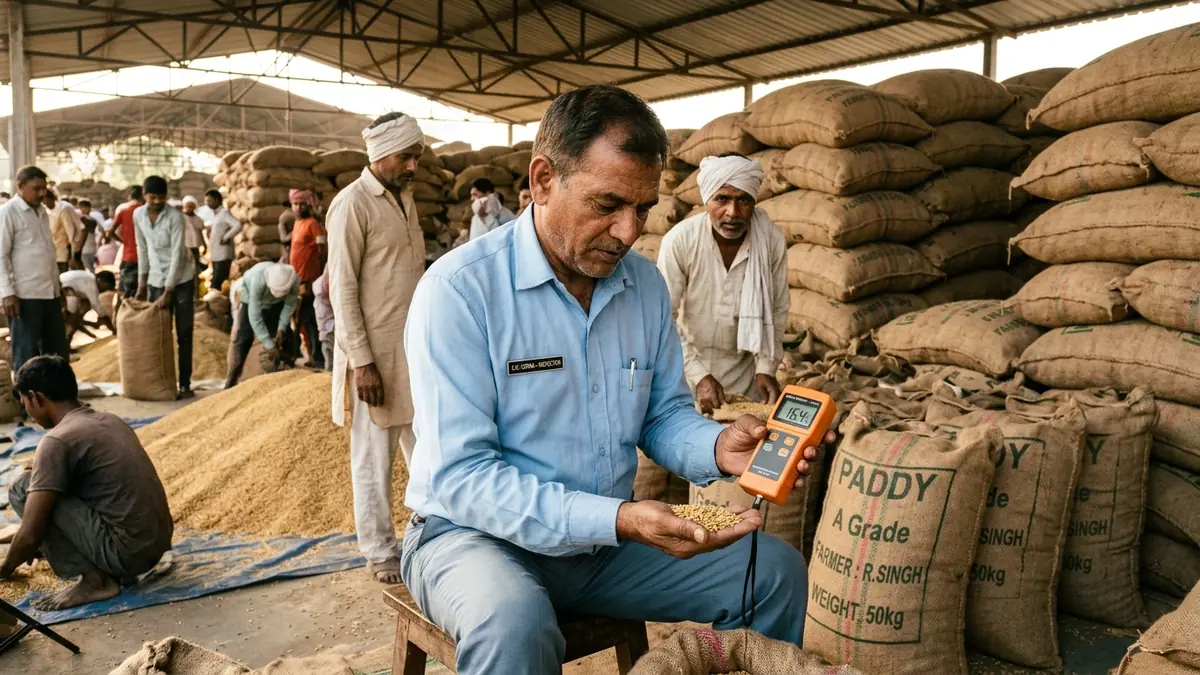
Simultaneously, Bhawani Mandi is integrated with the Central Government’s National Agriculture Market platform (e-NAM). Under e-NAM, lot samples are tested in the on-site quality testing laboratory for moisture, purity, and grain size. Lab test certificates are uploaded to the portal alongside lot photographs, enabling distant flour mills, edible oil refiners, and spice processors across India to place digital bids without physical presence.
Step 3: Tare Weighment and Unloading (11:00 AM – 04:00 PM)
Once the farmer accepts the highest bid and the "Sauda Patrak" (sale voucher) is generated, the vehicle is unloaded at the buyer’s demarcated platform. Empty vehicles re-enter the calibrated weighbridge to obtain tare weight. The net commodity weight is automatically computed by the APMC software, eliminating manual tally manipulation or unauthorized bag deductions.
Step 4: Billing and Direct Settlement (Same-Day Payment)
By mandate of the Rajasthan APMC Act, the buyer or commission agent must issue an itemized Form J (J-Form) to the cultivator. Payment must be disbursed either in cash up to statutory banking limits or transferred directly via RTGS / NEFT / IMPS to the farmer’s bank account on the same day (T+0).
Farmer Statutory Rights and 0% Commission Guarantee
A major source of concern for rural producers is illegal fee deductions at terminal agricultural markets. Rajasthan APMC regulations provide clear statutory protections that every farmer visiting Bhawani Mandi must know:
- Zero Farmer Commission: Commission agents (Arhtiyas) are strictly prohibited from charging commission (aadat) from the farmer. Mandi cess (1.6% to 2.0%) and agent commission (typically 1.5% to 2.0%) are borne 100% by the purchasing trader or processor.
- Regulated Labor Charges (Hamali / Tulaee): Unloading, sieving, and bag-stitching charges are fixed by the Mandi Samiti at statutory per-bag rates. Any trader demanding extra loading cuts or "dhalta" (moisture deduction beyond official test results) can be reported immediately.
- Right of Lot Refusal: If the top bid in an open auction or e-NAM session does not meet the farmer’s price expectation, the farmer holds the unconditional legal right to reject the sale, retain the produce, or store it in the mandi warehouse without penalty.
- Mandi Samiti Dispute Redressal Cell: An on-duty APMC magistrate and farmer welfare committee sit at the administrative building daily from 10:00 AM to 05:00 PM to adjudicate weighment disputes, non-payment complaints, and contract breaches on the spot.
Connecting Mandi Realization to Farm Mechanization and Working Capital
Timely and transparent realizations at Bhawani Mandi allow agricultural households in Jhalawar and adjoining Malwa districts to modernize their farming operations. Farmers reinvest cash flows from high-value orange and soybean sales into state-of-the-art farm equipment, high-efficiency solar irrigation, and balanced crop nutrition.
Growers looking to upgrade machinery can evaluate heavy-duty workhorses like the John Deere 5060E 60 HP 4WD or Swaraj 744 FE tailored for deep tillage and orchard spraying. Cultivators can also explore commercial financing and scale of finance through our KCC calculator.
Beyond tractors, securing dependable off-grid irrigation through the central government’s PM KUSUM Yojana allows farmers to install 3 HP to 10 HP solar pumps with 60% combined state and central financial assistance via our solar pump guide. Additionally, verifying seasonal income support via PM Kisan beneficiary status and tracking fertilizer input costs using our DAP fertilizer guide ensures optimum input budgeting throughout both Kharif and Rabi cycles.
Diversified farmers maintaining milch animals alongside orchard farming can explore high-yielding indigenous dairy breeds like the Gir cow, or check current livestock trends on our dairy farming portal and commercial poultry production in our poultry farming guide.
Logistics, Packing, and Cold Storage Infrastructure at Bhawani Mandi
Handling highly perishable citrus crops requires specialized post-harvest infrastructure. Over the past decade, both private agro-logistics firms and the Rajasthan Agricultural Marketing Board have invested significantly in modern cold chain facilities around the Bhawani Mandi industrial area.
Oranges destined for distant domestic consumption or export are washed, treated with food-grade fungicidal wax, and sorted in automated grading lines. Fruit is packed in 10 kg and 20 kg corrugated fiberboard (CFB) boxes or traditional wooden crates before being loaded into refrigerated multi-axle trucks. Cold storage facilities maintain temperatures between 5°C and 7°C with relative humidity of 85% to 90%, enabling growers and consolidators to hold fruit during market gluts and release inventory when terminal wholesale prices appreciate.
For foodgrains and oilseeds, Central Warehousing Corporation (CWC) and Rajasthan State Warehousing Corporation (RSWC) operate accredited warehouses near the railway siding. Farmers depositing grain receive Electronic Negotiable Warehouse Receipts (e-NWR), against which scheduled commercial banks extend pledge financing at concessional interest rates under the Kisan Credit Card (KCC) scheme, while mitigating harvest risks via PM Fasal Bima Yojana.
Comparative Analysis: Bhawani Mandi vs Nearby Regional Mandis
Cultivators situated in the border tehsils often evaluate whether to transport their harvest to Bhawani Mandi, Kota Bhamashah Mandi, or Jhalawar Mandi. The following operational comparison highlights the distinct strengths of each market center.
| Feature / Parameter | Bhawani Mandi APMC | Kota Bhamashah Mandi | Jhalawar APMC Mandi |
|---|---|---|---|
| Primary Specialization | Oranges, Soybean, Mustard, Dhaniya | Paddy, Soybean, Wheat, Mustard | Garlic, Orange, Soybean, Chana |
| Geographic Location | Jhalawar (Rajasthan-MP Border) | Kota District Headquarters | Jhalawar District Center |
| Orange Processing Hubs | North India largest aggregation center | Secondary transshipment | Local transit collection point |
| e-NAM Integration | Active with on-site lab assaying | Full computerized auction floors | Active for selected grains |
| Railway Loading Siding | Direct Western Railway siding facility | Direct freight terminal access | Nearest railhead at Jhalrapatan |
| Farmer Commission | 0% statutory farmer commission | 0% statutory farmer commission | 0% statutory farmer commission |
| Cold Storage Proximity | Within 5 km radius of auction yards | Large commercial cold storage hub | Semi-urban storage facilities |
Source: Rajasthan State Agricultural Marketing Board (rsamb.rajasthan.gov.in) market directory and Agmarknet verified returns. While Kota Bhamashah Mandi dominates paddy procurement (detailed in our paddy procurement MSP guide) and massive wheat consolidations, Bhawani Mandi remains unmatched across Rajasthan and western MP for citrus aggregation, garlic wholesale transactions, and cross-border oilseed liquidity.
Step-by-Step Guide for First-Time Farmers Visiting Bhawani Mandi
To ensure a hassle-free trading experience, growers visiting Bhawani Mandi for the first time should follow this practical operational checklist:
- Clean and Dry Your Produce: Ensure soybean and mustard lots are thoroughly sun-dried to bring moisture below 10%. Screen out excess dust, stones, and foreign matter to secure top-tier quality grades and avoid grading deductions.
- Sort Oranges by Size: For citrus consignments, separating small (goli) fruit from bold (super/special) fruit prior to loading increases the average price realization across the entire vehicle load by 15% to 25%.
- Carry Essential Identity Documents: Keep your Aadhaar card, bank passbook (or cancelled cheque showing IFSC code), and land revenue record (Bhulekh Jamabandi / Khasra copy) handy for rapid e-NAM farmer registration.
- Collect Your Computerized Gate Pass: Ensure the entry weighbridge operator inputs your correct mobile number on the Prawesh Parchi so that weighment slips and e-NAM bidding SMS alerts are delivered directly to your phone.
- Be Present During the Open Auction: Personally observe the auction proceedings alongside your commission agent. Verify that the final hammer price matches the figure written on your Sauda Patrak.
- Obtain Itemized J-Form Receipt: Never leave the mandi yard without an official J-Form signed by the purchaser, recording the exact gross weight, tare weight, net weight, rate per quintal, and net payable balance.
By adhering to regulated APMC channels, comparing daily auction trends on our mandi rates platform, and deploying modern techniques like organic farming certification or balanced nutrition via soil testing, farmers in Hadoti and Malwa can protect their crop margins throughout the marketing year.
Frequently asked questions
- Where is Bhawani Mandi located and why is it unique?
- Bhawani Mandi is located in Jhalawar district in southeastern Rajasthan, right on the border with Madhya Pradesh. It is famously unique because the municipal town and its railway station are divided between two states: Rajasthan and MP. The Krishi Upaj Mandi operates as North India’s premier trading hub for mandarin oranges and regional oilseeds, monitored via official RSAMB portal.
- What are the main agricultural commodities traded at Bhawani Mandi?
- The primary commodities traded by volume include mandarin oranges (Nagpur and Jhalawar Santra), yellow soybean (JS 9560, JS 2034), black mustard seed (Sarson), coriander seeds (Badami and Eagle grade Dhaniya), garlic (Desi and Ooty varieties), and Sharbati wheat.
- What are the daily gate timings and auction hours at Bhawani Mandi?
- The mandi gates open for vehicle entry and electronic weighbridge registration at 04:00 AM daily from Monday through Saturday. Open auctions and e-NAM digital bidding commence at 08:30 AM and run until 02:00 PM, with unloading and settlements continuing through the late afternoon. Real-time updates can be monitored on our mandi rates ticker.
- Do farmers have to pay commission (arhatiya fees) at Bhawani Mandi?
- No. Under the Rajasthan Agricultural Produce Markets Act, commission charges (aadat) are strictly 0% for farmers. The statutory mandi fee and commission agent brokerage are legally mandated to be paid entirely by the purchasing buyer or processing mill.
- When is the peak season for orange (Santra) auctions at Bhawani Mandi?
- Orange arrivals occur during two primary seasons: the Ambia Bahar harvest running from October to December, and the Mrig Bahar harvest running from February to April. During these months, hundreds of truckloads are auctioned and dispatched daily to major metropolitan cities like Muhana Mandi Jaipur.
- How does the e-NAM digital trading system work at Bhawani Mandi?
- Bhawani Mandi is linked to the national e-NAM network (enam.gov.in). Produce samples are assayed in an on-site laboratory for moisture and quality parameters, and test certificates are uploaded online so traders across India can submit transparent digital bids for local farmer lots.
- Can farmers from Madhya Pradesh sell their harvest at Bhawani Mandi?
- Yes. Cultivators from neighboring Madhya Pradesh tehsils like Shamgarh, Garoth, Bolia, Bhanpura, and Susner regularly bring produce to Bhawani Mandi. Produce transport across the border is tax-free upon presenting basic farmer identity or Kisan Credit Card proof.
- What documents should a farmer bring to receive direct bank payments?
- Farmers should carry a copy of their Aadhaar card, bank passbook or cancelled cheque (with clear bank account number and IFSC code), and land revenue documents (Bhulekh Jamabandi/Khasra). These details enable instant T+0 RTGS or NEFT payment into the farmer’s account.
- Where can farmers verify today’s official mandi bhav for Bhawani Mandi?
- Farmers can check official modal prices, minimum/maximum rates, and total arrivals on the Directorate of Marketing & Inspection portal at agmarknet.gov.in, the Rajasthan APMC portal at rsamb.rajasthan.gov.in, or through daily KisanPe agricultural market updates.
- What facilities are available for storing unsold produce at Bhawani Mandi?
- Farmers can store foodgrains, oilseeds, and pulses in nearby accredited warehouses operated by the Central Warehousing Corporation (CWC) and Rajasthan State Warehousing Corporation (RSWC). For oranges, specialized commercial cold storages maintaining 5°C to 7°C are available in the industrial area.
- What should a farmer do in case of a weighment or payment dispute at the mandi?
- If an unauthorized weight deduction or delayed payment occurs, the farmer should immediately report to the APMC Mandi Secretary or the on-duty Market Inspector at the administrative office. The APMC Dispute Redressal Committee investigates complaints and ensures immediate resolution before the buyer clears the lot.
- Is Bhawani Mandi open on Sundays and public holidays?
- Regular commercial auctions and e-NAM trading are closed on Sundays and gazetted government holidays. However, during the peak orange harvest season, emergency gate entries and temporary holding facilities remain operational to handle heavy transit arrivals.
This article is for general information only and is not financial advice. Loan and scheme eligibility depends on partner and government criteria.