Coconut Price Today: Copra MSP, Kerala & Karnataka Rates
Key takeaways
- Government of India CCEA/PIB approved Copra MSP for 2026 stands at Rs 12,027/qtl for Milling Copra (+Rs 445) and Rs 12,500/qtl for Ball Copra (+Rs 400), procured via NAFED & NCCF.
- Wholesale dehusked matured coconut spot prices in November 2026 indicatively trade at Rs 28 to Rs 46 per piece (Rs 3,800–Rs 6,200/quintal raw kernel equivalent) across Kerala, Tiptur (Karnataka), and Pollachi (Tamil Nadu).
- Dry Milling Copra trades indicatively between Rs 11,800 and Rs 14,600/qtl depending on FAQ <6% moisture and sulfur-free cleanliness; premium Ball Copra (Gola) in Tiptur touches Rs 12,500–Rs 15,800/qtl.
- Well-irrigated dwarf/hybrid coconut gardens yield 85 to 140 nuts per palm annually (~5,500 to 9,500 nuts per acre) plus valuable intercropping income under Coconut Development Board (CDB) schemes.
Checking the accurate coconut price across Indian wholesale mandis requires distinguishing immediately between four completely distinct traded forms: fresh drinking green Tender Coconut (Elaneer / Nariyal Pani), mature husked/dehusked Raw Kitchen Coconut (Dry/Dehusked Nut), sun-dried Milling Copra pressed into edible oil, and unbroken Ball Copra (Gola / Edible Copra) graded across Karnataka and Kerala auction centers! While fresh farmgate nut prices fluctuate daily based on regional transport supply and summer heat demand, long-term price floors across India are directly anchored by the Cabinet Committee on Economic Affairs (CCEA) notified via PIB (pib.gov.in)—setting 2026 Milling Copra MSP at Rs 12,027 per quintal and Ball Copra MSP at Rs 12,500 per quintal.
Southern India’s golden triangle—comprising Kerala (Kozhikode, Thrissur, Palakkad), Tamil Nadu (Pollachi, Kangeyam, Udumalpet), Karnataka (Tiptur, Arsikere, Doddaballapura, Channarayapatna), and coastal Andhra Pradesh (Amalapuram, Konaseema)—produces roughly 90% of national harvests overseen by the Coconut Development Board (CDB). Whether selling fresh nuts per 1,000 pieces, supplying edible ball copra into North Indian sweets markets, or pressing cold-pressed oil (coconut oil rate analysis alongside our full coconut palm farming guide), growers tracking real-time spot spreads on Agmarknet avoid costly village middleman markdowns.
1. Coconut Price Today & 2026 Copra MSP Benchmark Matrix (November 2026)
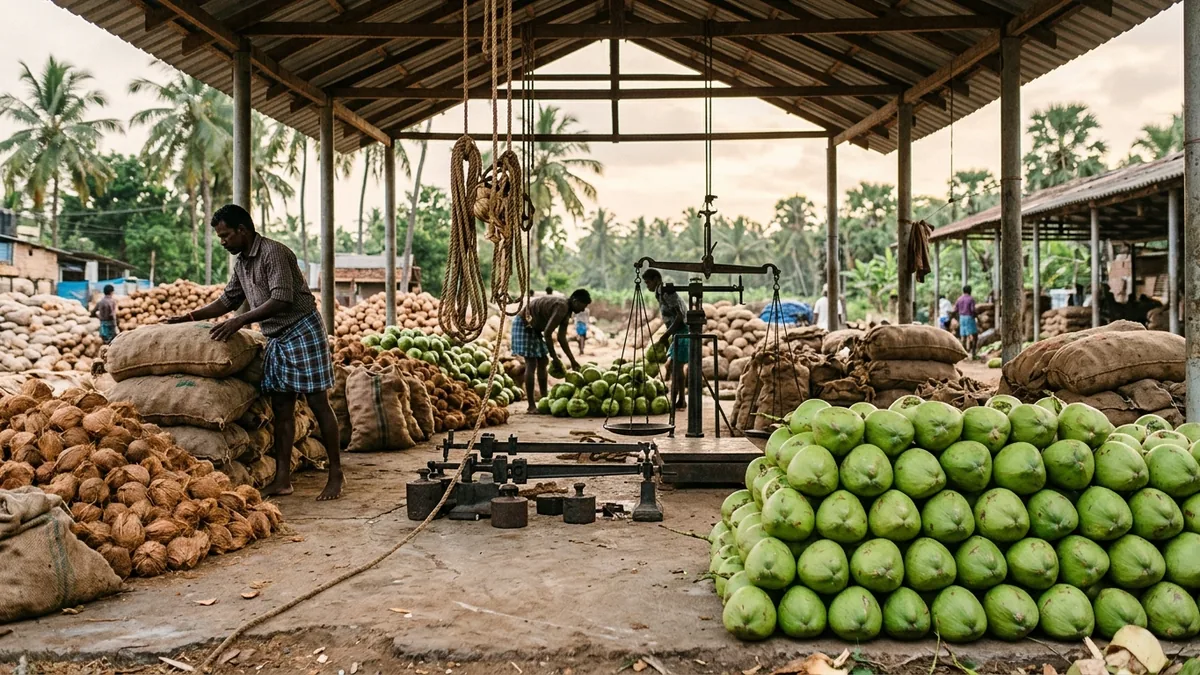
Mandis in Tamil Nadu and Kerala frequently quote dehusked matured coconuts per piece or per 1,000 nuts (grading by ~500–650 g weight class), whereas APMC portals like Agmarknet report weight-converted quintals alongside dry copra auction lots. Converting nuts cleanly helps orchardists verify whether peeling and drying mature nuts into copra yields higher net profit than immediate farmgate raw nut sales.
| Product / Benchmark Grade | Major Reference Market | Indicative Price Range (Nov 2026) | Key Quality Standard & Buyer Note |
|---|---|---|---|
| Milling Copra (CCEA Govt MSP) | All-India (NAFED / NCCF Centers) | Rs 12,027 / quintal (+Rs 445 YoY) | FAQ <6% moisture, clean split cups, zero fungus/smoke |
| Ball Copra (CCEA Govt MSP) | All-India (Tiptur / Arsikere Focus) | Rs 12,500 / quintal (+Rs 400 YoY) | Whole cured hollow shell balls, <5% moisture FAQ |
| Milling Copra (Open Spot) | Kozhikode & Kangeyam / Pollachi | Rs 11,800 – Rs 14,600 / quintal | Raja/dilux white dry sun-cured cups command top bid |
| Edible Ball Copra (Gola) | Tiptur APMC (Karnataka Benchmark) | Rs 12,500 – Rs 15,800 / quintal | 10–12 months bamboo lofts cure yields crisp dry hollow balls |
| Mature Dehusked Coconut | Pollachi, Thrissur, Doddaballapura | Rs 28 – Rs 46 / nut (~Rs 4,000–6,200/qtl) | Sorted Bold (600g+), Medium (450g+), and Small (Choor) |
| Tender Coconut (Elaneer) | Maddur (Karnataka), Pollachi, Konaseema | Rs 22 – Rs 38 / nut farmgate (Rs 45–65 urban) | Dwarf Chowghat Orange / Deejay Sampoorna rich sweet water |
2. Tiptur vs Pollachi vs Kozhikode vs Konaseema: How Regional Hubs Shape National Rates
Unlike perishable leafy crops that move locally, coconut markets operate a nationwide interstate arbitrage chain linking rural estates to Delhi, Mumbai, Ahmedabad, Jaipur, and Guwahati dry-fruit buyers:
- Tiptur APMC (Tumakuru, Karnataka — Global Ball Copra Capital): Farmers hang whole unhusked mature coconuts across ventilated wooden lofts (attic / thottil) for 10 to 12 months so water absorbs naturally and intact round white kernels rattle smoothly inside cured shells—creating crisp edible Ball Copra (Gola) prized by North Indian mithai, temple, and dry-fruit traders tracked tightly on e-NAM and Agmarknet.
- Pollachi & Kangeyam (Coimbatore–Tiruppur Belt, Tamil Nadu): Tamil Nadu leads India’s mechanized copra drying kilns, tender coconut interstate rail/truck dispatches to Delhi NCR/Mumbai, and high-efficiency dehusked kitchen-nut sorting across 1,000+ village curing yards.
- Kozhikode & Thrissur (Kerala Coast): Home to dense small-holding coastal palms producing oil-rich West Coast Tall (WCT) kernels (~68%–70% oil content in dry copra), setting daily virgin and regular milled coconut oil rates nationwide.
- Konaseema / Amalapuram (Coastal Andhra Pradesh): Supplies massive truckloads of tall bold fresh water coconuts year-round into Hyderabad, Odisha, Bihar, and Kolkata markets alongside coastal coir-fiber value addition.
3. Coconut Palm Yields, Dwarf Hybrids, CDB Subsidies & Multi-Tier Intercropping
Growing coconut cleanly isn’t waiting seven years for slow old seedlings anymore. High-yielding hybrids bred under ICAR-CPCRI (Kasaragod) and CDB bear heavy bunches within 3.5 to 4.5 years, maximizing farm revenue across both tender-water and copra markets:
- Top Hybrid Varieties: Kera Sankara (WCT × COD), Chandra Sankara (COD × WCT), and high-yield commercial dwarves yield 110 to 150+ nuts per palm annually (~7,500–10,000+ nuts per acre at 7.5 m × 7.5 m triangular/square spacing holding ~70–72 palms/acre).
- Multi-Tier Shade Intercropping Multiplier: Mature coconut canopies leave ~45%–55% dappled sunlight reaching understory soils—planting black pepper vines up palm trunks alongside turmeric, ginger, cocoa, or banana doubles annual gross income per acre smoothly without cutting main palm nut counts!
- Neera, Virgin Coconut Oil & Coir Value Addition: Progressive FPOs tap MIDH Horticulture & CDB processing subsidies to market cold-pressed Virgin Coconut Oil (VCO), desiccated coconut powder, and shell charcoal briquettes—capturing 2× to 3× value over ungraded farmgate nuts.
- Nutrient & Pest Discipline: Prevent yellowing nut-drop and rhinoceros beetle / rugose spiraling whitefly damage via balanced Soil Health Card potash/boron schedules computed using our fertilizer dosage calculator, clean micro-irrigation via our irrigation planner, and targeted organic controls verified in our pesticide calculator.
4. Calculating Fresh vs Copra Sale Arbitrage, NAFED Procurement & KCC Credit
Before harvesting bunches strictly for green buyers or drying mature nuts at home kilns, remember the golden weight conversion math: roughly 6,000 to 7,200 mature dehusked medium-bold nuts yield 1 metric tonne (10 quintals) of dry Milling Copra (~6 to 7.2 medium-bold nuts per 1 kg copra depending on coastal flesh thickness). Multiplying clean Milling Copra MSP (Rs 12,027/qtl = Rs 120.27/kg) immediately indicates a statutory floor worth ~Rs 17 to Rs 20 raw-kernel floor plus husky coir-shell byproduct revenue (~Rs 1.50–Rs 3.00 per shell/husk)—helping growers spot opportunistic buyer under-pricing instantly!
Model full multi-year orchard profits cleanly with our crop income calculator and farm ROI calculator, estimate drip/replanting grants up to 40%–55% on our farm subsidy calculator & government schemes portal, secure low-interest ~4% plantation maintenance funds through our KCC loan calculator, shield estates under Weather-Based PMFBY / WBCIS crop insurance (status checker), check adjacent plantation benchmarks on Shimoga arecanut rates & cashew rates, and complete Farmer ID enrollment cleanly for hassle-free NAFED PSS MSP registration!
5. Hygienic Solar Copra Drying, NAFED FAQ Rules & Storage Hygiene
During peak monsoon harvests across coastal Kerala, Dakshina Kannada, and Konaseema (June–October), open sand/mud yard drying breeds gray fungal Aspergillus mold and free fatty acid (FFA) rancidity—causing NAFED/NCCF procurement graders and oil millers to reject lots or apply steep Rs 600–Rs 1,500/quintal cuts. Avoiding smoke-tainted firewood kilns (which trigger PAH contamination penalties in export food oil markets!) starts with clean low-cost farm curing discipline:
- Solar Polyhouse Copra Dryers (Zero Smoke Contamination): Deploying low-cost UV-polythene solar cabinet or tunnel dryers (polyhouse engineering guide) lowers split-cup moisture cleanly from ~48% down to strict FAQ 5.5%–6.0% within 4 to 5 dry sunny days while shielding cups from sudden rain splashes and dust.
- Reject Unhealthy Heavy Sulfur Bleaching: Never fumigate culinary or VCO-bound copra with excess sulfur powder merely to look unnaturally chalk white—natural sunlight-cured ivory halves command superior demand from virgin oil processors and organic spice buyers.
- NAFED / NCCF Farmer Registration Checklist: Whenever open market copra rates soften near MSP, carry land tax receipts (Adangal / RTC / Patta), active NPCI Aadhaar-seeded bank passbook, clean dry cups (<6% moisture), and local cooperative registration card early before block procurement caps fill up.
Maximizing per-palm profitability also depends heavily on checking coconut coir husk & shell byproduct markets rather than letting middlemen carry off outer husks free during wholesale farmgate loading. In Pollachi, Tumakuru, and Konaseema coir belts, separated dry green/brown coconut husks fetch Rs 1.20 to Rs 2.50 per piece from fiber defibering units and coco-peat export nurseries—covering almost 50% to 70% of seasonal mechanical tree-climbing and harvest picking wages! Meanwhile, selecting high-yielding Chowghat Orange Dwarf (COD) or hybrid D × T seedlings specifically for steady 12-month green tender water trade yields crisp 350–450 ml sweet water nuts at eye-level height without expensive skilled tree climbers.
Equally vital for sustaining 70 to 120 nuts per palm over decades is managing devastating Rhinoceros Beetle, Red Palm Weevil, and Eriophyid Mite infestations early using integrated garden hygiene validated by ICAR-CPCRI and Coconut Development Board field officers. Placing green/dry palm frond traps, dusting leaf axils safely with neem-cake sand mixtures, clearing rotting compost heaps breeding beetle grubs near palm roots, feeding balanced boronated micronutrients alongside soil potash, and keeping steady drip wet-zones ~1.5 meters from the palm trunk shield nut shape and weight cleanly against harsh dry March–May summers.
Before harvesting or expanding coastal orchards, farmers can review domestic oil pricing parity cleanly on our coconut oil market rate page, check intercrop economics for black pepper or nutmeg vines, calculate basin water volumes using our irrigation calculator, and compare annual palm margins cleanly against alternative spice and horticulture crops across KisanPe agricultural calculators.
Comparing tall heritage plantations (West Coast Tall, East Coast Tall, Tiptur Tall) against precocious dwarf hybrids (Chowghat Orange Dwarf, Malayan Yellow Dwarf, and Kera Sankara) clarifies long-term farm cashflow dramatically: although tall heritage palms bear slightly slower (~6–7 years to commercial peak), they routinely remain productive well past 65 to 75 years under coastal monsoons, yielding thick firm kernel meat favored in heavy Ball Copra loft curing and expeller oil milling. Conversely, dwarf hybrids begin fruiting cleanly near 3.5 to 4.0 years right at ground harvest reach (~110–145 tender nuts/palm/yr), letting urban-fringe farms around Pollachi, Maddur, and Mangaluru cash in quickly on year-round chilled drinking tender-nut routes.
Additionally, coconut plantation owners across Kerala, Karnataka, Tamil Nadu, and Konaseema strengthen climate drought buffer significantly by cutting concentric circular husk-burial trenches (50 cm deep × 1.5 m wide spaced 2 m around bearing trunks) packed smoothly with chopped leftover coconut husks topped with red topsoil: buried porous husk layers soak up 5 to 6 times their dry weight in monsoon rainwater and gently release moisture plus natural potassium slowly back to coconut feeder roots across harsh dry March–May summer spells—preventing premature tender button shedding without extra borewell pumping hours.
Frequently asked questions
- What is the coconut price per piece and per quintal in India in 2026?
- Indicative November 2026 wholesale spot rates across Pollachi, Tiptur, Thrissur, and Doddaballapura stand around Rs 28 to Rs 46 per mature dehusked coconut (Rs 3,800 to Rs 6,200 per quintal raw kernel weight equivalent) on Agmarknet, while tender drinking coconuts wholesale between Rs 22 and Rs 38 per nut at farmgates.
- What is the official Government MSP of Milling Copra and Ball Copra for 2026?
- Approved by the CCEA and published via PIB, the official Government of India Minimum Support Price for 2026 is Rs 12,027 per quintal for FAQ Milling Copra (+Rs 445) and Rs 12,500 per quintal for Ball Copra (+Rs 400), procured via NAFED and NCCF.
- Which market decides the benchmark price of Ball Copra (Gola) in India?
- Tiptur APMC (Tumakuru, Karnataka) sets India’s primary spot benchmark price for edible Ball Copra (Gola), where whole dry cured coconuts trade on transparent electronic tenders synced across Karnataka APMCs and e-NAM.
- How many coconuts are needed to make 1 kg or 1 quintal of dry copra?
- Depending on regional variety and nut maturity, roughly 6 to 7.2 medium-bold dehusked mature nuts produce 1 kg of dry Milling Copra (meaning ~600 to 720 nuts yield 1 quintal / 100 kg of clean dry copra under 6% moisture).
- How many coconuts does 1 palm tree produce per year, and what is yield per acre?
- Under balanced potash nutrition and drip irrigation per Coconut Development Board (CDB) advisories, good palms yield 85 to 140+ nuts/tree annually—with ~70–72 palms per acre delivering 5,500 to 9,500+ nuts/acre each year cleanly alongside understory intercrops.
- Why is Kerala West Coast Tall copra prized for coconut oil milling?
- Kerala’s mature coastal West Coast Tall nuts contain thin fiber shells paired with thick white meat holding 68%–70% extractable edible oil content cleanly on expeller crushing. Track finished oil market differentials cleanly on our coconut oil price page.
- Does sulfur smoke-drying hurt the market price of white milling copra?
- Direct open firewood kiln smoke stains copra pale yellow/gray and leaves smoky benzopyrene taints rejected by virgin coconut oil and confectionery buyers; solar cabinet drying preserves spotless ivory aroma and full premium pricing.
- Can coconut farmers grow other profitable crops between palm trees?
- Yes! Widely spaced coconut trees (~7.5 m × 7.5 m) easily accommodate shade-loving black pepper vines climbing palm trunks, turmeric, ginger, cocoa, or banana, often doubling net income per acre—compare full details in our coconut farming guide.
- Which fertilizer nutrients are most important for bearing coconut palms?
- Potassium (MOP), Boron, and Magnesium govern nut number, kernel thickness, and drought resilience far more heavily than high Urea alone—plan split basin fertilization safely with our fertilizer dosage calculator.
- What subsidies are available from the Coconut Development Board (CDB)?
- CDB supports area expansion subsidies, tall-palm climbing machine grants (50%–75% small-tool support), Friends of Coconut Tree (FoCT) climber training, and MIDH micro-irrigation—check overall farm grant ratios via our farm subsidy calculator.
- Why does tender coconut price shoot up between March and May?
- Peak summer temperatures spanning 38°C–44°C across Mumbai, Delhi, Hyderabad, Pune, and Bengaluru spark fierce urban hydration demand precisely when palm soil-moisture stress slightly tightens farmgate bunch counts, pushing retail Elaneer up 25%–40%.
- Is coconut cultivation eligible for Weather-Based Crop Insurance and KCC loans?
- Yes! Major coconut belts in Kerala, Karnataka, Tamil Nadu, and Andhra Pradesh notify gardens under Weather-Based Crop Insurance (RWBCIS / Coconut Palm Insurance Scheme) alongside low-interest ~4% effective Kisan Credit Card maintenance limits.
This article is for general information only and is not financial advice. Loan and scheme eligibility depends on partner and government criteria.