NECC Egg Rate: Zone-Wise Mandi Bhav & Wholesale Guide
Key takeaways
- The National Egg Coordination Committee (NECC) operates as India’s apex producer-driven price discovery body, declaring daily benchmark wholesale egg prices across 45+ production and consumption zones.
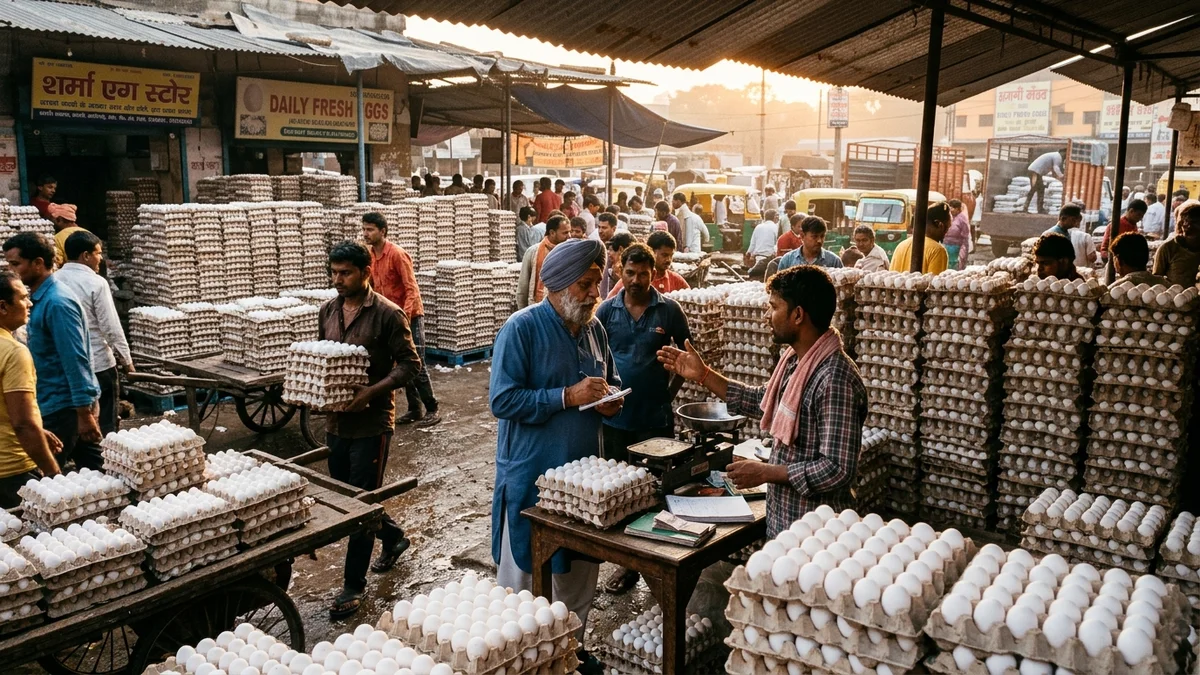
- Wholesale egg rates are published per 100 pieces (benchmark unit), translated into commercial trade packaging: 1 tray (30 eggs) and 1 carton/peti (typically 210 eggs in northern India or 180 to 240 eggs in southern/eastern transit).
- Major production surplus centers like Namakkal (Tamil Nadu) and Barwala (Haryana) drive national wholesale price trends, with consuming deficit centers like Bihar (Patna, Muzaffarpur), West Bengal (Kolkata), and Delhi absorbing daily inter-state rail and road consignments.
- Current layer farm production economics require approximately 1.45 to 1.55 kg of balanced layer mash feed per dozen eggs, establishing a farmgate breakeven threshold of ₹4.10 to ₹4.40 per egg depending on feed raw material prices (maize, soybean meal, DL-methionine).
- NECC price declarations reflect suggested farmgate wholesale rates; actual commercial transactions incorporate local trade premiums or minus deductions ("plus/minus") based on instantaneous regional cold storage stocks and seasonal demand flushes.
The NECC egg rate declared daily by the National Egg Coordination Committee (NECC) serves as the definitive economic benchmark governing India’s ₹1.2 lakh crore poultry layer industry. Established under the visionary leadership of Dr. B.V. Rao in May 1982 with the legendary slogan "My Egg, My Price, My Life," NECC transformed egg farming from a fragmented, trader-exploited cottage sector into one of the world’s most competitive, self-regulated agro-industries. Today, India ranks as the third-largest egg producer globally, producing upwards of 138 billion eggs annually as tracked by the Department of Animal Husbandry and Dairying (DAHD).
For commercial poultry farmers, wholesale egg traders, cold chain distributors, and institutional consumers, tracking the NECC daily price declaration is critical for daily revenue calculation and inventory management. Unlike perishable horticultural commodities sold via uncoordinated physical open auctions, eggs benefit from NECC’s structured price discovery mechanism. Every evening, local NECC zonal committees evaluate production volume, feed cost trends, inter-state transit flows, cold room holding capacities, and regional consumer demand to determine standard suggested farmgate wholesale rates, which we monitor daily alongside our dedicated today egg rate portal and our comprehensive national egg rate guide.
How the NECC Pricing Mechanism Works Across India
The National Egg Coordination Committee’s pricing architecture relies on a decentralized, three-tier committee hierarchy designed to ensure fair price realization for farmers while maintaining affordability for daily consumers:
- Local Zonal Price Committees (45+ Centers): Established in every major poultry-producing district (Namakkal, Barwala, Hyderabad, Ajmer, Hosapete, Warangal, Anand) and primary metropolitan consumption market (Delhi, Mumbai, Kolkata, Chennai, Bengaluru, Patna, Varanasi). These local committees comprise elected poultry farmers, experienced trade brokers, and NECC coordinators.
- Daily Telephonic Price Deliberation (04:30 PM – 06:00 PM): Every afternoon, local committee members confer via conference calls. They analyze farmgate clearances, dispatch truck arrivals from production belts, cold storage stock levels, and festival-related demand fluctuations.
- Zonal Benchmark Declaration (06:30 PM Daily): The local consensus price is finalized and published across national telecommunications channels, mobile apps, and trade bulletins as the official NECC rate per 100 eggs for the succeeding 24-hour trading cycle.
- Central Core Committee Supervision: NECC’s national core body monitors inter-zonal price parity to prevent regional arbitrage exploitation, ensuring that production surplus centers do not artificially dump excess eggs into neighboring consuming markets below cost.
Understanding Packaging Units: Per Piece, Tray (30 Eggs), and Peti (Carton)
While NECC publishes its official benchmark on a "per 100 eggs" basis, commercial poultry trade across Indian mandis operates through standardized packaging units. Understanding these conversions ensures farmers and buyers avoid billing confusion:
- Per 100 Eggs (NECC Base Quotation): The standard rate quoted by NECC. For example, an NECC rate of ₹510 per 100 eggs indicates a farmgate benchmark rate of ₹5.10 per individual egg.
- Tray (30 Eggs): The universal molded paper pulp or plastic storage tray used by retail kirana shops, supermarkets, and catering vendors. When the base rate is ₹510/100 eggs, the wholesale tray price calculates to (5.10 × 30) = ₹153.00.
- Peti / Carton (210 Eggs in North India): In northern belts including Haryana, Punjab, Delhi, and Uttar Pradesh, eggs are packed in cardboard cartons containing 7 paper trays of 30 eggs each, totaling 210 eggs. At ₹5.10/egg, a 210-egg peti costs ₹1,071.00. Detailed northern trends can be checked on our Barwala egg rate analysis.
- Commercial Export / South Indian Carton (180 to 240 Eggs): In southern production belts like Namakkal and Hyderabad, corrugated fiberboard master boxes contain either 6 trays (180 eggs) or 8 trays (240 eggs) optimized for heavy inter-state freight transit to Kerala, Mumbai, and overseas export terminals.
Zone-Wise Indicative Wholesale Egg Price Benchmarks
Egg prices fluctuate dynamically across seasons: winter typically witnesses peak consumption demand, pushing rates upward, whereas peak summer temperatures and religious observances (Shravan, Navratri) moderate consumer intake. The following benchmark table outlines indicative wholesale price ranges across key Indian poultry hubs based on verified data from the National Egg Coordination Committee and daily market records on Agmarknet:
| Zone / Major Center | Center Role | Rate / 100 Eggs (₹) | Tray Price (30 Eggs) (₹) | Peti Price (210 Eggs) (₹) |
|---|---|---|---|---|
| Barwala (Haryana) | North Surplus Hub | ₹480 – ₹545 | ₹144 – ₹164 | ₹1,008 – ₹1,145 |
| Delhi NCR | Primary Consumption Metro | ₹505 – ₹570 | ₹152 – ₹171 | ₹1,060 – ₹1,197 |
| Namakkal (Tamil Nadu) | South/National Surplus Hub | ₹460 – ₹525 | ₹138 – ₹158 | ₹966 – ₹1,102 |
| Patna (Bihar) | East Consumption Deficit | ₹525 – ₹590 | ₹158 – ₹177 | ₹1,102 – ₹1,239 |
| Muzaffarpur (Bihar) | North Bihar Consuming Hub | ₹520 – ₹585 | ₹156 – ₹176 | ₹1,092 – ₹1,228 |
| Kolkata (West Bengal) | East Metro Deficit Hub | ₹530 – ₹595 | ₹159 – ₹179 | ₹1,113 – ₹1,250 |
| Mumbai (Maharashtra) | West Metro Consuming Hub | ₹510 – ₹575 | ₹153 – ₹173 | ₹1,071 – ₹1,208 |
| Hyderabad (Telangana) | South Central Surplus Hub | ₹465 – ₹530 | ₹140 – ₹159 | ₹977 – ₹1,113 |
| Ajmer (Rajasthan) | West-Central Surplus Hub | ₹485 – ₹540 | ₹145 – ₹162 | ₹1,018 – ₹1,134 |
| Varanasi / Gorakhpur (UP) | East UP Consuming Market | ₹515 – ₹580 | ₹155 – ₹174 | ₹1,082 – ₹1,218 |
Source: National Egg Coordination Committee (e2necc.com) & Department of Animal Husbandry and Dairying (dahd.nic.in). Indicative wholesale price ranges, November 2026. Spot farmgate transactions may vary according to daily plus/minus trade discounts and freight differentials, which can be monitored via our mandi rates platform.
Layer Poultry Farm Economics: Cost of Production per Egg
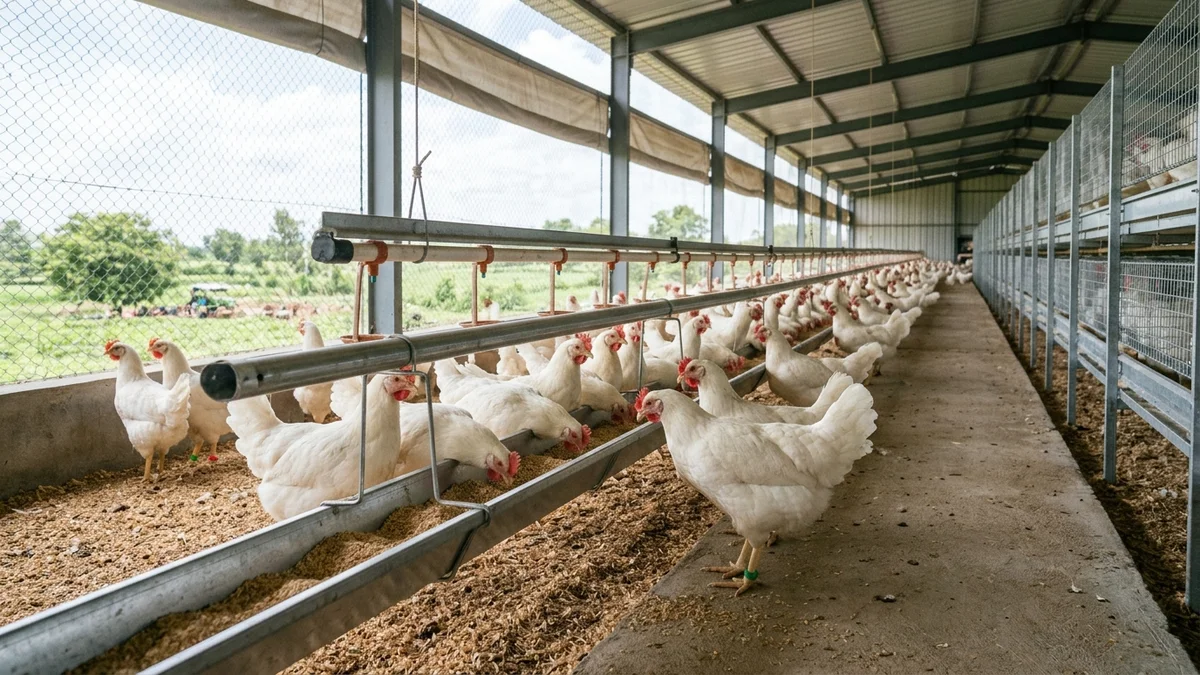
Evaluating the viability of commercial layer farming requires rigorous understanding of the underlying feed conversion biology and input economics. Feed constitutes 75% to 80% of the recurring operational expenditure on any modern layer farm, as detailed in our comprehensive poultry farming setup guide.
1. Layer Feed Ingredients and Nutritional Composition
A high-producing commercial layer bird (such as BV-300, Bovans White, or Hy-Line W-36) requires a scientifically balanced ration providing approximately 2,650 to 2,750 kcal/kg metabolizable energy, 16.5% to 17.5% crude protein, and 3.8% to 4.2% elemental calcium to build robust eggshells. Guidelines from the Central Poultry Development Organization (CPDO) define the standard layer mash ration as follows:
- Maize / Corn (50% – 55%): The principal carbohydrate and energy source. Spikes in mandi maize prices immediately increase feed cost per kilogram.
- De-Oiled Soya Cake / Soybean Meal (20% – 25%): The primary vegetable protein ingredient, supplying essential amino acids including lysine and tryptophan.
- Calcite Powder / Shell Grit (8% – 10%): Supplies digestible calcium required for eggshell calcification in the shell gland pouch.
- Di-Calcium Phosphate (DCP) (1.2% – 1.5%): Provides bio-available phosphorus vital for skeletal integrity and metabolic cellular energy.
- Amino Acid Supplements & Premixes (1.5% – 2.0%): Synthetic DL-methionine, L-lysine, phytase enzymes, liver tonics, choline chloride, and vitamin AD3EK premixes.
2. Feed Conversion Ratio (FCR) and Breakeven Calculation
A commercial commercial layer consumes an average of 110 to 115 grams of feed per day during its peak laying cycle (from 22 weeks to 72 weeks of age), maintaining an egg production rate of 90% to 94%. This translates into a Feed Conversion Ratio (FCR) of approximately 1.45 to 1.55 kg of feed per dozen eggs laid.
Assuming standard feed production costs of ₹28 to ₹32 per kg of prepared layer mash, the direct feed cost per egg stands between ₹3.20 and ₹3.60. Adding chick amortization (depreciation of ₹45 day-old chick over 320 eggs), biosecurity vaccinations, electricity, labor, and water brings the national average total production cost per egg to ₹4.10 – ₹4.40. Therefore, when the NECC farmgate rate falls below ₹4.00, layer producers face severe cash losses, whereas realizations above ₹5.00 deliver healthy capital returns. Farmers can also project combined livestock returns with our crop and farm income calculator.
Decoding "Plus / Minus" Trade Deductions in Egg Mandis
One of the most frequent sources of confusion for newcomer poultry producers is the concept of "Minus" and "Plus" rates prevailing in wholesale physical mandis. While the NECC rate represents the recommended benchmark, ground-level transactions often trade at a variance:
- Minus Trade (Buyer Discount): When regional production exceeds immediate dispatch demand, wholesale egg aggregators demand a deduction (e.g., "NECC minus 15 paise" or "minus 25 paise"). This means if the declared NECC rate is ₹5.00, the farmer receives ₹4.85 or ₹4.75 net at the farmgate.
- Plus Trade (Farmer Premium): During festival seasons, sudden cold waves, or severe regional supply shortages, wholesale traders offer an incentive (e.g., "NECC plus 10 paise") to secure committed supply.
- Egg Breakage Tolerance: Standard wholesale contracts permit a maximum transport breakage threshold of 0.5% to 1.0%. Breakage beyond this threshold is either borne by the transport logistics contractor or deducted from the transit invoice.
Connecting Poultry Cash Flows with Diversified Agriculture and Farm Tools
Commercial poultry layer farming generates continuous daily cash flow, providing farmers with working capital liquidity that cushions the seasonal volatility of foodgrain cultivation. Many progressive agriculturalists integrate poultry farming alongside field crops and commercial dairy operations on our dairy farming hub.
For instance, poultry manure (deep litter or cage droppings) is one of the richest organic fertilizers available, containing nearly 3% Nitrogen, 2.5% Phosphorus, and 1.5% Potassium. Farmers can utilize poultry manure to substantially reduce commercial fertilizer expenditure, complementing inputs like DAP fertilizer and calculating balanced basal doses on our fertilizer dose calculator across wheat, sugarcane, and horticultural crops.
Farm equipment is vital for feed handling, manure clearing, and grain transport. Growers can explore high-efficiency tractors like versatile Swaraj tractors or heavy-duty John Deere 60 HP tractors, taking advantage of 40% to 50% capital assistance through our tractor subsidy guide.
Livestock operators maintaining dairy herds alongside layer sheds can study indigenous milch cattle like the Gir cow, secure concessional credit under the Kisan Credit Card, and mitigate climate-induced feed crop risks through PM Fasal Bima Yojana.
Frequently asked questions
- What is NECC and what role does it play in setting egg rates?
- The National Egg Coordination Committee (NECC) is a voluntary registered trust of poultry farmers established in 1982. It acts as India’s apex price discovery and stabilization body, declaring daily suggested wholesale benchmark prices for eggs across 45+ regional zones to protect farmers from exploitative trader cartels. Track daily movements on our today egg rate portal.
- At what time does NECC declare the daily egg rate?
- Local NECC zonal price committees meet every afternoon via conference calls between 04:30 PM and 06:00 PM. The final official benchmark rates for the following day’s trade are declared and published by 06:30 PM daily on e2necc.com.
- How many eggs are there in a standard commercial tray and peti?
- A standard retail egg tray contains 30 eggs. In northern Indian wholesale mandis (Haryana, Punjab, Delhi, UP), a peti or carton contains 7 trays, totaling 210 eggs, as detailed in our Barwala egg rate guide. In southern and export consignments, master cartons contain 6 trays (180 eggs) or 8 trays (240 eggs).
- What is the current cost of producing an egg on a commercial layer farm?
- The national average total production cost per egg ranges from ₹4.10 to ₹4.40. Feed represents 75% to 80% of this cost (₹3.20 to ₹3.60), while the remainder covers chick cost amortization, vaccines, labor, electricity, and administrative overheads.
- Why are egg rates in Bihar and West Bengal higher than in Barwala or Namakkal?
- Barwala (Haryana) and Namakkal (Tamil Nadu) are massive surplus production belts producing tens of millions of eggs daily. States like Bihar and West Bengal are consumption-heavy deficit zones that rely on imported eggs transported 1,000+ kilometers by rail or road, adding freight charges of ₹0.40 to ₹0.60 per egg.
- What does "plus" or "minus" mean in daily egg trading?
- The NECC rate represents a recommended benchmark. When local supply is surplus and demand is sluggish, buyers demand a discount ("minus" 10 to 25 paise below NECC). When demand exceeds immediate availability, farmers command a premium ("plus" 10 to 15 paise above NECC).
- What is the standard Feed Conversion Ratio (FCR) in commercial egg production?
- Modern high-performing commercial layer strains (BV-300, Bovans White, Hy-Line W-36) achieve a Feed Conversion Ratio of 1.45 to 1.55 kg of feed per dozen eggs laid, consuming approximately 110 to 115 grams of layer mash per day during peak laying, as certified by CPDO.
- How does seasonal weather impact the NECC egg rate?
- Egg rates peak during the winter months (November to February) due to higher per capita protein consumption in northern India and festive demand. Rates experience seasonal downward pressure in peak summer months (May-June) due to higher egg spoilage risks and lower appetite, as well as during Shravan and Navratri observances.
- Can small poultry farmers join NECC directly?
- Yes. Any poultry layer farmer in India can enroll as an NECC member through their nearest zonal office. Membership provides voting rights for local price committee elections, daily SMS price alerts, and participation in state and national poultry welfare forums.
- What government subsidies are available for setting up a layer poultry farm?
- Under the Central Government’s National Livestock Mission (NLM) administered by the Department of Animal Husbandry and Dairying, entrepreneurs can avail 25% to 50% capital subsidies (up to ₹25 lakh to ₹50 lakh) alongside 3% interest subvention for establishing commercial layer farms. Check full instructions in our poultry farm guide.
- How long can commercial eggs be stored safely without quality degradation?
- At ambient room temperatures (25°C to 30°C), commercial infertile table eggs remain fresh for 10 to 14 days. In commercial cold rooms maintained at 10°C to 12°C with 75% to 80% relative humidity, eggs can be safely stored for 4 to 6 weeks without significant interior quality or air-cell deterioration.
- Where can farmers verify today’s official NECC egg rate online?
- Farmers can check official daily declared rates on NECC’s official website at e2necc.com, via daily updates on Agmarknet, or through our real-time mandi rates portal.
This article is for general information only and is not financial advice. Loan and scheme eligibility depends on partner and government criteria.