Raj Kisan Portal 2026: Sathi Login & Subsidy Registration
Key takeaways
- The official single-window digital gateway for agricultural and horticultural schemes in Rajasthan is the Raj Kisan Sathi Portal (rajkisan.rajasthan.gov.in), developed by the Department of Information Technology & Communication (DoIT&C) and the Department of Agriculture as of November 2026.
- Farmer authentication on the portal is entirely integrated with the Rajasthan Jan Aadhaar platform, automatically pulling digital land records from Apna Khata (E-Dharti) without requiring physical land ownership documentation.
- Under the flagship Rajasthan Crop Protection Fencing Scheme (Taarbandi Yojana), farmers receive 50% capital subsidies (up to ₹40,000 for 400 running meters), enhanced to 60% (up to ₹48,000) for small and marginal landholders to safeguard crops against wild animals.
- The portal coordinates PM-KUSUM Component B solar agriculture pump subsidies, granting up to 60% financial assistance (Central + State share) for 3 HP, 5 HP, and 7.5 HP solar water pump installations.
- Applications can be submitted directly through citizen self-service login via Single Sign-On (SSO ID), localized e-Mitra kiosks, or the official Raj Kisan Sathi Android mobile application with real-time SMS status updates.
The Raj Kisan Portal (popularly known across rural Rajasthan as the raj kisan sathi or raj kisan sathi portal) is the official single-window Direct Benefit Transfer (DBT) digital platform administered by the Department of Agriculture, Government of Rajasthan as of 23 November 2026. Hosted at rajkisan.rajasthan.gov.in and commonly searched by cultivators as kisan sathi portal, kisan sathi, or rajkishan sathi, this unified portal delivers more than 150 farmer-centric schemes, input subsidies, farm mechanization grants, and licensing services directly to agrarian families across all 50 districts of the state.
Prior to the launch of the unified Raj Kisan platform, farmers in Rajasthan had to navigate fragmented departmental offices—running between the Krishi Bhawan in Jaipur, district agriculture offices, horticulture directorates, and renewable energy agencies—to secure government subsidies for drip irrigation or farm ponds. Today, by integrating the Jan Aadhaar family digital identity with real-time land records from Apna Khata (Jamabandi), the portal allows farmers to apply for major capital subsidies in under ten minutes from any local e-Mitra kiosk or personal smartphone. Whether you are applying for wire fencing under the Taarbandi Yojana to protect standing mustard or wheat crops from stray cattle and Neelgai, setting up off-grid solar pumps under PM-KUSUM, or tracking farm machinery subsidies, understanding how to navigate the Raj Kisan Sathi portal is indispensable. This definitive guide details the portal registration workflow, outlines major agriculture and horticulture subsidy scales, walks through the Taarbandi application process, explains solar pump allocations, and provides complete troubleshooting steps for application approvals.
How the Raj Kisan Sathi portal works: Jan Aadhaar & SSO integration
The structural core of the Raj Kisan Sathi portal lies in its seamless integration with Rajasthan’s state digital infrastructure. Unlike central schemes that require standalone document uploads, the Rajasthan portal operates on an automated paperless verification pipeline:
- Jan Aadhaar Card as the Universal Key: The Jan Aadhaar family card (issued by the Rajasthan Jan Aadhaar Authority) serves as the primary master identity. All family member details, bank account numbers, category classifications (General, OBC, SC, ST), and mobile numbers are pulled automatically.
- Real-Time Land Ownership Verification: When a farmer enters their Jan Aadhaar number and selects their agricultural land parcel, the portal connects directly to the Apna Khata (E-Dharti) revenue database. It auto-populates the village name, Patwar circle, Khasra/survey numbers, and total landholding in hectares, eliminating the need to upload manual revenue stamp certificates.
- Citizen SSO ID and e-Mitra Integration: Cultivators can access the portal directly using their Rajasthan Single Sign-On (SSO ID) at sso.rajasthan.gov.in or apply through any of the 85,000+ authorized e-Mitra service centers operating in gram panchayats across the state.
- Digital Workflow & Geo-Tagging: Once an application is submitted, it moves through a transparent 4-tier digital workflow: Online scrutiny by the Agriculture Supervisor (Krishi Paryavekshak), Field Inspection & Geo-tagging by the Assistant Agriculture Officer (AAO), Sanction Order issuance by the Deputy Director of Agriculture, and direct treasury payment via e-Grass/PFMS.
Cultivators tracking commercial produce prices in Rajasthan mandis can review our dedicated market intelligence on muhana mandi jaipur, bhawani mandi rajasthan, and sarson ka tel price today.
Major agricultural schemes and subsidies on Raj Kisan Sathi
The Department of Agriculture channels extensive financial assistance through the Raj Kisan portal to encourage water conservation, modern mechanized cultivation, and crop diversification across Rajasthan’s arid and semi-arid agro-climatic zones.
| Scheme / Program Name | Subsidy Percentage & Slabs | Maximum Financial Ceiling (INR) | Eligible Beneficiaries & Criteria |
|---|---|---|---|
| Rajasthan Crop Fencing (Taarbandi Yojana) | 50% to 60% of material cost | ₹40,000 (Gen) / ₹48,000 (Small/SC/ST) | Individual farmer owning min 1.5 Ha (or 0.5 Ha in group) |
| Farm Pond Construction (Khet Talai) | 60% (Plastic lined) / 70% (Non-lined) | ₹1,00,000 to ₹1,20,000 per pond | Cultivators with minimum 0.5 Ha agricultural land |
| Drip Irrigation System Grant | 70% (Small/Marginal/Women) / 75% (SC/ST) | As per cost norms (up to ₹1.0 Lakh/Ha) | Farmers owning cultivable land with perennial water source |
| Sprinkler Irrigation System Grant | 70% to 75% capital subsidy | As per micro-irrigation layout norms | All categories of irrigated crop growers |
| Farm Mechanization (Krishi Yantra) | 40% (General) / 50% (SC/ST/Women/Small) | Up to ₹2.0 Lakh (tractors, rotavators) | Farmers registered on Jan Aadhaar without machinery subsidy in past 3 yrs |
| Diggi Construction (Canal Command) | 75% to 85% construction cost | ₹3,00,000 to ₹3,40,000 per diggi | Farmers in canal command areas (IGNP, Gang Canal, Bhakra) |
| Greenhouse & Shade-Net Polyhouse | 50% to 70% capital investment | Up to ₹20.0 Lakh to ₹35.0 Lakh per unit | Horticulture growers setting up protected structures (1,000-4,000 sqm) |
| Solar Agriculture Pump (PM-KUSUM) | 60% total subsidy (30% Centre + 30% State) | Up to ₹2.0 Lakh to ₹2.8 Lakh per pump | Farmers with borewell/open well lacking electric connection |
Source: Department of Agriculture and Directorate of Horticulture, Government of Rajasthan, Annual Scheme Guidelines and DBT Subsidy Schedules, November 2026.
For detailed machinery purchasing guides eligible for 40% to 50% state grants under the farm mechanization category, consult our in-depth reviews on the Mahindra tractor price list, Swaraj 855 FE guide, and rotavator implement price guide.
Rajasthan Taarbandi Yojana: protecting crops from wild animals
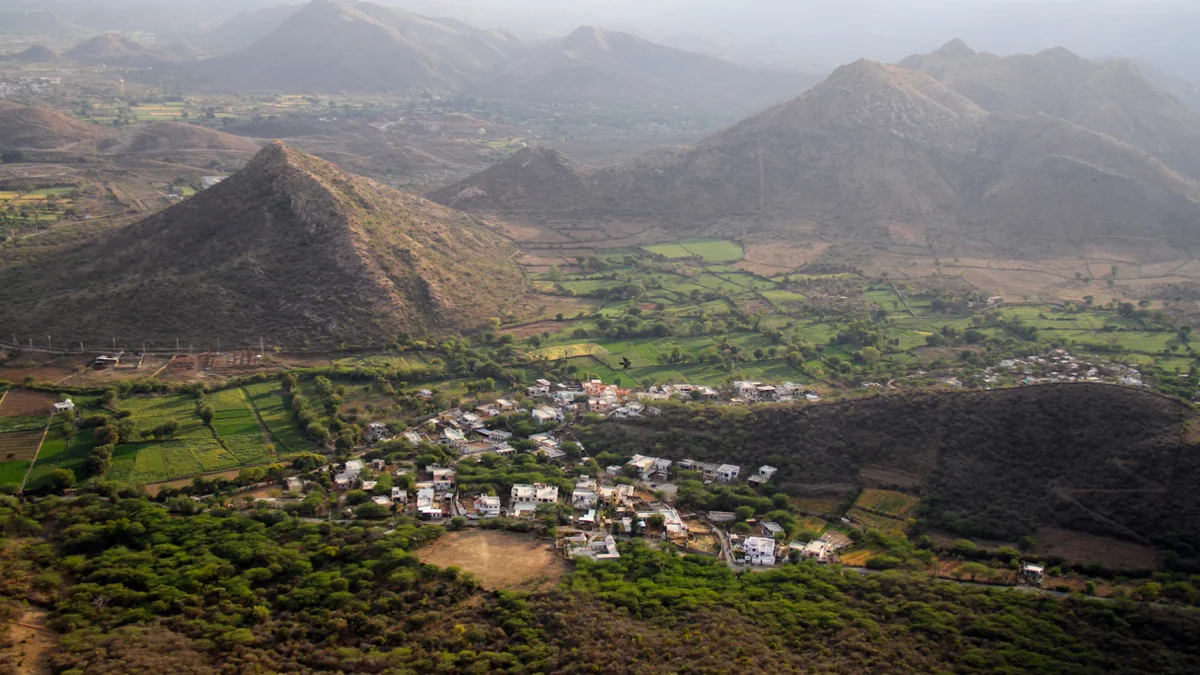
In Rajasthan, stray cattle, Neelgai (blue bulls), and wild boars inflict catastrophic crop destruction during both Kharif (bajra, moong, guar) and Rabi (mustard, wheat, gram) seasons. To protect farm investments, the state government operates the highly popular Taarbandi Yojana (Farm Boundary Wire Fencing Scheme) exclusively via the Raj Kisan portal.
1. Subsidy scale and landholding rules
- Small and Marginal Farmers: Eligible for 60 percent subsidy on the standard cost of wire fencing, capped at a maximum of ₹48,000 for 400 running meters.
- General Category Farmers: Eligible for 50 percent subsidy, capped at a maximum of ₹40,000 for 400 running meters.
- Individual Landholding Threshold: An individual farmer must own at least 1.5 hectares (approx. 6 bighas) of cultivable land in a single compact block.
- Group Farming Provision (Samoohik Kheti): If small farmers do not individually own 1.5 hectares, a cluster of two or more neighboring farmers owning a combined minimum of 1.5 hectares can apply jointly, with each farmer receiving up to ₹40,000 to ₹48,000 for fencing their peripheral boundary.
2. Technical fencing specifications mandated by the department
- Wire Specification: Only galvanized barbed wire (GI barbed wire, min 12x14 gauge or chain-link mesh) with high tensile strength is permitted.
- Pole Distance & Height: Minimum fence height must be 5 feet (1.5 meters). Reinforced concrete poles (RCC) or iron angle posts must be spaced no more than 10 to 12 feet apart and embedded in concrete footings.
- Horizontal Wire Strands: The fence must feature at least 6 to 7 horizontal strands of barbed wire, or woven chain-link mesh with 2 top strands.
- Pre and Post-Fencing Inspection: An Agriculture Supervisor conducts a pre-inspection of the unfenced field boundary and a post-inspection with mandatory geo-tagged photographs once the fence is erected.
Farmers managing horticulture crops alongside fencing can also review our comprehensive market benchmarks on onion price today, avocado price dynamics, and anjeer price trends.
PM-KUSUM Component B: solar agriculture pumps in Rajasthan
Rajasthan leads all Indian states in the deployment of off-grid solar water pumping systems under the Pradhan Mantri Kisan Urja Suraksha evam Utthaan Mahabhiyan (PM-KUSUM Component B). The program is executed jointly by the Rajasthan Renewable Energy Corporation Limited (RRECL) and the Department of Horticulture through the Raj Kisan portal.
Subsidy structure and farmer investment share
- Central Government Subsidy (MNRE): 30 percent of the benchmark system cost.
- State Government Grant: 30 percent matching grant from the Government of Rajasthan.
- Total Direct Subsidy: 60 percent of the total installation cost.
- Farmer Equity Share: The farmer pays only 10 percent upfront as margin money. The remaining 30 percent can be financed through concessional bank loans under the Agriculture Infrastructure Fund (AIF) or Kisan Credit Card (KCC).
- Pump Capacities Available: 3 HP, 5 HP, and 7.5 HP surface or submersible solar pumps (both DC and AC options) from empanelled tier-1 manufacturers (including Shakti Pumps, Tata Power Solar, and Kirloskar).
Eligibility conditions for solar pump grants
- Must possess cultivable land with a functional open well, borewell, or farm pond with adequate water yield.
- The applicant must not have an existing grid-connected agricultural electricity connection on the same survey plot.
- Adoption of micro-irrigation (drip or sprinkler system) is mandatory to prevent groundwater depletion.
Calculate your machinery and pump loan installment commitments using our interactive tractor loan calculator and KCC loan calculator.
Step-by-step: applying online on rajkisan.rajasthan.gov.in
Applying for any agricultural subsidy on the Raj Kisan Sathi portal follows a straightforward, standardized digital workflow. Follow these step-by-step instructions:
- Access the Portal: Visit https://rajkisan.rajasthan.gov.in or log into your SSO portal (sso.rajasthan.gov.in) and select the "Raj Kisan Sathi" application icon.
- Authenticate Jan Aadhaar: Enter your 10-digit Jan Aadhaar Card number or 27-digit Jan Aadhaar Enrollment Receipt. Select the specific family member who owns the land, and complete OTP authentication sent to the linked mobile number.
- Select Department & Scheme: Choose between "Agriculture Schemes" or "Horticulture Schemes". Click on your desired program (e.g., "Subsidy on Wire Fencing", "Subsidy on Farm Pond", or "Subsidy on Agricultural Implements").
- Verify Land Parcel: The system displays your registered Khasra numbers from Apna Khata. Select the specific plot where the implement will be utilized or infrastructure erected.
- Submit Supporting Details: Confirm bank account details (auto-fetched from Jan Aadhaar) and agree to scheme terms and conditions.
- Generate Application Number: Upon clicking "Submit", the portal issues a unique alphanumeric Application Reference Number (e.g., RJ-AGR-2026-XXXXX). An instant SMS confirmation is dispatched to your registered phone.
- Track Real-Time Status: Return to the Raj Kisan portal anytime and click "Track Application Status", entering your reference number to monitor supervisor scrutiny, administrative sanctions, and treasury disbursements.
Cultivators enrolled in central direct income support can verify their installment status using our guides on pm kisan status check, pm kisan status check balance, and pmkisan gov in status check.
Troubleshooting portal issues and key helpline contacts
If your application encounters unexpected delays or document validation errors on the Raj Kisan Sathi portal, use the following diagnostic steps to resolve the issue:
- Jan Aadhaar Bank Account Mismatch: If your bank account is not updated or linked to your individual name in the Jan Aadhaar family folder, the portal will reject subsidy disbursement. Update your bank account details at your nearest e-Mitra kiosk or on the Jan Aadhaar portal before applying.
- Apna Khata Land Record Not Appearing: If recent land inheritance or division (Namantran/Mutation) is pending in tehsil records, the portal cannot auto-fetch your plot. Ensure your local Patwari enters the mutation in the computerized revenue system.
- Pre-Inspection Delays: Once an application is submitted, the Agriculture Supervisor must complete pre-inspection within 15 to 30 days. Contact your local Gram Panchayat Krishi Paryavekshak or visit the Block Assistant Director of Agriculture (ADA) office if the status remains pending.
- Official Helpdesk: Farmers can call the dedicated Raj Kisan Sathi toll-free helpline at 1800-180-1551 (Kisan Call Centre) or contact the Krishi Bhawan IT helpdesk at 0141-2227365 during working hours.
Cultivators and livestock owners in Rajasthan can combine state subsidies with central welfare programs. Review our step-by-step guides on PM Kisan status check, central portal troubleshooting in pmkisan.gov.in status check, and credit verification in our PM Kisan balance check guide. Digital farmer credentials can be generated through our Farmer ID registration guide, and neighboring state mechanisms can be reviewed with the MP Kisan portal guide.
For dairy operators managing livestock herds across Rajasthan, explore our comprehensive breed guides on Gir cow milk yield and commercial dairy farm setup. Farmers planning tractor and machinery investments under state subsidy programs can review the Mahindra tractor price list, the heavy-duty Swaraj 855 FE, and calculate subsidized financing on the tractor loan EMI calculator.
Stay updated on regional produce realisations across Rajasthan mandis via our market intelligence guides on Bhawani Mandi, the world coriander capital in Ramganj Mandi, and edible oil benchmarks in sarson ka tel rates. Official state government portals consulted for this guide include Raj Kisan Sathi, the Rajasthan Jan Aadhaar Authority, computerized land records on Apna Khata (E-Dharti), and solar schemes managed by RRECL.
Frequently asked questions about Raj Kisan Sathi portal
Frequently asked questions
- What is the official website of the Raj Kisan Portal in Rajasthan?
- The official website of the Raj Kisan Portal is rajkisan.rajasthan.gov.in (Raj Kisan Sathi). Farmers can also access its services through the Rajasthan Single Sign-On portal at sso.rajasthan.gov.in or any local e-Mitra kiosk.
- Which document is mandatory to apply for subsidies on Raj Kisan Sathi?
- The Rajasthan Jan Aadhaar Card is the mandatory document, managed by the Rajasthan Jan Aadhaar Authority. It auto-authenticates the farmer's identity, family details, bank account numbers, and links to Apna Khata (Jamabandi) land records without requiring physical paperwork.
- How much subsidy is provided under Rajasthan Taarbandi Yojana?
- Under the Taarbandi Yojana, small and marginal farmers receive a 60 percent subsidy up to ₹48,000 for 400 running meters of wire fencing. General category farmers receive a 50 percent subsidy up to ₹40,000. In group farming, two or more farmers owning 1.5 hectares combined can apply together. You can align these grants with digital credentials via our Farmer ID registration guide.
- What is the subsidy percentage for solar pumps under PM-KUSUM on Raj Kisan?
- Eligible farmers receive a 60 percent total capital subsidy (30% Central Ministry of New & Renewable Energy grant + 30% Government of Rajasthan state subsidy). The farmer pays only 10% upfront margin money, with the remaining 30% available via bank loans.
- How much subsidy does Rajasthan provide on Drip and Sprinkler irrigation systems?
- Small, marginal, and women farmers receive a 70% to 75% subsidy on certified drip and sprinkler micro-irrigation systems. Other categories of farmers receive up to 70% financial assistance based on land area norms.
- Can a farmer apply for farm machinery subsidies on Raj Kisan Portal?
- Yes. Farmers can apply for 40% to 50% capital subsidies (up to ₹2.0 Lakh) on certified agricultural machinery including tractors, rotavators, multi-crop seed drills, and power weeders through the portal during active application windows. Compare machinery options in our Mahindra tractor price list.
- How can I track the status of my Raj Kisan Sathi application online?
- Visit rajkisan.rajasthan.gov.in and click on "Track Application Status". Enter your unique Application Reference Number (received via SMS upon submission) and select the scheme type to see real-time updates from supervisor scrutiny to treasury sanction.
- What is the Khet Talai (Farm Pond) subsidy amount in Rajasthan?
- For plastic-lined farm ponds, the state provides up to 60% subsidy capped at ₹1,00,000 to ₹1,20,000. For non-lined raw farm ponds, the grant covers up to 70% of construction costs, helping farmers store rainwater for life-saving crop irrigation.
- What should I do if my land records do not appear on the Raj Kisan portal?
- If your land survey numbers do not auto-populate after entering your Jan Aadhaar number, verify that your land mutation (Namantran) has been digitally recorded on the Apna Khata (E-Dharti) revenue portal. Contact your local Patwari or Tehsildar to update your computerized revenue records.
- Is there a mobile application available for Raj Kisan Sathi?
- Yes. The Department of Agriculture provides the official "Raj Kisan Sathi" Android application on the Google Play Store, allowing farmers to submit scheme applications, track status, view weather alerts, and consult agricultural advisories on mobile.
- How is the subsidy amount disbursed to the farmer after approval?
- All subsidies are disbursed via Direct Benefit Transfer (DBT) directly into the bank account linked with the applicant's Jan Aadhaar card, following geo-tagged physical verification of the implement or farm infrastructure by agricultural officers.
- What is the toll-free helpline number for Raj Kisan Portal support?
- Farmers can contact the Kisan Call Centre at 1800-180-1551 (toll-free) or call the Krishi Bhawan Jaipur helpdesk at 0141-2227365 for technical and scheme-related assistance.
This article is for general information only and is not financial advice. Loan and scheme eligibility depends on partner and government criteria.