Mushroom Farming in India: Cultivation & Profit Guide 2026
Key takeaways
- Mushroom farming in India represents one of the fastest-growing agri-business micro-enterprises, converting agricultural crop residues (wheat straw, paddy straw) into high-protein functional food.
- White Button mushroom (Agaricus bisporus) accounts for roughly 75% of total domestic production, requiring climate-controlled growing rooms (14°C to 24°C) and pasteurized compost.
- Oyster mushroom (Pleurotus spp.) is the most profitable entry-level variety for beginners, cultivating easily on sterilized cereal straw in polybags at 20°C to 30°C within a rapid 45-day cycle.
- Commercial yield standards achieve 18 to 22 kg of fresh button mushrooms per 100 kg of pasteurized compost, and 25 to 30 kg of oyster mushrooms per 100 kg of dry straw substrate.
- A small 1,000-bag oyster mushroom enterprise requires an initial capital setup of ₹60,000 to ₹85,000, delivering net returns of ₹45,000 to ₹65,000 per cycle with 35% to 45% net profit margins.
- The National Horticulture Board (NHB) and Mission for Integrated Development of Horticulture (MIDH) provide 40% to 50% credit-linked back-ended capital subsidies for commercial mushroom production facilities.
Mushroom farming (मशरूम की खेती / खुंबी उत्पादन) is widely recognized as one of the most profitable, space-efficient, and sustainable commercial agribusiness enterprises in modern Indian agriculture. As of 23 November 2026, India’s annual mushroom production has crossed 3.2 lakh metric tonnes, driven by surging urban dietary demand for plant-based proteins, immune-boosting functional foods, and gourmet culinary ingredients. Unlike traditional open-field crop farming which demands vast acreage and heavy irrigation, mushroom cultivation is an indoor, vertically stacked bio-conversion process. It utilizes inexpensive agricultural byproducts—such as wheat straw, paddy straw, sugarcane bagasse, and poultry litter—to generate premium food without competing for fertile arable land.
From small-scale rural self-help groups (SHGs) and progressive youth cultivating oyster mushrooms in dark thatched huts to multimillion-rupee automated, climate-controlled commercial button mushroom facilities, the enterprise offers scalable entry points for every investment level. Supported by 40% to 50% capital subsidies through the National Horticulture Board (NHB) and the Mission for Integrated Development of Horticulture (MIDH), mushroom agriculture consistently delivers exceptional returns on investment with net profit margins ranging between 35% and 45%. This definitive guide provides a comprehensive roadmap for commercial mushroom cultivation in India, detailing primary commercial varieties, substrate formulation, composting protocols, spawn inoculation, environmental control, pest and disease sanitation, complete project economics, and institutional subsidy guidelines.
Primary commercial mushroom varieties in India: characteristics, yields, and climate parameters
Selecting the appropriate mushroom species is the foundational commercial decision for any grower. In India, four commercial varieties dominate market production, each tailored to specific climatic zones, capital investment capacities, and consumer preference patterns:
| Mushroom Variety | Scientific Botanical Name | Share of Indian Production | Optimal Growing Temperature | Substrate / Growing Medium | Average Crop Cycle Duration | Indicative Wholesale / Retail Rate |
|---|---|---|---|---|---|---|
| White Button Mushroom | Agaricus bisporus | 75% Market Share | 14°C – 18°C (Cropping) / 24°C (Spawn) | Fermented & Pasteurized Wheat Straw Compost | 75 – 90 Days (Complete Cycle) | ₹90 – ₹130 / kg (Wholesale) | ₹140 – ₹220 / kg (Retail) |
| Oyster / Dhingri Mushroom | Pleurotus ostreatus / sajor-caju | 16% Market Share | 20°C – 30°C (Wide Tolerance) | Sterilized Chopped Paddy / Wheat Straw in Polybags | 40 – 50 Days (Fast Flushes) | ₹80 – ₹120 / kg (Wholesale) | ₹130 – ₹180 / kg (Retail) |
| Milky Mushroom (Doodh Chhata) | Calocybe indica | 6% Market Share | 30°C – 38°C (High Heat Tolerant) | Pasteurized Straw Substrate with Casing Soil | 55 – 65 Days | ₹100 – ₹150 / kg (Wholesale) | ₹160 – ₹240 / kg (Retail) |
| Paddy Straw Mushroom | Volvariella volvacea | 2% Market Share | 32°C – 38°C (High Humidity) | Raw Soaked Paddy Straw Bundles / Beds | 20 – 25 Days (Ultra Short) | ₹120 – ₹160 / kg (Wholesale) | ₹180 – ₹250 / kg (Retail) |
| Shiitake / Specialty Medicinal | Lentinula edodes / Ganoderma | 1% Specialty Niche | 16°C – 22°C (Controlled Light) | Hardwood Sawdust Bags / Hardwood Logs | 90 – 120 Days | ₹500 – ₹1,200 / kg (Dehydrated / Gourmet) |
For beginners and rural micro-entrepreneurs lacking expensive refrigeration infrastructure, Oyster mushroom (Dhingri) represents the most forgiving, low-risk starting point. It requires no composting yard or casing soil and yields three flushes within 45 days. Conversely, for urban-adjacent growers with access to cold chain logistics and institutional buyers (hotels, supermarket chains, quick-commerce delivery hubs), White Button mushroom remains the undisputed volume leader.
Agri-entrepreneurs evaluating equipment loans for establishing insulated cropping sheds can calculate repayment terms using our farm machinery EMI calculator and verify their borrowing capacity through the loan eligibility checker.
Composting science for button mushrooms: Phase I fermentation and Phase II pasteurization
Unlike green plants that perform photosynthesis to generate carbohydrates, mushrooms are saprophytic macro-fungi devoid of chlorophyll. They rely entirely on pre-decomposed organic compost rich in lignin-protein complexes, cellulose, and microbial biomass for nutrition. Producing high-yielding White Button mushrooms hinges on master-level composting science, conducted through two sequential phases:
Standard Short-Method Compost Formula (Per 1,000 kg Wheat Straw): Wheat straw (toodi) 1,000 kg; Chicken manure (deep litter) 400 kg; Wheat bran (chokar) 100 kg; Urea 15 kg; Muriate of Potash (MOP) 10 kg; Single Super Phosphate (SSP) 10 kg; and Gypsum 100 kg. This blend provides an ideal initial Carbon-to-Nitrogen (C:N) ratio of 30:1, which narrows to approximately 16:1 to 18:1 upon final maturation.
Phase I: Outdoor Fermentation (Days 0 to 12): Wheat straw is thoroughly pre-wetted on a clean concrete floor for 48 hours until it reaches 70% to 75% moisture content. Chicken manure and chemical fertilizers are thoroughly blended in, and the material is built into rectangular windrow ricks (typically 5 feet wide by 5 feet high). Within 48 hours, thermophilic bacteria and actinomycetes initiate vigorous aerobic fermentation, driving internal core temperatures to 65°C–72°C. The windrow is turned systematically on Days 4, 6, 8, 10, and 12 to ensure uniform aeration, moisture balance, and heat distribution. Gypsum is incorporated during the third turning to flocculate colloidal clay particles, neutralize alkaline grease, and condition compost structure.
Phase II: Bulk Tunnel Pasteurization & Conditioning (Days 13 to 18): The semi-fermented compost is transferred into an insulated peak-heat tunnel with slatted floors and centrifugal air blowers. Steam is injected to elevate air temperature to 58°C–60°C for 6 to 8 hours, completely exterminating harmful weed molds, nematode worms, insect larvae, and pathogenic fungal spores. Following pasteurization, the tunnel temperature is gently lowered to 48°C–52°C for 3 to 4 days for aerobic conditioning. During conditioning, beneficial actinomycetes convert toxic free ammonia gas into microbial protein. Once ammonia levels drop below 5 ppm (undetectable by smell) and compost cools to 24°C, it is ready for spawning.
Spawning, spawn run, and casing layer management
Once the pasteurized compost or sterilized straw substrate is cooled to room temperature (below 25°C), it undergoes spawning—the process of mixing pure fungal mycelium grown on sterilized cereal grains (typically wheat or bajra grains) into the compost bed.
Spawning Methodology: High-quality grain spawn sourced from certified ICAR laboratories or accredited commercial spawn labs is inoculated at a rate of 0.5% to 0.75% of the wet compost weight (roughly 500 to 750 grams of grain spawn per 100 kg of compost). Thorough spawning involves homogeneously blending the grain kernels throughout the compost bulk before pressing it firmly into polypropylene bags or wooden tier shelves at a depth of 18 to 22 cm. The bags are immediately covered with clean newspaper sheets or food-grade 2% formalin-treated butter paper to retain humidity.
Spawn Run (Vegetative Colonization, Days 1 to 14): During the initial 12 to 15 days, the growing room is maintained in total darkness at an ambient temperature of 23°C to 25°C with 85% to 90% relative humidity. Carbon dioxide (CO2) concentrations are intentionally allowed to rise above 5,000 to 8,000 ppm, as elevated CO2 stimulates rapid vegetative mycelial proliferation without triggering premature fruiting. By Day 14, cottony white mycelium thoroughly permeates the entire compost bed, turning it into a dense, fragrant, sweet-smelling white mass.
The Vital Casing Layer: White Button mushrooms are physiologically incapable of forming fruit bodies without a specialized non-nutritive, porous casing soil applied over the colonized compost. The standard casing mixture comprises decomposed coir pith (coconut coir) blended with 2-year-old spent mushroom compost or well-rotted farmyard manure (FYM) in a 1:1 ratio, treated with calcium carbonate (chalk powder) to adjust pH to 7.6–8.0. The casing mixture is chemically pasteurized with 2% formalin solution or steam-treated at 65°C for 4 hours. A uniform 3.5 cm to 4.0 cm layer is spread evenly over the colonized compost surface.
Environmental Shocking & Pinhead Initiation: After 8 to 10 days of casing run—when mycelial strands reach two-thirds of the casing depth—the grower introduces a dramatic environmental shock. The room temperature is dropped rapidly from 24°C to 15°C–16°C, fresh air blowers are engaged to flush out carbon dioxide (reducing CO2 below 800 to 1,000 ppm), and relative humidity is held at 85% to 90%. This thermal and aeration shock halts vegetative growth and triggers reproductive pinheading. Within 4 to 6 days, thousands of tiny pearl-like pinheads (primordia) emerge across the casing surface.
Oyster mushroom (Dhingri) cultivation: simplified low-cost protocol for beginners
While button mushroom production requires substantial capital and composting precision, Oyster mushroom (Pleurotus) cultivation is exceptionally straightforward, making it the perfect agribusiness for rural households, landless laborers, and peri-urban youth.
Step 1: Substrate Chopping & Soaking: Fresh, golden wheat straw or clean paddy straw is chopped into 3 to 5 cm bits using a mechanical fodder cutter. The straw is soaked in clean water inside a concrete tank for 12 to 16 hours to attain 70% moisture.
Step 2: Chemical / Hot-Water Sterilization: In the chemical method, 100 kg of soaked straw is treated with 75 grams of Bavistin (carbendazim fungicide) and 125 ml of Formalin dissolved in 100 liters of water inside a covered tank for 18 hours. Alternatively, small growers immerse jute bags containing straw in boiling hot water (80°C) for 60 to 90 minutes. The sterilized straw is spread on a disinfected sloping floor for 2 to 3 hours to drain excess free moisture.
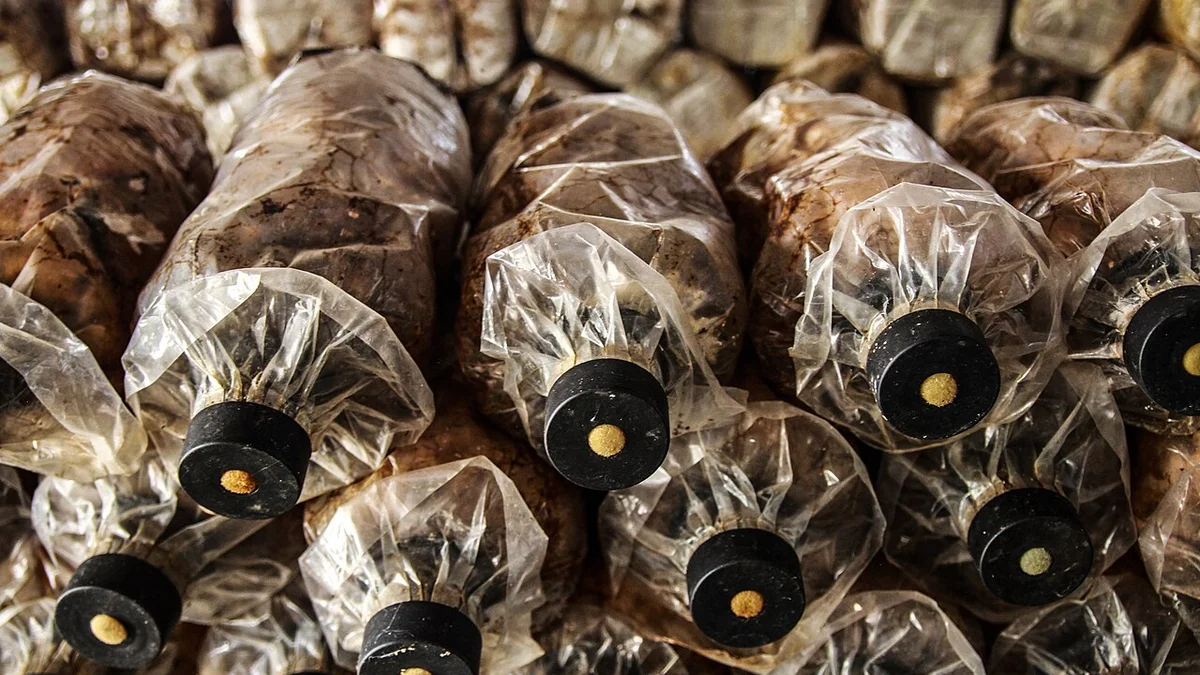
Step 3: Bagging and Layer Spawning: Transparent polythene bags (measuring 16x24 inches, 100 gauge) are packed with alternating layers of moist straw and grain spawn. A layer of straw (8 to 10 cm) is pressed into the bottom, followed by a sprinkle of spawn along the periphery. Four to five alternating layers are created, using approximately 100 grams of spawn per 5 kg of wet straw. The bag is tied securely with twine, and 12 to 16 tiny ventilation pinholes are pierced around the circumference.
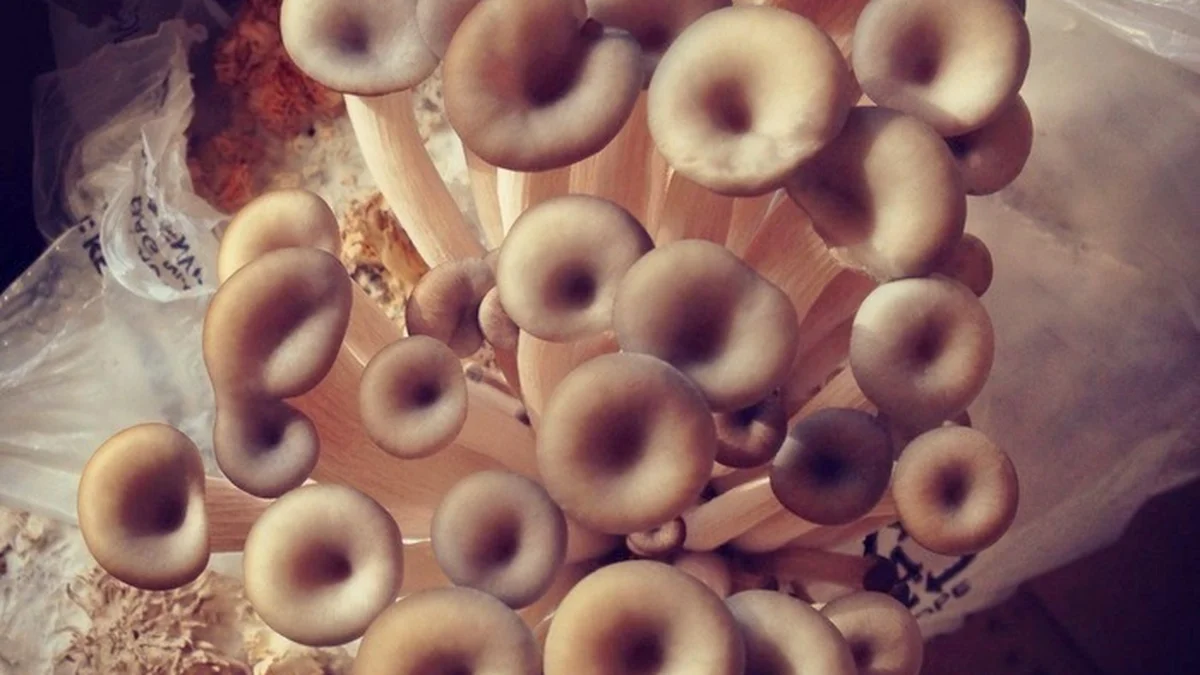
Step 4: Incubation and Fruiting: Bags are arranged on bamboo racks in a ventilated room at 22°C to 28°C. Within 15 to 18 days, the white mycelium completely colonizes the straw. The plastic bag is carefully slit open and stripped away. The cylindrical straw blocks are misted with clean water twice daily. Clusters of fan-shaped oyster mushrooms blossom within 3 to 5 days, ready for harvesting.
Harvesting techniques, post-harvest grading, and cold chain handling
Harvesting mushrooms at the precise stage of maturity is critical to capturing top-tier commercial market rates and maximizing shelf life:
Button Mushroom Harvesting: Button mushrooms must be harvested while the cap (pileus) remains tightly closed and compact, measuring 3.5 to 5.0 cm in diameter, before the underlying veil breaks to expose dark gills. The harvester gently holds the cap between thumb and index finger, rotates it slightly clockwise, and lifts upward without disturbing neighboring pinheads. Never pull straight up, as this dislodges the casing soil. The soil-covered base of the stipe (stem) is neatly trimmed off using a sharp curved stainless steel knife into a waste container.
Grading Slabs for Button Mushrooms: 1. Grade A (Button / Closed Cap): 3.5 to 4.5 cm cap, immaculate white, veil fully intact; commands top market price; 2. Grade B (Cup / Semi-Open): 4.5 to 6.0 cm cap, veil slightly parted; preferred by commercial pizza chains and restaurants; 3. Grade C (Flat / Open Gill): Cap fully open with dark brown exposed gills; discounted by 30% to 40%, sold for soup powder dehydration or canning.
Post-Harvest Pre-Cooling & Packaging: Fresh mushrooms have a rapid metabolic respiration rate and lose moisture quickly. Immediately after harvesting and trimming, produce should be placed in a pre-cooling chamber maintained at 4°C for 2 hours to remove field heat. Mushrooms are weighed into 200-gram food-grade punnet trays and wrapped in micro-perforated anti-fog stretch film. At 4°C, pre-cooled packed button mushrooms retain pristine white appearance and culinary crispness for 5 to 7 days, allowing safe transit to urban wholesale markets.
Project economics and ROI: 1,000-bag oyster unit and 10-tonne commercial button setup
To demonstrate the robust financial viability of commercial mushroom production, two distinct operational business models are detailed below: Model A (Low-cost 1,000-bag Oyster Mushroom Shed) and Model B (High-tech 10-Tonne Seasonal Button Mushroom Unit).
| Economic & Operational Parameter | Model A: 1,000-Bag Oyster Unit (Thatched / Shade Net) | Model B: 10-Tonne Compost Button Unit (Insulated Rooms) |
|---|---|---|
| Initial Capital Expenditure (Capex) | ₹65,000 – ₹85,000 (Bamboo shed, sprayers, racks) | ₹6,50,000 – ₹9,50,000 (Insulated PUF panels, chiller unit) |
| Substrate / Compost Quantity | 2,500 kg Dry Straw (yields 1,000 bags of 5 kg wet) | 10,000 kg (10 Tonnes) Pasteurized Prepared Compost |
| Spawn Requirement & Cost | 150 kg Grain Spawn @ ₹100/kg = ₹15,000 | 70 kg Button Grain Spawn @ ₹120/kg = ₹8,400 |
| Raw Material & Chemical Costs | Straw (₹12,000) + Formalin/Bavistin (₹3,500) = ₹15,500 | Straw, chicken manure, gypsum, casing soil = ₹95,000 |
| Electricity, Water & Labor Costs | ₹8,000 (Domestic power + family labor) | ₹45,000 (Chiller running power + 2 hired laborers) |
| Total Operating Cost per Cycle | ₹38,500 (Excluding initial capital assets) | ₹1,48,400 per 75-day crop cycle |
| Harvest Yield per Cycle | 650 kg to 750 kg Fresh Oyster Mushrooms | 1,800 kg to 2,200 kg Fresh Button Mushrooms |
| Gross Revenue Realization | 700 kg @ ₹140/kg (Wholesale/Local retail) = ₹98,000 | 2,000 kg @ ₹130/kg (Wholesale market average) = ₹2,60,000 |
| Net Profit per Crop Cycle | ₹59,500 (Gross Revenue minus Operating Cost) | ₹1,11,600 (Net Margin ~42.9%) |
| Payback Period of Fixed Capital | 1 to 2 Crop Cycles (approx. 3 to 5 Months) | 3 to 4 Crop Cycles (approx. 12 to 14 Months) |
As demonstrated by the cost-benefit analysis, an entry-level oyster mushroom grower recovering ₹59,500 net profit across a 45-day cycle recovers total shed setup capital within the very first harvest. For large-scale climate-controlled button units operating 4 to 5 cycles annually, the enterprise generates over ₹4.5 Lakh to ₹5.5 Lakh in annual net earnings per 10-tonne chamber.
Agri-entrepreneurs can integrate mushroom farming with other lucrative agri-value addition ventures such as sugarcane processing in our sugarcane juice machine commercial guide, spice marketing at Ramganj Mandi, and seasonal oilseed processing covered in sarson ka tel price dynamics.
Government subsidies and bank financing: NHB and MIDH schemes
Recognizing mushroom farming as an exceptional driver of rural livelihood creation, the Ministry of Agriculture & Farmers Welfare provides substantial credit-linked capital subsidies through two central flagship schemes: the National Horticulture Board (NHB) Scheme and the Mission for Integrated Development of Horticulture (MIDH).
National Horticulture Board (NHB) Commercial Schemes: Under the "Capital Investment Subsidy Scheme for Construction/Expansion/Modernization of Cold Storage and Storage for Horticulture Products and Commercial Horticulture Development in Protected Cover", commercial mushroom production units are eligible for a 40% capital investment subsidy for general category beneficiaries (up to ₹20.0 Lakh to ₹30.0 Lakh per unit), and up to 50% capital subsidy in hilly, tribal, and northeastern states (such as Himachal Pradesh, Uttarakhand, Jammu & Kashmir, and NE states). The subsidy is back-ended and credited directly against the principal term loan sanctioned by scheduled commercial banks.
MIDH Assistance for Spawn Labs and Compost Units: Under MIDH state horticulture missions, individual growers, FPOs, and cooperative societies receive financial assistance across modular components: 1. Specialized Mushroom Spawn Production Laboratory: 50% subsidy up to ₹15 Lakh for private sector units; 2. Bulk Pasteurization Composting Unit: 50% subsidy up to ₹8 Lakh for individual entrepreneurs and up to ₹20 Lakh for FPOs; 3. Small-Scale Mushroom Growing Unit: 40% subsidy up to ₹3 Lakh for decentralized village sheds.
Institutional Credit & KCC Facility: Commercial banks (including SBI, Punjab National Bank, Bank of Baroda, and Regional Rural Banks) finance up to 75% to 80% of project costs under the Agriculture Infrastructure Fund (AIF), which provides an additional 3% annual interest subvention for 7 years. Small growers can also obtain working capital credit up to ₹1.60 Lakh without collateral under the revised Kisan Credit Card (KCC) horticulture mandate.
Pest and disease management in mushroom sheds
Maintaining strict hygiene and environmental biosecurity is essential, as the warm, humid conditions required for mushroom growth are equally hospitable to competitive weed molds and insect pests:
Major Fungal Competitors & Diseases: 1. Green Mold (Trichoderma harzianum): Highly destructive weed mold that forms aggressive emerald-green patches over compost and casing, inhibiting mushroom mycelium; prevented by ensuring thorough Phase II pasteurization at 58°C and treating casing soil with 0.1% Carbendazim; 2. Wet Bubble Disease (Mycogone perniciosa): Causes deformed, cauliflower-like fleshy masses that exude amber-colored droplets of foul liquid; controlled by maintaining casing pH at 7.8 and spraying Chlorothalonil or Prochloraz-manganese; 3. Dry Bubble (Verticillium fungicola): Produces pale brown sunken spots on caps, followed by splitting and leathering of stipes.
Insect Pests: Sciarid and Phorid flies lay eggs in moist compost, and their burrowing larvae sever mushroom mycelial strands and bore tunnels through button caps. Prevent fly ingress by installing 40-mesh fine insect-proof nylon netting over all fresh air louvers and intake vents, hanging yellow sticky traps inside growing rooms, and treating shed walls with neem-based bio-pesticides.
Official government resources and mushroom research institutes
Access authentic training calendars, project report templates, commercial spawn suppliers, and subsidy application forms directly from official government portals. Entrepreneurs can apply for credit-linked capital assistance through the National Horticulture Board (NHB), review scientific protocols at the ICAR-Directorate of Mushroom Research (DMR Solan), and explore regional scheme guidelines on the Mission for Integrated Development of Horticulture (MIDH). Food safety and standard retail packaging norms are established by the Food Safety and Standards Authority of India (FSSAI).
Growers can calculate farm machinery finance and working capital requirements using our farm machinery EMI calculator and KCC loan calculator. For diversified agricultural models, explore our guides on commercial sugarcane juice machinery, regional APMC commodity rates in Neemuch Mandi bhav, and perishable market movements in wholesale onion prices.
Frequently asked questions about mushroom farming in India
Frequently asked questions
- How much money is required to start a mushroom farming business in India?
- Starting a small, low-cost Oyster mushroom unit (1,000 bags) in a shaded or thatched shed requires an initial capital of ₹60,000 to ₹85,000. Conversely, setting up a medium-scale commercial climate-controlled White Button mushroom facility with insulated panels and refrigeration chillers costs between ₹15 Lakh and ₹25 Lakh.
- Which mushroom variety is best and easiest for beginners in India?
- Oyster mushroom (Pleurotus / Dhingri) is the best variety for beginners. It does not require complex compost preparation or casing soil, tolerates a broad temperature range of 20°C to 30°C, cultivates readily on sterilized cereal straw, and produces harvestable flushes in just 40 to 45 days.
- How much profit can I earn from 1,000 bags of oyster mushrooms?
- A 1,000-bag oyster mushroom setup produces approximately 650 to 750 kg of fresh mushrooms per 45-day cycle. At an average wholesale/retail realization of ₹140 per kg, total revenue is around ₹98,000. After deducting operational costs of ₹38,500, the net profit is roughly ₹59,500 per cycle.
- What is mushroom spawn and where can farmers buy it in India?
- Mushroom spawn is the pure vegetative fungal mycelium multiplied on sterilized cereal grains (wheat, millet, or sorghum). Farmers can procure certified, disease-free spawn directly from the ICAR-Directorate of Mushroom Research (DMR Solan), state agricultural universities (SAUs), regional Krishi Vigyan Kendras (KVKs), or accredited private spawn laboratories.
- What is the role of casing soil in button mushroom farming?
- Casing soil is a non-nutritive, porous, water-retentive layer (typically composed of decomposed coir pith and spent compost at pH 7.6–8.0) applied 3 to 4 cm thick over colonized compost. It creates a microclimate that prevents compost drying, provides physical support, and triggers pinhead initiation via rhizomorphic development.
- How much government subsidy is available for mushroom farming under NHB?
- Under the National Horticulture Board (NHB) commercial horticulture scheme, eligible entrepreneurs receive a 40% credit-linked back-ended capital subsidy (up to ₹20.0 Lakh to ₹30.0 Lakh) in plain areas, and up to 50% in hilly and scheduled Himalayan/Northeastern states for commercial units and spawn labs. Explore application rules in our government schemes guide.
- What is the ideal temperature and humidity for growing button mushrooms?
- During the spawn run (vegetative colonization), button mushrooms require 24°C temperature and 85% to 90% relative humidity in darkness. During the reproductive fruiting/cropping stage, the temperature must be lowered to 14°C–18°C with 85% humidity, fresh air ventilation, and CO2 levels below 1,000 ppm.
- Can mushroom farming be practiced without farmland or agricultural land?
- Yes. Mushroom farming is completely soil-independent and land-free. It can be successfully operated inside rented warehouses, spare residential rooms, basements, terrace sheds, or thatched outhouses using vertical multi-tier shelving racks, making it ideal for urban and peri-urban entrepreneurs looking for allied businesses like sericulture silk farming.
- How many kilograms of button mushrooms can be harvested from 100 kg of compost?
- Under proper pasteurization, temperature management, and humidity controls, growers harvest between 18 and 22 kg of fresh White Button mushrooms from 100 kg of wet pasteurized compost across 3 to 4 weekly harvesting flushes.
- How are fresh mushrooms packaged and what is their normal shelf life?
- Fresh mushrooms are pre-cooled to 4°C, packed in 200-gram breathable food-grade punnet trays, and wrapped in micro-perforated stretch film. Stored under continuous refrigeration at 4°C to 5°C, fresh button mushrooms retain quality for 5 to 7 days, while dried oyster mushrooms can be stored for 6 to 9 months.
- What are the most common diseases in mushroom farming and how are they prevented?
- The most destructive diseases are Green Mold (Trichoderma), Wet Bubble (Mycogone), and Dry Bubble (Verticillium). They are prevented through strict shed biosecurity, thorough Phase II compost pasteurization at 58°C, chemical treatment of casing with 0.1% Carbendazim, and 40-mesh insect netting against flies. Crop protection formulations can be reviewed in our Saaf fungicide guide.
- Where can farmers get formal practical training in commercial mushroom cultivation?
- Comprehensive hands-on training is provided regularly by the ICAR DMR Solan in Himachal Pradesh, state agricultural universities (such as PAU Ludhiana, CCSHAU Hisar, and TNAU Coimbatore), and district Krishi Vigyan Kendras (KVKs).
This article is for general information only and is not financial advice. Loan and scheme eligibility depends on partner and government criteria.