Delhi Egg Rate Today: NECC Price, Mandi Bhav & Guide
Key takeaways
- Delhi NCR consumes between 3.5 crore and 4.2 crore table eggs daily, making the National Capital Territory one of India’s largest commercial egg consuming and redistribution zones.
- Wholesale egg rates in Delhi are formally declared daily at 11:30 AM by the National Egg Coordination Committee (NECC) Delhi CC (Commercial Committee) zone, setting benchmark prices across Northern India.
- Wholesale transactions in Delhi mandis are quoted per 100 eggs, while retail trade operates across 30-egg pulp trays and 210-egg corrugated master cartons (peti).
- Over 85% of Delhi’s wholesale egg supply originates from commercial layer belts in Barwala (Panchkula), Karnal, Jind, and Punjab, arriving via NH-44 into major aggregation depots at Ghazipur and Azadpur.
- Wholesale realizations reflect seasonal demand swings, peaking by 25% to 40% during winter months (October to February) and softening during summer heat waves and cultural observance periods.
Delhi NCR stands as Northern India’s undisputed epicentre for commercial table egg consumption and distribution. With a metropolitan population exceeding thirty-three million residents alongside thousands of bakeries, quick-service restaurant chains, industrial catering hubs, hotels, and street food vendors, the capital region absorbs an estimated 3.5 crore to 4.2 crore eggs every single day. From roadside omelette kiosks in Old Delhi to modern supermarket shelves across South Delhi, Noida, and Gurugram, the daily demand for high-quality, affordable poultry protein remains relentless.
However, Delhi itself possesses virtually zero commercial poultry layer farms. The entire urban megalopolis relies on an intricate, highly coordinated inter-state supply network that funnels fresh eggs daily from high-density production belts across Haryana, Punjab, and western Uttar Pradesh. At the financial heart of this massive trade is the daily Delhi egg rate—a benchmark price declared by the National Egg Coordination Committee (NECC Delhi CC) that reverberates through mandis, wholesale aggregation yards, cold storages, and local neighborhood kirana stores across northern and central India.
Whether you are a commercial poultry farmer seeking fair farmgate realizations, an egg wholesaler negotiating master peti lots at Ghazipur Mandi, a bakery enterprise budgeting weekly raw ingredients, or a household consumer tracking grocery inflation, understanding how the Delhi egg rate is determined, converted, and distributed is vital. This comprehensive terminal market guide breaks down daily NECC price mechanisms, unit conversions across piece, tray, and peti, supply chain logistics, seasonal volatility patterns, quality grading standards, and poultry economics.
The NECC Delhi CC Price Determination Mechanism
The National Egg Coordination Committee (NECC), founded under the visionary leadership of Dr. B.V. Rao in 1982, serves as the premier apex body protecting poultry farmers from speculative trader cartels. In Delhi, the committee operates through its specialized "Delhi CC" (Commercial Committee) zonal chapter. Every morning between 10:30 AM and 11:30 AM, an intensive consultative conference takes place among elected layer farmer representatives, major feed compounders, wholesale stockists, and logistics coordinators representing Delhi, Barwala, Punjab, and western UP.
The committee evaluates real-time market data points before announcing the official benchmark rate at 11:30 AM daily:
- Total Daily Inflow: The exact volume of truckloads crossing Kundli and Ghazipur toll plazas into Delhi overnight.
- Cold Storage Inventories: Warehouse stock levels across commercial holding depots in Sahibabad, Kundli, and Okhla.
- Climatic Factors: Prevailing weather conditions, including winter cold waves (which trigger heavy consumption) or summer heatwaves (which accelerate egg spoilage and depress consumer demand).
- Production Cost Benchmarks: Current procurement costs of feed ingredients, particularly commercial maize (makka) and soybean de-oiled cake (DOC), which represent over 70% of egg production overheads.
- Regional Mandi Parity: Prevailing quotations in competing North Indian production centres, most notably the Barwala egg rate, Namakkal South India trends, and Mumbai wholesale benchmarks.
Once established, the NECC publishes the "Suggested Egg Price" per 100 eggs. While this figure serves as the legal and commercial benchmark, spot trading in terminal mandis often incorporates minor premiums or discounts (known in industry parlance as plus-minus or "kat" भाव) depending on lot freshness, egg weight grading, and immediate cash liquidity.
Unit Conversion Economics: Piece, Tray, 100 Eggs & Peti
A frequent source of confusion among retailers, bulk institutional caterers, and consumers is navigating the multiple trade units used across the poultry supply chain. In professional mandi operations, eggs are never sold by the dozen or individual unit; rather, transactions are standardized into specific industrial lots.
1. Wholesale Base Lot (100 Eggs Quote)
The NECC and agricultural marketing boards quote egg prices on a per-hundred basis (₹ per 100 pieces). For example, if today’s Delhi NECC rate is published at ₹620, the base wholesale cost is exactly ₹6.20 per egg. Wholesalers use this base figure to compute multi-crate consignments and transshipment freight billing.
2. Standard Paper Pulp Tray (30 Eggs)
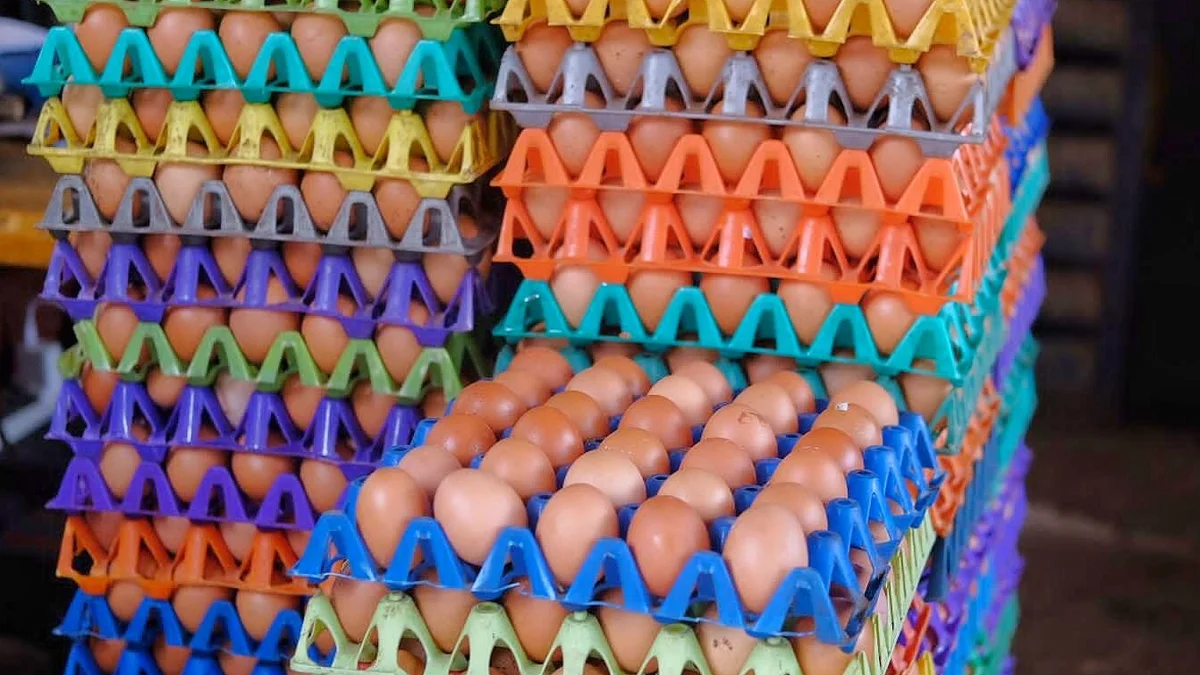
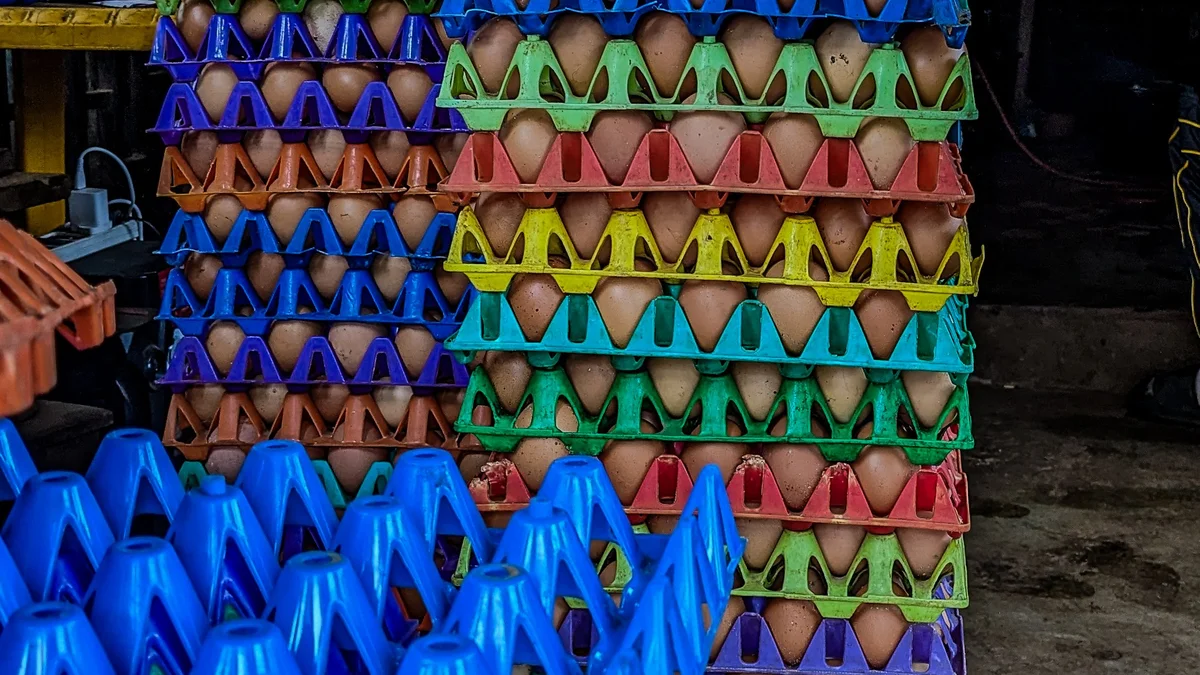
The 30-egg moulded paper pulp tray is the universal intermediate commercial handling unit in India. Trays are engineered with 5x6 dimple recesses designed to cushion eggs during transit and prevent shell-to-shell impact cracking. To calculate the wholesale tray rate, multiply the 100-egg rate by 0.30. At a ₹620 per 100 base rate, a wholesale tray costs ₹186.00 (plus packing and handling costs of ₹2 to ₹4 per tray).
3. Master Corrugated Crate or Peti (210 Eggs)
In the North Indian wholesale trade, a "peti" is the standard heavy cardboard master carton containing exactly 7 stacked trays (7 trays × 30 eggs = 210 eggs). Master cartons protect the eggs from dust, sun exposure, and transit vibrations. To calculate the wholesale peti price, multiply the 100-egg price by 2.1. At a ₹620 base quote, a standard peti costs ₹1,302.00.
4. Commercial Box Lot (350 Eggs)
Some high-volume institutional exporters and interstate logistics haulers utilize 350-egg crates (composed of 10 trays of 35 eggs or 11.66 standard trays). These boxes are predominantly utilized by industrial biscuit and pasta manufacturing units.
5. Retail Kirana Pricing (Per Piece / Per Dozen)
At the neighborhood retail level, shopkeepers purchase wholesale trays or petis from local mandi distributors and sell eggs either individually or in 6-egg and 12-egg cartons. Retail margins typically add ₹0.60 to ₹1.20 per egg to cover transport from the depot, packaging wastage, shell breakage risks (averaging 1% to 2%), and overhead electricity.
Indicative Wholesale & Retail Price Table in Delhi NCR
The following structured price matrix details indicative wholesale modal rates and retail consumer price ranges across Delhi NCR, benchmarked against official returns registered with the National Egg Coordination Committee and the Department of Animal Husbandry and Dairying.
| Commercial Packaging Unit | Total Quantity (Pieces) | Wholesale Indicative Range (₹) | Retail Consumer Range (₹) | Primary Purchasing Segment |
|---|---|---|---|---|
| 100 Eggs Wholesale Base | 100 Pcs | ₹580 – ₹720 | ₹680 – ₹820 | Mandi Commission Agents & Stockists |
| Standard Paper Tray | 30 Pcs | ₹174 – ₹216 | ₹200 – ₹250 | Bakeries, Eateries & Urban Families |
| Master Carton Peti | 210 Pcs (7 Trays) | ₹1,218 – ₹1,512 | ₹1,400 – ₹1,750 | Hotels, Cloud Kitchens & Grocers |
| Bulk Consignment Lot | 1,000 Pcs (10 x 100) | ₹5,800 – ₹7,200 | ₹6,800 – ₹8,200 | Semi-Wholesale Depot Distributors |
| Single Table Egg | 1 Pc | ₹5.80 – ₹7.20 | ₹7.00 – ₹8.50 | Daily Kirana & Retail Consumers |
| Dozen Retail Pack | 12 Pcs | ₹70 – ₹86 | ₹84 – ₹105 | Branded Supermarkets & E-Groceries |
| Brown Layer Table Eggs | 30 Pcs (Tray) | ₹240 – ₹310 | ₹300 – ₹380 | Health Stores & Fitness Cafes |
| Desi / Free-Range Eggs | 30 Pcs (Tray) | ₹360 – ₹480 | ₹450 – ₹600 | Gourmet Organic Consumers |
| Omega-3 Enriched Eggs | 6 Pcs Pack | ₹55 – ₹70 | ₹75 – ₹95 | Premium Nutritional Retail Stores |
Source: National Egg Coordination Committee (e2necc.com) & Department of Animal Husbandry and Dairying (dahd.nic.in). Indicative wholesale price ranges, November 2026. Spot quotations fluctuate dynamically based on morning auction turnover at Ghazipur and Azadpur depots.
The Inter-State Supply Corridors: Barwala to Delhi Mandis
Because Delhi has no commercial layer farms within its borders, the capital’s food security in poultry protein hinges entirely on inter-state freight transit corridors. More than 80% of Delhi’s fresh egg receipts travel along the National Highway 44 (GT Road corridor) and National Highway 9.
1. The Barwala-Panchkula Layer Belt
Barwala, located in the Panchkula district of Haryana near the Shivalik foothills, is widely acknowledged as the egg capital of North India. The Barwala-Raipur Rani cluster houses hundreds of state-of-the-art commercial layer farms maintaining over 1.5 crore laying birds. Daily production exceeds 1.2 crore eggs, of which more than 50% is dispatched directly to Delhi NCR.
2. Karnal, Jind & Kaithal (Haryana Central Belt)
Central Haryana districts like Karnal, Panipat, Jind, and Kaithal operate substantial automated environmental-control (EC) poultry sheds. Located within 120 to 180 km of Delhi, these farms enjoy minimal transit times, allowing eggs collected at 04:00 PM to arrive at Ghazipur and Azadpur mandi docks before midnight.
3. Punjab Layer Clusters (Ludhiana, Sangrur, Patiala)
Punjab provides crucial volume buffers during periods of peak seasonal demand. Large commercial layer farms around Khanna, Samrala, and Sangrur dispatch refrigerated and insulated multi-axle freight carriers to northern Delhi distribution depots.
4. Transit Logistics & Breakage Minimization Protocols
Transporting fragile table eggs across 250 kilometers of highway requires stringent logistics management. Trucks enter Delhi during the designated commercial vehicle night-entry window (11:00 PM to 06:00 AM) to comply with Delhi Traffic Police congestion regulations. Experienced logistics operators utilize air-suspension chassis trucks and secure corrugated strapping to limit transit shell hairline breakage to under 1.5%.
Wholesale Aggregation Terminals in Delhi: Ghazipur vs Azadpur
Once consignments arrive inside the National Capital Territory, wholesale distribution is managed through two massive terminal hubs:
- Ghazipur Wholesale Poultry & Egg Market: Located in East Delhi along NH-9 near Anand Vihar, Ghazipur operates Delhi’s largest specialized wholesale egg yard. It acts as the primary clearing house for consignments servicing East Delhi (Laxmi Nagar, Mayur Vihar, Shahdara), Noida, Greater Noida, and Ghaziabad. Secondary wholesale auctions and truck-to-van cross-docking operate continuously from 04:00 AM to 11:00 AM.
- Azadpur Mandi Egg Depot: Situated within the sprawling Azadpur wholesale complex in North Delhi, this terminal handles long-distance arrivals originating from Punjab and Himachal Pradesh. Azadpur supplies wholesale distributor fleets servicing North Delhi, Central Delhi, West Delhi, and transshipments bound for South Delhi and Gurugram.
- Okhla Industrial Area Consolidators: An informal network of cold chain consolidators operates in South Delhi’s Okhla and Mohan Cooperative zones, catering directly to institutional buyers, airline caterers, five-star hotel chains, and premium quick-commerce dark stores.
Seasonal Price Dynamics and Annual Consumption Cycles
The Delhi egg market is characterized by stark seasonal volatility driven by climatic shifts, religious festivities, and agricultural cycles:
1. The Winter Boom (October to February)
As winter temperatures in Delhi NCR drop from November through January, egg consumption escalates dramatically by 30% to 50%. Colder weather enhances consumer preference for hot, protein-rich diets, street-side boiled egg vendors proliferate across every metro station and corner, and commercial bakery production spikes ahead of Christmas and New Year. During this window, NECC Delhi CC rates reach their annual peaks, frequently touching ₹6.50 to ₹7.50+ per egg.
2. The Summer Slump (April to July)
Summer in the northern plains brings severe heat waves with temperatures often exceeding 42°C. High ambient heat shortens the shelf life of unchilled table eggs, forcing wholesalers to liquidate arrivals quickly to prevent spoilage. Consumer perception regarding eggs producing "internal body heat" reduces domestic consumption. Consequently, wholesale rates soften toward ₹4.80 to ₹5.50 per egg, occasionally dipping below farmer production break-even thresholds.
3. Religious & Cultural Fasting Dips
Demand experiences sharp, predictable contractions during major Hindu religious observances in North India. During the month of Sawan (Shravan, falling in July-August), the nine-day Navratri festivals (March-April and October), and the Pitru Paksha ancestor fortnight, egg sales in Delhi drop by 20% to 35%. Poultry farms in Barwala intentionally divert excess production into commercial cold storage or process eggs into whole-egg powder during these weeks to cushion market prices.
Quality Grading Standards: Agmark & FSSAI Guidelines
High-quality table eggs auctioned in Delhi must comply with standards laid down by the Food Safety and Standards Authority of India (FSSAI) and the Agricultural Produce (Grading and Marking) Act (Agmark):
- Weight Classification: Extra Large (60g+ per egg), Large / Standard (53g to 59g), Medium (45g to 52g), and Small / Pullet (sub-45g). Standard NECC quotes apply to Large/Standard grade eggs.
- Shell Integrity & Cleanliness: Commercial table eggs must feature smooth, crack-free, unwashed shells free from fecal contamination, blood spots, or fungal mold.
- Internal Quality & Freshness: Fresh eggs exhibit firm, high albumen (measured in Haugh units > 72) and a centered, domed yolk free of blood spots. As eggs age or face heat exposure, the albumen thins and the air cell expands.
- Cold Chain Storage: FSSAI guidelines recommend storing table eggs at temperatures between 10°C and 15°C with 75% to 80% relative humidity, preserving consumer shelf life for up to 30 days compared to barely 7 to 10 days in uncooled summer heat.
Farm Economics: Feed Inflation & Layer Farmer Margins
For commercial poultry producers in Haryana and Punjab feeding the Delhi market, profitability is tightly squeezed between feed ingredient prices and volatile mandi realizations. Feed represents roughly 70% to 75% of the total recurring cost of producing an egg.
A modern commercial layer bird consumes approximately 110 to 115 grams of balanced mash feed daily. The feed ration consists of 50-55% yellow maize (energy source), 20-25% de-oiled soybean meal (protein source), 8-10% limestone grit / dicalcium phosphate (calcium for eggshell formation), alongside amino acids, trace minerals, and vitamins. In 2026, with maize trading between ₹2,200 and ₹2,600 per quintal and soybean meal at ₹4,000 to ₹4,600 per quintal, the baseline cost of producing an egg at the farmgate stands between ₹4.40 and ₹5.00.
When Delhi NECC wholesale rates average above ₹5.80, layer farmers earn healthy operational profits to reinvest in bio-security, automated feeding conveyors, and environmental sheds. Conversely, during summer price dips below ₹4.80, farmers face operational losses, prompting culling of older flocks (birds aged >72 weeks) to reduce feed overheads.
Connecting Poultry Profits to Farm Diversification, Machinery & Working Capital
Poultry entrepreneurs and diversified agricultural households supplying livestock products to Delhi NCR frequently reinvest liquidity into modern farm equipment, solar energy installations, and allied agribusinesses to build sustainable wealth.
Commercial Working Capital, Solar Cold Storage & Enterprise Economics
Wholesale egg warehousing and commercial layer logistics require reliable, cost-effective climate control to maintain egg shell integrity during blistering northern summers. Producers and traders are increasingly deploying grid-tied solar systems subsidized up to 60% under the PM KUSUM solar scheme to power refrigerated storage facilities. Furthermore, traders and poultry farmers can access institutional short-term credit via the Kisan Credit Card (KCC) scheme with concessional interest subvention, or calculate operational capital requirements using our farm income calculator.
How to Start a Wholesale Egg Trading Business in Delhi NCR
Given Delhi’s voracious egg consumption, wholesale and semi-wholesale egg distribution represents a lucrative commercial opportunity for aspiring agri-entrepreneurs. Here is the operational roadmap for launching an egg trading business:
- Secure Working Capital & Storage Depot: Establish a dry, well-ventilated 500 to 1,000 sq ft transit warehouse located close to arterial roads (such as NH-9 in Ghazipur or GT Karnal Road in Kundli/Azadpur). Ensure ambient temperatures do not exceed 25°C, or install split air conditioning units for summer preservation.
- Tie Up with Layer Farms or Mandi Arhtiyas: Direct procurement contracts with layer farms in Barwala or Karnal yield the highest margins (saving ₹0.20 to ₹0.35 per egg compared to secondary agents). Alternatively, partner with bonded commission agents at Ghazipur Poultry Mandi.
- Procure Standard Handling Equipment: Invest in plastic crates, high-grade pulp trays, a battery-operated hydraulic hand pallet truck, and digital weighing scales to verify crate tare weights.
- Obtain Regulatory FSSAI Registration: Any commercial food distribution entity in Delhi must hold a valid FSSAI Food Business Operator (FBO) license under the Food Safety and Standards Act.
- Establish Dedicated Distribution Routes: Deploy light commercial vehicles (LCVs like Tata Ace or electric delivery vans) on fixed daily delivery routes servicing bakeries, hotel kitchens, institutional hostels, and retail kirana clusters.
Institutional Benchmarks, Regulatory Oversight & Mandi Intelligence
Delhi NCR wholesale egg commerce operates under strict quality, fair-trade, and animal husbandry benchmarks established by central and national industry authorities. Official daily farmgate quotations and cold storage stocks are monitored directly through the National Egg Coordination Committee (e2necc.com). Regulatory veterinary hygiene and disease surveillance standards are governed by the Department of Animal Husbandry and Dairying (dahd.nic.in), with daily agricultural marketing arrivals catalogued on Agmarknet (agmarknet.gov.in).
Traders and poultry entrepreneurs can track related regional pricing in our today egg rate directory, compare historical northern spreads in our Barwala egg rate analysis, and evaluate large-scale shed engineering via our commercial poultry farm guide. Farm operators managing integrated poultry-cum-dairy operations can also explore dairy farm business planning and indigenous Gir cow dairy management.
Frequently asked questions
- What is today’s wholesale egg rate in Delhi and who declares it?
- The wholesale egg rate in Delhi is declared daily at 11:30 AM by the National Egg Coordination Committee (NECC) Delhi CC (Commercial Committee). The official price is quoted per 100 eggs and serves as the benchmark for wholesale and retail trading across Delhi NCR. You can track multi-state daily quotations in our today egg rate national index.
- How many eggs are there in a standard tray and peti in Delhi mandis?
- A standard paper pulp tray holds exactly 30 eggs. A master commercial corrugated box, known locally as a "peti", contains exactly 7 stacked trays, totalling 210 eggs. High-volume industrial shipments may also use 350-egg crates.
- Where do most of Delhi’s wholesale egg supplies come from?
- Delhi produces no commercial layer eggs within its borders. Over 85% of Delhi’s daily egg consumption arrives from major commercial layer belts in Haryana (Barwala, Karnal, Jind) and Punjab (Sangrur, Patiala), with minor arrivals from western Uttar Pradesh. Compare supply and price dynamics in our dedicated Barwala egg rate guide.
- Why do egg prices in Delhi rise significantly during winter months?
- During the winter season (November to February), consumer demand surges by 30% to 50% due to cold weather, higher consumption by street vendors, and increased commercial baking ahead of year-end holidays, causing NECC wholesale prices to appreciate by 25% to 40%.
- What is the difference between NECC suggested price and spot market rate?
- The NECC suggested price is the official benchmark announced daily by the committee. The actual spot trading rate (known as net realization or kat bhav) may trade at a minor discount or premium (typically ₹5 to ₹20 per 100 eggs) depending on immediate supply gluts, egg weight, and cash settlement terms.
- How is the wholesale price of a single egg calculated from a 100-egg quote?
- To calculate the single egg wholesale rate, divide the published 100-egg NECC price by 100. For instance, if the Delhi NECC rate is ₹620 per 100 eggs, the wholesale cost per piece is ₹6.20.
- Where are the primary wholesale egg mandis located in Delhi NCR?
- The two primary wholesale aggregation terminals in Delhi are the Ghazipur Poultry & Egg Mandi in East Delhi (near Anand Vihar off NH-9) and the Azadpur Mandi terminal depots in North Delhi off GT Karnal Road. Review terminal procedures and market timings in our Ghazipur mandi guide.
- How long can fresh eggs be stored without refrigeration during summer in Delhi?
- In extreme summer heat (above 35°C), unchilled eggs begin deteriorating within 7 to 10 days as the inner albumen thins. FSSAI recommends storing table eggs under cool conditions (10°C to 15°C with 75-80% humidity) to maintain freshness for up to 30 days. Commercial layer storage protocols are detailed in our commercial poultry farming guide.
- Are brown eggs more nutritious than white eggs in Delhi markets?
- Nutritionally, brown eggs and white eggs are virtually identical in terms of protein, fat, and calories. The shell color is determined entirely by the breed of the hen (e.g., Rhode Island Red for brown eggs, White Leghorn for white eggs). Brown eggs cost more primarily because brown layer hens are larger and consume more feed.
- Do religious festivals impact the Delhi egg rate?
- Yes. During Hindu religious fasting observances—specifically the month of Sawan (Shravan), Navratri, and Pitru Paksha—daily egg consumption in Delhi drops by 20% to 35%, leading to noticeable price softening.
- What is the typical retail markup on eggs over wholesale mandi prices in Delhi?
- Neighborhood kirana grocers and supermarket vendors typically add a retail markup of ₹0.60 to ₹1.20 per egg (or ₹15 to ₹35 per tray) over wholesale rates to cover transportation, handling losses, shell breakage, and store overheads.
- Where can farmers and traders verify official historical and daily NECC egg rates?
- Official daily and historical egg prices can be accessed directly on the National Egg Coordination Committee website (e2necc.com), the Department of Animal Husbandry and Dairying portal, or through daily market price intelligence updates on KisanPe.
This article is for general information only and is not financial advice. Loan and scheme eligibility depends on partner and government criteria.