Maida 1kg Price in India: Wholesale Katta & FSSAI Guide
Key takeaways
- Raw Wheat MSP Anchors Milling Cost (PIB): Government of India fixed Wheat MSP at ₹2,425/quintal (RMS 2025-26) and raised it to ₹2,585/quintal (+₹160/qtl) for RMS 2026-27—directly setting the grain-procurement cost floor underneath every roller flour mill producing maida.
- Why 1 Kg Retail Maida Exceeds 50-Kg Katta Wholesale Cost: Bakeries buying 50-kg commercial PP bags direct from industrial roller mills avoid single-kg pouch packaging films, distributor tiers, barcode margins, and kirana retail markups tracked by the Department of Consumer Affairs.
- FCI OMSS & Bharat Atta Price Stabilization (PIB / FCI): When wholesale wheat tightens in off-season months, the Food Corporation of India (FCI) auctions central pool wheat to roller flour mills under the Open Market Sale Scheme (OMSS) and supplies cooperatives for Bharat Atta interventions.
- Strict FSSAI Regulation 2.4.2 Quality Standards: Statutory Maida (Refined Wheat Flour) limits require ≤14.0% moisture, ≥6.0% dry gluten, ≤1.0% total ash, ≤0.1% acid-insoluble ash, and ≤0.15% alcoholic acidity—separating soft namkeen/samosa flour from strong high-gluten bakery blends.
- Bran (Choker) Co-Product Credit Keeps Milling Balanced: Industrial roller mills strip outer bran (~22%–26% cattle-feed by-product) and germ away from starchy white endosperm (~70%+ refined maida/suji streams), meaning livestock choker prices also subtly influence ex-mill flour pricing.
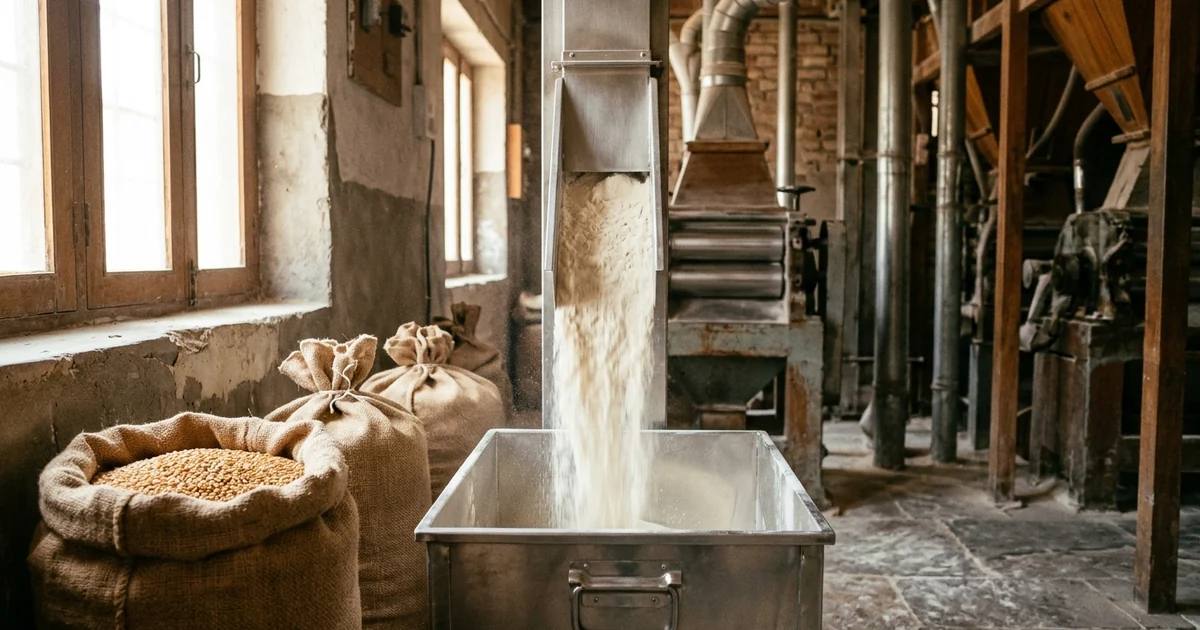
Whether you buy groceries asking a neighborhood kirana shopkeeper "maida kaise kg hai" or run a sweet-shop frying crisp samosas, namkeen, and pastries, understanding fair maida 1kg price in India starts straight at the wholesale wheat mandi and roller flour mill floor. Unlike stone-ground whole-wheat chakki atta milled locally across villages, refined wheat flour (maida) is milled almost exclusively inside multi-pass industrial roller flour mills that clean, temper, de-bran, and sift pure wheat endosperm into fine ivory flour.
Because raw wheat contributes the dominant share of flour-mill expense, maida ka bhav moves tightly alongside daily APMC wheat arrivals tracked on Agmarknet, Government of India Wheat MSP announcements, weekly Food Corporation of India (FCI) OMSS e-auction reserves, and national retail food monitoring overseen by the Department of Consumer Affairs. Explore wholesale wheat fundamentals across our Wheat Farmers Hub, inspect farm-gate grain trends inside Gehu Ka Rate and Wheat Rate Today, compare whole-wheat Atta Price trends, and review our broader Maida Market Overview.
How Wheat MSP (₹2,425–₹2,585/qtl) & FCI OMSS Auctions Shape Maida Ka Bhav
Indian households and confectioners sometimes wonder why white maida 1kg price rallies right ahead of winter festivals even though April Rabi harvesting filled silos months earlier. The causal link sits inside India’s Central Pool grain supply chain managed under the Ministry of Consumer Affairs, Food & Public Distribution (PIB and FCI):
- Official GOI Wheat MSP Baseline (PIB): For Fair Average Quality (FAQ) Rabi wheat, the Cabinet approved a Minimum Support Price of ₹2,425 per quintal for RMS 2025-26 and raised it by ₹160/qtl to ₹2,585 per quintal for RMS 2026-27—guaranteeing farmers an assured harvest floor while establishing higher baseline grain replacement values for open-market flour mills.
- Open Market Sale Scheme (OMSS) Mill Auctions: Between October and March ahead of fresh northern harvests, private roller mills participate actively in FCI OMSS e-auctions offloading FAQ and Under Relaxed Specifications (URS) Central Pool wheat stacks. Lower auction reserve prices ease wholesale 50-kg flour-mill bag quotes swiftly; tighter auction caps nudge open-mandi mill buying higher.
- Bharat Atta Spillover Parity: Under OMSS(D), central wheat allocated through NAFED, NCCF, and Kendriya Bhandar is milled into subsidized retail wheat flour (Bharat Atta), tempering speculative upward spikes across urban retail atta and 1-kg bakery flour shelves (consumeraffairs.gov.in).
Retail 1 Kg Packet vs Wholesale 50 Kg Katta Pricing Structure
Why does buying a hygienically sealed 1 kg maida supermarket brand pack cost noticeably more per kilogram than dividing a commercial 50-kg bulk mill katta invoice by 50? Look at every cost step separating factory roller sifters from a retail shelf:
| Supply Chain Tier / Pack Size | Typical Buyer Segment | Primary Cost & Quality Determinants | Official Price Verification Channel |
|---|---|---|---|
| Ex-Roller Flour Mill 50-Kg PP Katta | Commercial bakeries, biscuit units, mithai/namkeen makers | Mandi wheat rate / FCI OMSS bid + conditioning + multi-stage milling − choker bran realization | Agmarknet raw wheat rates (agmarknet.gov.in) & KisanPe Gehu Ka Rate hub |
| Wholesale Mandi / Distributor Trade (30–50 Kg Bags) | Town kirana grocers, street caterers, halwais | Ex-mill base + inter-district freight + trader credit & commission handling | Regional Grain Merchants & APMC market parity via KisanPe Mandi Rates |
| Loose Kirana Retail Weighing (500 g / 1 Kg) | Daily home kitchens ("maida kaise kg hai") | Bulk sack break-up + retail shop shrinkage + paper/poly carry bag | Department of Consumer Affairs Monitoring (consumeraffairs.gov.in) |
| Branded FSSAI-Sealed 500 g / 1 Kg Supermarket Packs | Modern trade & urban household baking | Multi-layer laminate barrier film, strict <14% moisture sorting, lab QA, GST/logistics & retail margin | FSSAI Regulation 2.4.2 packaging standards (fssai.gov.in) |
To read wholesale wheat arrivals across MP, UP, Punjab, and Haryana mandis that dictate flour-mill input costs every week, cross-check our Wholesale Wheat Price analysis, Daily Wheat Rate guide, Mandi Verification Manual, Mandi Ka Bhav hub, and regional flour insights in Wheat Flour terminology guide.
Statutory FSSAI Maida Standards (Regulation 2.4.2): Gluten, Ash & Acidity Limits
Not all bags carrying the word "maida" perform identically in kitchens or industrial ovens. Commercial bakeries producing yeast-leavened pav, sandwich loaves, and laminated puff pastry require higher gluten elasticity than samosa-strip or gulab-jamun makers, while unclean storage exposes flour quickly to rancidity and weevil infestation. Across India, the Food Safety and Standards Authority of India (FSSAI) enforces five strict analytical benchmarks under Food Products Standards Regulation 2.4.2 for Maida (Refined Wheat Flour):
| FSSAI Analytical Standard (Reg. 2.4.2) | Permissible Legal Limit | Practical Impact on Shelf Life & Cooking Quality |
|---|---|---|
| Moisture Content | Not more than 14.0% by mass (Max; select sub-norms up to 14.5%) | Flour milled above 14% cakes rapidly, turns sour, and grows hidden warehouse fungi |
| Gluten Content (on dry mass basis) | Not less than 6.0% (Min) | Determines stretchy dough strength—bread/naan flour blends target much stronger gluten |
| Total Ash (on dry mass basis) | Not more than 1.0% (Max) | High ash means leftover dark outer bran bits slipped past purifier sieves, dulling brightness |
| Acid-Insoluble Ash in dilute HCl | Not more than 0.1% (Max) | Detects poor wheat pre-cleaning, gritty sand dust, or unauthorized mineral/chalk adulterants |
| Alcoholic Acidity (as H2SO4 in 90% alcohol) | Not more than 0.15% (Max) | Signals stale old stock where oxidized fats turned flour bitter and rancid |
Maida vs Chakki Atta vs Suji: How Wheat Extraction & Bran Yield Affect Economics
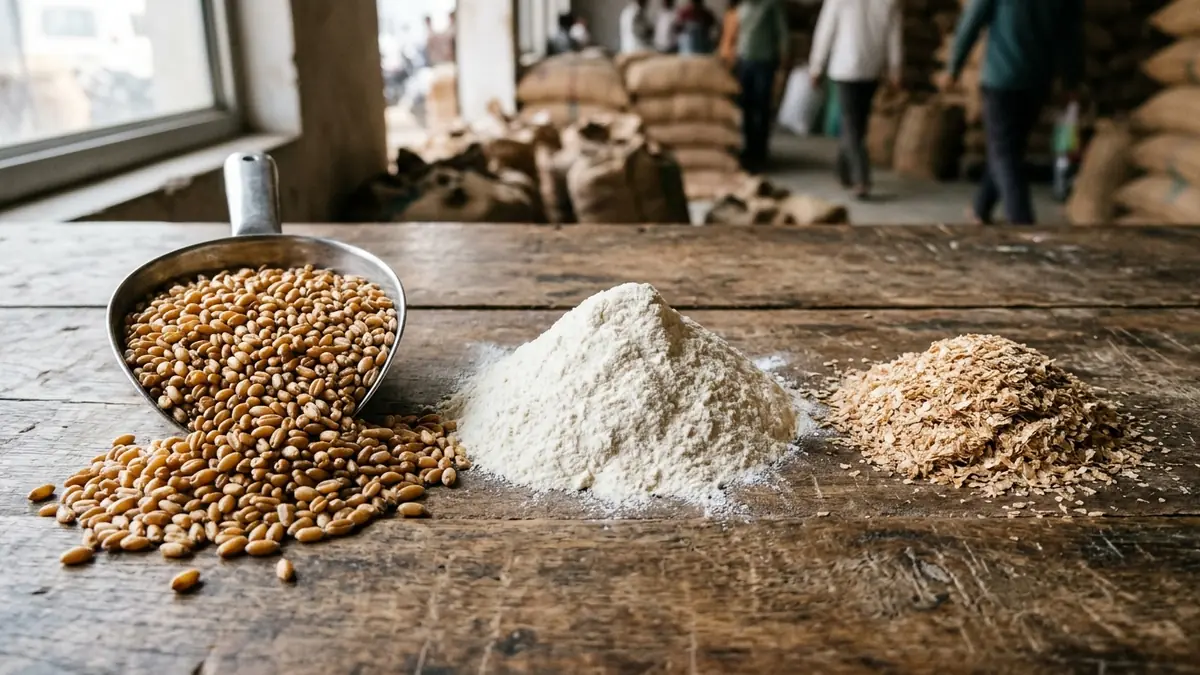
Understanding what leaves the roller sifter explains why millers convert one quintal of dry cleaned wheat into multiple profitable product streams instead of a single bag. Before grinding, tempered clean grain runs through fluted break rolls and smooth reduction rolls calibrated to separate three anatomical parts—an engineering balance studied extensively alongside cultivar hardness research by Indian Council of Agricultural Research (ICAR) wheat institutes:
- Whole-Wheat Chakki Atta (~95%–100% Extraction): Grinds clean whole grain preserving fibrous bran (choker), lipid-rich wheat germ, and sweet endosperm together—yielding earthy flavour and high dietary fibre while retaining shorter shelf life if moisture creeps up.
- Suji / Rawa (Coarse Semolina): Sifted mid-stage from clean hard endosperm granules rather than crushed completely down into silky flour—prized in South Indian upma, halwa, and pasta extrusion.
- Maida / Refined Flour (Fine Endosperm): Pure white starch-and-gluten interior sifted finely past bran skins—commanding low ash (≤1.0% dry weight) and clean ivory texture prized across confectioneries, noodles, and bakeries.
- Wheat Bran / Choker Co-Product: Fibrous outer seed coats sold immediately into dairy cattle feed markets; strong dairy cattle-feed demand helps mills subsidize pure flour pricing slightly, whereas slow choker off-take pushes flour bags higher.
How Farmers Earn Premiums From Milling-Grade Wheat & Safe Storage
Farmers across Madhya Pradesh, Punjab, Haryana, Rajasthan, and Uttar Pradesh directly influence downstream maida ka bhav through seed selection and harvest cleanliness. Hard bread-wheat varieties rich in grain protein and vitreous endosperm—developed with ICAR wheat breeding programs and disseminated through district Krishi Vigyan Kendras (KVKs)—mill cleanly into higher flour extraction percentages with minimal bran shatter, earning competitive private mill bids cleanly on APMC mandi floors.
Keep combine-harvested wheat clean of wild weed seeds and moisture above 12%, check spring rain alerts on KisanPe Weather hub, calculate seasonal input funding cleanly via our KCC Calculator, protect standing Rabi fields against March hail under PMFBY, and follow clean DA&FW post-harvest storage guidance so grain avoids insect-hole penalties before reaching flour mills.
Frequently asked questions
- What is the main difference between loose retail maida 1kg price and 50-kg wholesale mill katta cost?
- Industrial bakeries buying 50-kg commercial bags directly from roller flour mills pay close to ex-mill grain conversion value plus bulk bag handling. Single 1 kg retail maida packets absorb packaging film costs, lab-testing compliance (fssai.gov.in), wholesaler/distributor tiers, freight, and kirana retail margin tracked by the Department of Consumer Affairs. Compare whole-flour costs in our Atta Price guide and Maida Market guide.
- How does Government Wheat MSP affect maida ka bhav in India?
- Because raw wheat makes up the bulk of flour-mill production cost, raising central Wheat MSP directly shifts open-market raw-grain parity. According to Press Information Bureau (PIB) approvals, Wheat MSP rose from ₹2,425/quintal (RMS 2025-26) to ₹2,585/quintal (RMS 2026-27)—lifting baseline grain procurement floors across northern mandis (Agmarknet) covered in our Gehu Ka Rate hub.
- What role does FCI OMSS play in stabilizing maida and atta prices?
- During lean non-harvest months when open-mandi wheat supply tightens, the Food Corporation of India (FCI) conducts Open Market Sale Scheme (OMSS) e-auctions selling central pool wheat directly to qualified roller flour mills and processors—alongside OMSS(D) allocations powering subsidized retail Bharat Atta (PIB)—which cools speculative spikes cleanly across wheat market prices.
- What are the mandatory FSSAI standards for Maida (Refined Wheat Flour) under Regulation 2.4.2?
- Under FSSAI Regulation 2.4.2, genuine commercial Maida must comply strictly with: Moisture ≤14.0% (max by mass), Total Ash ≤1.0%, Acid-Insoluble Ash ≤0.1%, Gluten ≥6.0% (dry mass basis), and Alcoholic Acidity ≤0.15%, while remaining strictly free from foul odours, live insects, and filth. Check local flour vs wheat specs via Wheat Farmers Hub.
- Why can maida sometimes be priced closely to packaged chakki atta even after extra refining?
- Industrial roller mills process hundreds of tonnes daily with automated pneumatic plansifters and recoup secondary revenue by selling extracted outer bran (choker) briskly into dairy cattle-feed markets and semolina (suji) lines, whereas branded whole-wheat chakki atta often selects pricier specialty MP Sharbati or high-moisture stone-milled conditioning batches (Atta Price Guide). Always check daily wholesale quotes via Mandi Rates.
- Why does bakery maida behave differently from regular household samosa/bhatura maida?
- Yeast-risen loaves and flaky patties depend heavily on strong protein gluten networks (well above FSSAI’s 6.0% floor) milled carefully from harder high-protein wheat lines (ICAR grain research), whereas soft crisp Indian snacks mix tender medium-protein flours—check state wheat procurement varieties via your district KVK centre.
- How can sweet-shop buyers test if stored 50-kg maida bags have gone stale before frying?
- Inspect sealed pack dates, smell freshly opened flour for sour musty notes (which indicate high alcoholic acidity above FSSAI’s 0.15% limit from warm storage moisture above 14%), sieve a handful over white paper to spot red flour beetles (susri), and stack kattas off damp concrete floors on dry wooden pallets—monitor monsoon humidity spikes via KisanPe Weather hub.
- How do farmers check daily APMC wheat prices before selling grain to local roller mills?
- Check verified same-day Minimum, Maximum, and Modal wholesale wheat rates at your district mandi on Agmarknet (agmarknet.gov.in) alongside our Wheat Rate Today and Mandi Rates Guide—ensuring grain moisture stays ≤12% under DA&FW norms so mills never apply quality cuts.
- What financing and crop protection tools help wheat farmers avoid distress harvest sales?
- Wheat growers can fund certified high-protein Rabi seed and fertilizers via KCC Working Capital, insure standing winter wheat acreage against untimely March hail or storm lodging under PMFBY, and plan storage decisions calmly using Rabi Crops guidance rather than rushing uncleaned trailers at harvest.
- Bharat mein maida kaise kg hai aur maida 1kg price bazar mein kyun badalta rehta hai?
- Bazar mein loose ya packaged maida 1kg price seedhe gehu ke wholesale mandi bhav (agmarknet.gov.in), Bharat Sarkar ke wheat MSP (₹2,585/quintal RMS 2026-27 per PIB), FCI OMSS e-auction aur 50 kg mill katta packaging kharch par nirbhar karta hai. Rozana ke gehu, atta aur maida bhav check karne ke liye hamara Gehu Ka Rate aur Atta Price page dekhen.
This article is for general information only and is not financial advice. Loan and scheme eligibility depends on partner and government criteria.