Almond 1kg Price: Badam Rate per Kg, Mandi Bhav & Grades
Key takeaways
- The almond 1kg price in India ranges from ₹650 to ₹780 for standard California kernels (Nonpareil), ₹850 to ₹1,150 for Afghan Gurbandi, and ₹2,400 to ₹3,600 for premium Kashmiri Mamra badam as of November 2026.
- In wholesale terminal mandis (Delhi Khari Baoli and Mumbai APMC Vashi), bulk 10kg cartons trade at indicative wholesale benchmarks of ₹6,200 to ₹7,200 (₹620–₹720/kg) depending on kernel size count.
- Commercial kernel sizing standards follow international counts per ounce: 18/20 count (jumbo), 20/22 count (extra large), 23/25 count (standard medium), and 27/30 count (small confectionery grade).
- India imports over 85% of its commercial almond consumption from the United States (California), subject to an applied custom tariff of ₹35 per kg on in-shell almonds.
- Domestic Kashmiri Mamra almonds from Pulwama and Shopian boast superior oil content (50% to 54%) compared to California varieties (38% to 42%), commanding an exceptional 3x to 4x price premium.
The almond 1kg price in India ranges between ₹650 and ₹780 for standard California almonds, ₹850 and ₹1,150 for imported Afghan Gurbandi, and ₹2,400 to ₹3,600 for authentic GI-tagged Kashmiri Mamra badam as of November 2026. Commonly searched by buyers as badam price per kg or 1 kg almond price in india, almond rates are governed by kernel size counts (kernels per ounce), natural oil content, moisture percentages, processing grade, and import tariff structures. In India’s primary wholesale dry fruit hubs—most notably Asia’s largest spice and dry fruit market at Khari Baoli, Delhi, and the APMC Dry Fruit Market in Vashi, Navi Mumbai—commercial 10kg bulk bags trade at indicative wholesale benchmarks of ₹620 to ₹720 per kg.
Whether you are an agricultural trader sourcing bulk badam cartons, a baker or sweet manufacturer planning seasonal inventory, or a health-conscious consumer evaluating the nutritional and economic differences between California kernels and Kashmiri Mamra, this comprehensive guide delivers verified mandi rates, variety comparisons, shelling economics, import duty frameworks, and retail buying standards.
Almond Price per Kg Today: Variety-Wise & Mandi-Wise Rate Benchmark
Almond pricing in India exhibits substantial tiering based on botanical variety, geographical origin, and kernel integrity (whole vs broken pieces). The table below details verified indicative wholesale and retail price ranges across India’s major APMC mandis and dry fruit trading centers for November 2026.
| Badam Variety / Grade | Origin & Kernel Characteristics | Wholesale Rate (10kg+ Lot) | Retail Rate (per 1 Kg) | Primary Market Applications |
|---|---|---|---|---|
| California Nonpareil (23/25) | USA | Uniform oval, smooth skin, sweet taste | ₹620 – ₹690 / kg | ₹720 – ₹780 / kg | Daily snacking, packaging, corporate gifting |
| California Carmel / Butte | USA | Slightly darker skin, wrinkled surface | ₹590 – ₹640 / kg | ₹680 – ₹740 / kg | Commercial baking, badam milk, confectionery |
| California Jumbo (18/20) | USA | Bold extra-large kernels, premium visual | ₹710 – ₹770 / kg | ₹820 – ₹890 / kg | Luxury dry fruit platters, festival gift boxes |
| Afghan Gurbandi Badam | Afghanistan | Small kernel, 46-49% oil, rare bitter | ₹780 – ₹920 / kg | ₹950 – ₹1,150 / kg | Traditional Ayurvedic formulations, brain tonics |
| Kashmiri Mamra (Grade A) | J&K (India) | Concave boat shape, 50-54% oil | ₹2,200 – ₹2,700 / kg | ₹2,600 – ₹3,200 / kg | High-end health foods, pregnant mother nutrition |
| Kashmiri Mamra Special | Pulwama (India) | Single-origin organic, zero bitter | ₹2,800 – ₹3,200 / kg | ₹3,400 – ₹3,800 / kg | Premium therapeutic diets, luxury exports |
| In-Shell Kagzi Badam | Kashmir / Iran | Thin soft shell, cracked by hand | ₹450 – ₹550 / kg | ₹580 – ₹700 / kg | Traditional unbleached snacking in shell |
| Almond Tukda / Broken | Mixed | Halves and splits from processing lines | ₹440 – ₹510 / kg | ₹550 – ₹620 / kg | Sweets (mithai), ice cream topping, chikki |
California vs Kashmiri Mamra vs Gurbandi: Why Badam Prices Vary Widely
One of the most persistent confusions among Indian consumers is why badam price per kg ranges from ₹650 for California almonds all the way to ₹3,500+ for Kashmiri Mamra. While both belong to the Prunus dulcis species, their cultivation microclimates, harvesting mechanics, genetic profiles, and chemical compositions differ profoundly.
1. California Almonds (The Volume Leader): California produces roughly 80% of the world’s commercial almond supply through massive, highly mechanized orchards in the Central Valley. Varieties like Nonpareil, Carmel, Monterey, and Butte are harvested using mechanical tree shakers and automated huller-sheller processing facilities. California kernels are cosmetically uniform, visually attractive, sweet, and low in natural bitter amygdalin. However, their oil content is moderate (38% to 42%), and pasteurization is mandatory by US law (often using steam or propylene oxide treatment), which slightly diminishes live enzyme vitality.
2. Kashmiri Mamra Almonds (The Ayurvedic Gold Standard): Grown in high-altitude, cold Himalayan valleys across Pulwama, Shopian, and Budgam in Jammu & Kashmir, Mamra almonds represent less than 2% of the world’s total almond harvest. Trees are cultivated organically on traditional hill slopes without chemical fertilizers or mechanical irrigation, watered solely by Himalayan snowmelt. Mamra kernels have a distinctive concave boat shape with a pointed tip, a darker, wrinklier skin, and an extraordinary oil concentration exceeding 50% to 54%. Completely non-pasteurized and 100% natural, Mamra delivers significantly higher levels of monounsaturated fatty acids (MUFA), magnesium, and Vitamin E, justifying its steep price premium in Indian Ayurvedic nutrition.
3. Afghan Gurbandi Almonds: Originating from the mountain valleys of Afghanistan, Gurbandi badam (also called Choti Giri) are compact, slender kernels prized for their potent medicinal properties. Like Mamra, Gurbandi kernels have high oil density (46% to 49%). Because pollination is open and non-hybridized, roughly 3% to 5% of kernels in any batch carry a natural bitter taste due to trace amygdalin, which traditional medicine regards as a natural liver and respiratory cleanser.
Commercial Grading Standards: How Kernel Size & Count Drive Wholesale Rates
In the international and domestic wholesale trade, almonds are valued and bought based on standardized size gradings defined as kernel count per ounce (28.35 grams). A lower number indicates larger, plumper kernels, which command higher market prices due to superior visual presentation and consumer demand.
- 18/20 Count (Jumbo / Extra Large): 18 to 20 whole kernels per ounce. The largest commercial California grade, trading at a 15% to 20% premium over standard sizes. Heavily utilized in premium festival gift packaging and luxury dried fruit assortments.
- 20/22 Count (Large Grade): 20 to 22 kernels per ounce. A popular high-end retail pack size offering bold visual appearance with balanced unit weight.
- 23/25 Count (Standard Commercial Grade): 23 to 25 kernels per ounce. The volume benchmark of the Indian almond market, representing over 55% of all retail packet sales across supermarket shelves and local Kirana stores.
- 27/30 & 30/32 Count (Medium to Small Grade): 27 to 32 kernels per ounce. Smaller kernels favored by industrial sweet manufacturers (mithai karigars) for whole badam barfi, crushed almond garnishing, and chocolate manufacturing.
- Nonpareil Supreme vs US Extra No. 1: USDA quality classifications that mandate allowable percentages of chips, scratches, foreign material, and split kernels. Supreme grade limits chipping to under 10%, ensuring immaculate kernel presentation.
Import Tariffs, Currency Rates & Seasonal Price Drivers in India
Because domestic production in Jammu & Kashmir and Himachal Pradesh totals less than 15,000 metric tonnes annually—covering less than 5% of India’s 3,50,000 MT annual consumption—the domestic almond rate is intrinsically tied to global import dynamics, currency fluctuations, and customs duties.
Key Economic Factors Governing the Almond 1kg Price in India:
- Specific Customs Import Duty: India levies an import duty of ₹35 per kg on in-shell (inshell) almonds and ₹100 per kg on shelled almond kernels (giri). Because the in-shell tariff is dramatically lower, Indian importers import over 95% of almonds in their hard shells and process them locally in specialized shelling and grading mills in Delhi, Khurja, and Mumbai, creating domestic employment while reducing raw material landed costs.
- USD to INR Exchange Rate: Since California contracts are denominated in US Dollars (USD per pound), any depreciation of the Indian Rupee directly inflates the landed cost of container shipments arriving at Nhava Sheva (JNPT) and Mundra ports.
- California Crop Forecasts: The USDA National Agricultural Statistics Service (NASS) releases official California Almond Subjective and Objective crop estimates every May and July. Favorable winter chilling hours and bee pollination produce bumper 3.0-billion-pound harvests that depress global prices, whereas severe droughts or frost cause sharp price rallies.
- Diwali & Festive Demand Cycle: Domestic consumption peaks during the August to November festival corridor (Raksha Bandhan, Dussehra, Diwali, and the winter wedding season). Mandi arrivals from the new California crop begin reaching Indian ports by late October, with prices experiencing temporary festive premiums before stabilizing in mid-winter.
Shelling Economics: In-Shell (Kagzi) vs Shelled Kernel (Giri) Yields
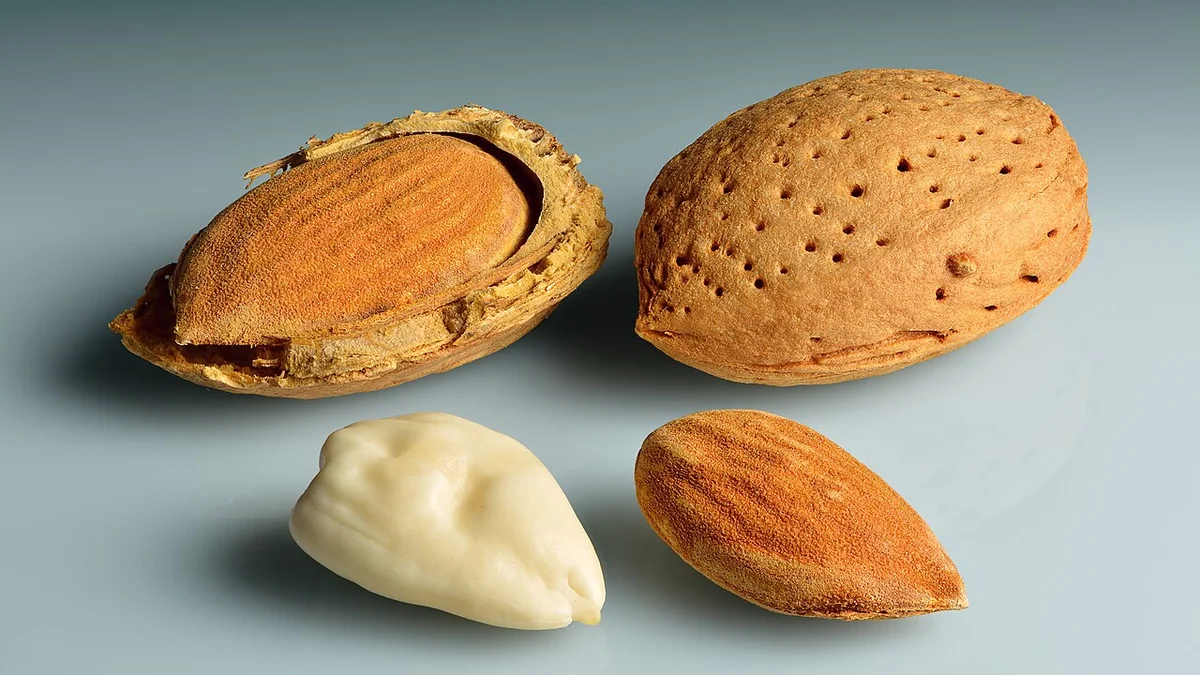
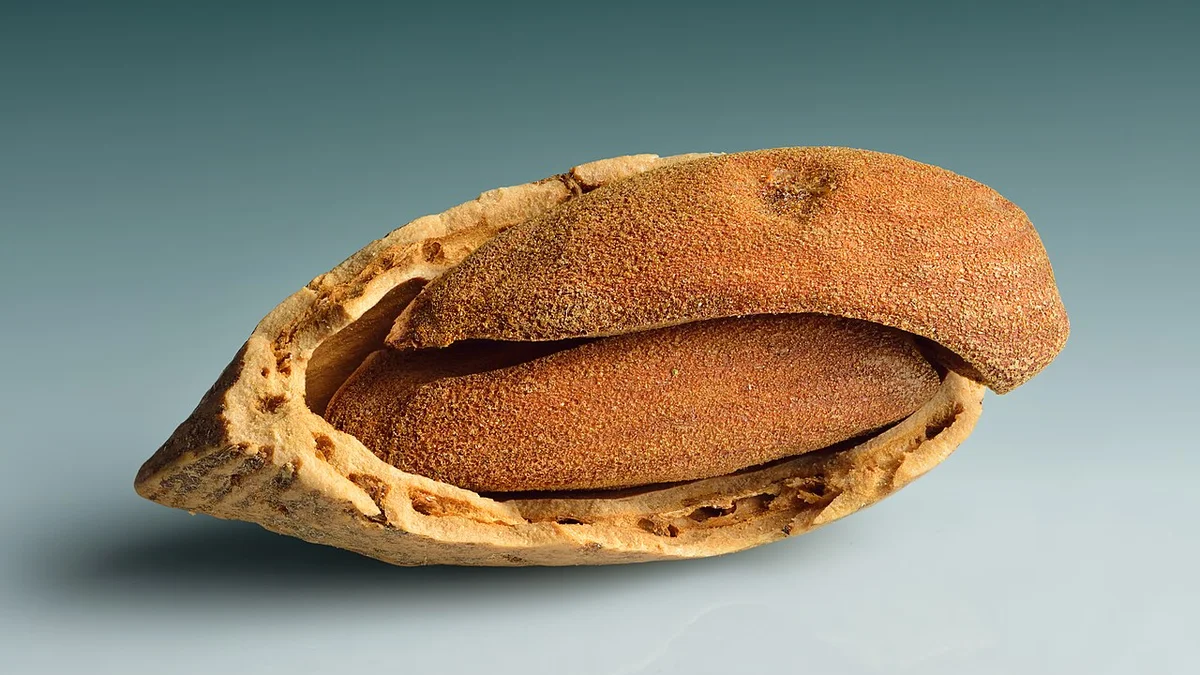
Traders and rural processors frequently evaluate the economics of buying in-shell almonds versus processed shelled kernels. In-shell almonds (Kagzi badam) are naturally encased in a protective fibrous outer hull and a woody inner shell.
Commercial Processing Parameters:
- Shelling Recovery Rate (Outturn): California Nonpareil soft-shell almonds deliver an average kernel outturn of 60% to 65% (i.e., 100 kg of in-shell almonds yields 60 to 65 kg of clean whole kernels). In contrast, thick-shell hard varieties deliver only 35% to 42% kernel recovery.
- Shelling & Processing Cost: Mechanical cracking, electronic color sorting, de-stoning, and aspirating costs approximately ₹8 to ₹12 per kg of processed raw in-shell input in modern Indian processing facilities.
- By-Product Value: Crushed almond shells find commercial resale markets as industrial abrasives, poultry bedding, and activated carbon feedstock, generating ₹3 to ₹5 per kg to offset processing overheads.
- Direct Sourcing Math: When in-shell almonds trade at ₹480 per kg at the port, a 62% recovery yield yields raw kernel cost of ₹774/kg before processing. Comparing this to processed wholesale kernel prices determines whether local shelling offers profit margins.
Retail Consumer Buying Guide: Spotting Adulteration & Quality Tests
Due to the premium value of almonds, adulteration and chemical cosmetic enhancement are widespread in unorganized retail markets. Dishonest traders frequently polish old, stale, or moldy kernels with chemical oils, paraffin wax, or artificial ochre dyes (geru / red oxide) to make dull kernels look fresh and shiny.
- The Water Rub Test: Place 5 to 6 almond kernels on a clean white paper towel and rub them firmly with a water-dampened thumb. If the paper or your skin leaves a reddish-brown or yellowish chemical dye stain, the almonds have been artificially polished with color dyes and should not be consumed.
- Internal Kernel Color: Cut an almond kernel lengthwise with a clean knife. The interior meat must be pristine milky-white or ivory. If the core exhibits a yellowish, translucent, or brown tint, the natural fats have turned rancid through oxidation, creating harmful free radicals and a bitter, soapy taste.
- The Soak & Skin Peel Test: Soak almonds in warm water for 4 to 6 hours. Fresh, high-quality almonds will plump up noticeably, and the papery brown skin (epidermis) will slide off effortlessly between two fingers. Stale, chemically treated, or sulfur-fumigated almonds retain tight, stubbornly clinging skins.
- Moisture & Crunch Check: Fresh kernels snap crisply when bitten, releasing a clean, nutty, sweet flavor. Leathery, chewy, or spongy textures indicate excessive moisture absorption (exceeding FSSAI’s 6% maximum moisture limit), increasing susceptibility to toxic Aspergillus flavus mold and aflatoxin contamination.
Dry fruit market intelligence & agricultural trade resources
Wholesale buyers and food processors can monitor related commodity markets to optimize procurement costs across diverse agricultural categories. Explore our wholesale market guides on cashew nut (kaju) wholesale prices, fresh and dry anjeer (fig) mandi rates, high-value spice tracking in cardamom auction price trends, and commercial essential oils in mentha oil commodity rates, alongside regional horticultural distributions via avocado commercial farming. For daily agricultural price intelligence across regional APMCs, consult the KisanPe daily mandi rates portal.
Traders can also verify official market arrivals and export standards through the Agmarknet Directorate of Marketing & Inspection, post-harvest schemes from the National Horticulture Board (NHB), international export notifications on the APEDA Agri-Exchange Portal, and temperate research updates from the ICAR - Central Institute of Temperate Horticulture (CITH Srinagar).
Frequently Asked Questions About Almond 1kg Prices & Mandi Bhav
Frequently asked questions
- What is the current almond 1kg price in India in 2026?
- In 2026, the almond 1kg price in India ranges from ₹650 to ₹780 for standard California Nonpareil almonds, ₹850 to ₹1,150 for Afghan Gurbandi almonds, and ₹2,400 to ₹3,600 for premium authentic Kashmiri Mamra badam. Bulk wholesale purchases in 10kg cartons at APMC mandis trade at ₹620 to ₹720 per kg. Compare with other dry fruits in our cashew price analysis.
- Why is Kashmiri Mamra badam so expensive compared to California almonds?
- Kashmiri Mamra almonds are grown organically in high-altitude Himalayan valleys without chemical inputs, producing less than 2% of the world almond supply. They contain over 50% to 54% natural oils (compared to 38-42% in California almonds), are completely non-pasteurized, and possess significantly higher Vitamin E and monounsaturated fatty acids, commanding a 3x to 4x price premium. Temperate orchard management can be reviewed with ICAR CITH Srinagar.
- What does almond count per ounce mean (e.g., 20/22, 23/25)?
- Almond size is commercially measured by kernel count per ounce (28.35 grams). A 18/20 count means 18 to 20 jumbo kernels per ounce; 20/22 represents large kernels; 23/25 is standard medium size; and 27/30 represents smaller kernels. Lower count numbers indicate larger individual nuts, which command higher market prices.
- Where is the largest wholesale market for almonds in India?
- Asia’s largest wholesale dry fruit market is Khari Baoli in Old Delhi (specifically Gadodia Market and Fatehpuri). In Western India, the APMC Dry Fruit Market in Sector 19, Vashi, Navi Mumbai, is the largest port-proximate terminal hub for imported container shipments. Regional fruit arrivals can also be tracked in our Gazipur Sabji Mandi market guide.
- How much import duty does India levy on almonds?
- India levies a specific customs import tariff of ₹35 per kg on in-shell (inshell) almonds and ₹100 per kg on shelled almond kernels (giri). Due to this duty difference, over 95% of almonds imported from California arrive in their hard shells and are cracked and processed locally in Indian shelling mills. Export and import policies are documented by the APEDA Agri-Exchange.
- What is the difference between Gurbandi badam and California badam?
- California almonds are large, uniform, sweet, and low in natural bitter amygdalin with 38-42% oil content. Afghan Gurbandi almonds are smaller, irregular kernels boasting higher oil density (46-49%) and antioxidant levels. Approximately 3% to 5% of Gurbandi kernels carry a mild natural bitter taste, which Ayurveda values for liver and respiratory wellness.
- How can you identify chemically polished or dyed almonds?
- Rub an almond kernel firmly against a damp white paper towel. If a reddish-brown or yellow tint stains the paper, the almonds have been adulterated with synthetic color dyes or paraffin polish. Cutting the kernel should reveal pure white internal meat; yellowish or translucent meat indicates rancidity.
- What is the shelf life of raw almonds, and how should they be stored?
- Whole raw almonds stored in a cool, dark, and dry pantry remain fresh for 6 to 9 months. Kept in airtight containers inside a refrigerator, shelf life extends to 18 to 24 months. For commercial stockpiling, cold storage units maintain 0°C to 4°C with relative humidity below 60% to prevent aflatoxin development.
- What is in-shell Kagzi badam, and what is its price?
- Kagzi badam refers to soft-shell almonds that can be cracked effortlessly by hand between two fingers. Harvested in Kashmir, Iran, and Afghanistan, in-shell Kagzi almonds trade at ₹450 to ₹600 per kg in wholesale mandis and ₹580 to ₹750 per kg in retail markets.
- Why do almond prices fluctuate during festive seasons like Diwali?
- Domestic dry fruit consumption surges by over 250% during the Raksha Bandhan to Diwali festive window due to corporate gifting, sweet manufacturing, and home celebrations. While fresh California crop shipments arrive in Indian ports in October/November, high seasonal demand creates temporary retail price spikes of ₹50 to ₹100 per kg.
- What are almond Tukda (broken kernels), and why are they cheaper?
- Almond Tukda consists of clean kernel halves, splits, and chipped pieces produced during mechanical de-shelling and sorting. Retaining identical nutritional value and taste as whole almonds, Tukda sells at a 25% to 35% discount (₹440–₹510/kg wholesale), widely used in badam milk, halwa, and bakery goods.
- Can almonds be grown commercially in India outside Jammu & Kashmir?
- Almonds require cold temperate climates with 400 to 800 winter chilling hours below 7.2°C, followed by frost-free dry spring conditions during blossom. Commercial orchards thrive in Kashmir (Pulwama, Budgam, Shopian) and parts of Himachal Pradesh (Kinnaur, Shimla) and Uttarakhand. Subtropical plains are agronomically unsuitable for commercial nut bearing. Growers exploring commercial horticulture can check subsidies from the National Horticulture Board.
This article is for general information only and is not financial advice. Loan and scheme eligibility depends on partner and government criteria.