Raw Turmeric Price Today: Varieties, Yield & Mandi Guide
Key takeaways
- Indicative wholesale mandi rates for fresh raw turmeric (kacchi haldi) in November 2026 range from Rs 2,800 to Rs 5,200 per quintal (Rs 28 to Rs 52/kg) for standard Salem and Erode cultivars, while urban retail rates average Rs 60 to Rs 110/kg.
- High-curcumin GI-tagged Lakadong raw turmeric from Meghalaya (7% to 9% curcumin vs 2.5% to 3.5% in plains cultivars) commands premium farmgate realizations of Rs 65 to Rs 120 per kg fresh.
- Fresh raw turmeric rhizomes carry 75% to 80% moisture; boiling, curing, and sun-drying yields a 4:1 to 5:1 dry recovery ratio (100 kg raw rhizomes yields 20 to 25 kg cured fingers).
- India produces over 75% of global turmeric (~11 to 12 lakh tonnes dry equivalent), led by Maharashtra (Sangli, Hingoli), Telangana (Nizamabad), Tamil Nadu (Erode, Salem), and Odisha (Kandhamal).
- Standard planting seed rate is 800 to 1,000 kg of healthy mother or finger rhizomes per acre, delivering 80 to 110 quintals (8 to 11 tonnes) of fresh raw turmeric per acre in 8 to 9 months.
- Spices Board of India, MIDH, and NABARD schemes provide capital subsidies for high-curcumin planting material, drip irrigation, shade-net nurseries, and solar turmeric boilers.
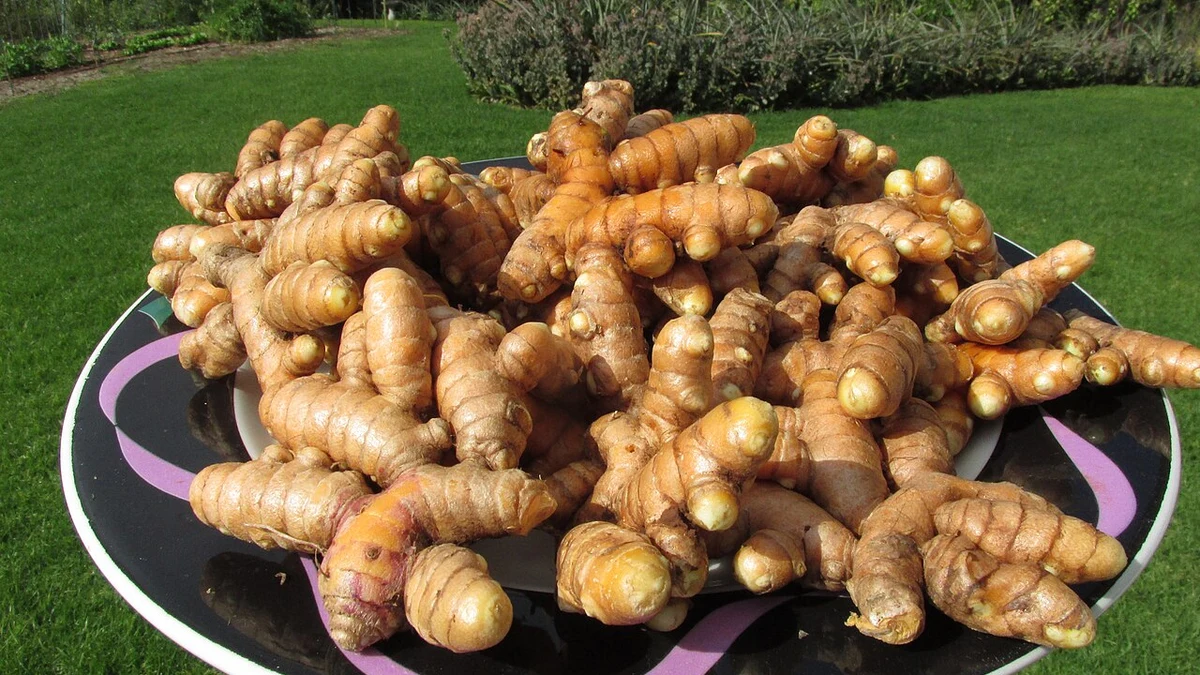
Raw turmeric (Curcuma longa), widely searched and traded across Indian kitchens and vegetable mandis as kacchi haldi (fresh wet turmeric rhizome), occupies a vital position across Indian culinary commerce, winter immunity diets, pickle processing, and spice export value chains. Unlike boiled, dried, and polished dry turmeric fingers traded on NCDEX futures—detailed in our NCDEX turmeric futures and Sangli-Nizamabad guide—raw turmeric consists of freshly dug underground rhizomes sold directly with natural field moisture intact, vibrant deep-orange flesh, crisp ginger-like texture, and high aromatic volatile oils (turmerone and zingiberene).
Across leading turmeric belts in Maharashtra, Telangana, Tamil Nadu, Andhra Pradesh, Karnataka, Odisha, and Meghalaya, cultivators evaluate a key marketing choice each winter between December and March: sell freshly dug raw turmeric immediately into brisk winter demand across metro vegetable markets, or incur boiling, drying, and polishing costs to enter dry-finger APMC auctions. Comparing fresh-versus-dry parity alongside Agmarknet market arrivals, Spices Board of India grading norms, and ICAR-IISR Kozhikode varietal data empowers farmers to maximize net income per acre. Growers monitoring wider wholesale crop movements can also review our daily mandi rates platform and Kisan Mandi trading directory.
1. Raw Turmeric Price in India: Mandi & Retail Rates (November 2026)
Unlike dry cured turmeric which holds stable warehouse prices year-round, raw turmeric prices follow sharp seasonal winter cycles. Retail demand peaks sharply across North India from November through February as households purchase fresh kacchi haldi for winter pickles, haldi ki sabzi, and immunity milk decoctions, before softening during peak February–April harvest arrivals in Maharashtra and Telangana.
| Variety / Origin | Key Hub / Mandi | Curcumin Range | Indicative Wholesale (Rs/Qtl) | Indicative Retail (Rs/kg) |
|---|---|---|---|---|
| Salem / Erode Fresh Raw Finger | Erode, Salem, Azadpur | 3.0% - 4.2% | Rs 3,200 - Rs 4,800 | Rs 60 - Rs 95 |
| Nizamabad / Sangli Rajapuri Raw | Nizamabad, Sangli, Pune | 2.8% - 3.8% | Rs 2,800 - Rs 4,400 | Rs 55 - Rs 85 |
| Lakadong GI-Tagged Raw | Jaintia Hills (Meghalaya) | 7.0% - 9.2% | Rs 6,500 - Rs 11,500 | Rs 140 - Rs 220 |
| Kandhamal Organic Raw Haldi | Kandhamal (Odisha) | 3.5% - 4.8% | Rs 3,800 - Rs 5,600 | Rs 80 - Rs 130 |
| Waigaon GI Raw Turmeric | Wardha (Maharashtra) | 5.5% - 6.8% | Rs 4,800 - Rs 7,200 | Rs 100 - Rs 160 |
| Mother Rhizome (Seed Grade) | Sangli, Erode, Warangal | 2.8% - 4.0% | Rs 4,200 - Rs 6,500 | Rs 55 - Rs 80 (Bulk Seed) |
Source: Compiled from Agmarknet (Directorate of Marketing & Inspection) fresh spice arrival bulletins, Spices Board of India market reports, and National Horticulture Board (NHB) metro mandi data as of November 2026. Disclaimer: Indicative figures exclude interstate cold-van transport and 5% retail sorting loss; verify local APMC rates before sale.
2. Fresh Raw Turmeric vs Cured Dry Turmeric: The 4:1 Recovery Math
Before deciding whether to sell raw turmeric fresh at farmgate or cure it into dry fingers, every grower must understand dry-matter recovery math. Freshly harvested raw turmeric rhizomes contain 75% to 80% water. When washed, boiled in pressurized steam kettles or open vats for 45–60 minutes to gelatinize starch, sun-dried on clean drying yards for 10 to 15 days, and mechanically drum-polished, weight drops sharply.
Standard commercial curing achieves an average dry recovery ratio of 20% to 25% (4.0 kg to 5.0 kg of raw turmeric produces 1.0 kg of dry polished finger turmeric), depending on cultivar fiber and maturity at harvest. Consequently, when dry cured turmeric trades at Rs 13,000 to Rs 15,000 per quintal (Rs 130–Rs 150/kg), the raw equivalent parity—before deducting Rs 6 to Rs 9 per kg in boiling firewood, labor, and polishing charges—stands near Rs 26 to Rs 34 per kg. Selling clean, bold raw kacchi haldi directly to winter wholesale mandis at Rs 38 to Rs 52/kg often yields superior immediate cash flow without tying up working capital for three weeks.
- Mother Rhizome (Gatta / Bulb): The thicker central rounded bulb from which fingers branch out; denser, higher starch, widely sold for seed planting and wet paste grinding.
- Primary & Secondary Fingers: Slender, crisp lateral shoots prized by urban retail consumers for kacchi haldi salads, pickles, and fresh juicing because they peel easily and offer vivid saffron-orange juice.
- Curcumin Bio-Potency: Curcuminoid concentration depends strongly on genetics and soil zinc/potassium balance rather than bright outer skin polish alone.
- Winter Price Premiums: Urban North Indian markets such as Delhi (Gazipur Sabji Mandi), Jaipur (Muhana Mandi), and Chandigarh pay 25% to 40% premiums for clean, mud-free, hand-graded orange fingers packed in 20 kg mesh bags.
3. Top High-Curcumin & High-Yielding Varieties in India (ICAR-IISR)
Varietal selection dictates both raw yield per acre and buyer price premiums. Traditional local cultivars typically yield 60 to 75 quintals of raw rhizomes per acre with 2.5% to 3.2% curcumin. Improved selections bred by the ICAR-Indian Institute of Spices Research (IISR), Kozhikode and state horticulture universities deliver 90 to 120+ quintals per acre alongside curcumin levels exceeding 5% to 6%.
| Variety Name | Primary Regions | Maturity (Days) | Fresh Raw Yield (Q/Acre) | Curcumin % | Key Commercial Advantage |
|---|---|---|---|---|---|
| IISR Pratibha | All India (Plains & South) | 225 - 240 | 110 - 135 Q/ac | 5.5% - 6.2% | Highest commercial curcumin among plains cultivars; bright orange flesh |
| IISR Pragati | Telangana, AP, UP, MH | 180 (Short) | 120 - 140 Q/ac | 4.8% - 5.2% | Short-duration; resistant to root-knot nematodes; escapes late water stress |
| Salem / Erode Local | Tamil Nadu, MH, MP | 240 - 270 | 95 - 115 Q/ac | 3.2% - 4.0% | Bold thick fingers; preferred for winter raw retail & dry-finger polish |
| Lakadong (GI) | Meghalaya, Northeast | 240 - 260 | 70 - 90 Q/ac | 7.0% - 9.2% | World-leading curcumin concentration; commands 2x–3x organic export price |
| Rajapuri / Sangli | Western Maharashtra | 240 - 260 | 90 - 110 Q/ac | 3.0% - 3.6% | Heavy bold rhizomes; huge domestic mandi liquidity at Sangli APMC |
| Roma & Suroma | Odisha, Bihar, WB | 240 - 250 | 95 - 115 Q/ac | 5.0% - 6.0% | Adapted to eastern red loams and tribal rainfed hill tracts |
Source: Official varietal release catalogs from ICAR-IISR Kozhikode and Spices Board of India (2026). Always purchase certified disease-free seed rhizomes tested negative for Pythium soft rot and bacterial wilt.
4. Raw Turmeric Cultivation Guide: Soil, Seed Rate, Spacing & Nutrition
Turmeric thrives in warm, humid tropical and subtropical conditions (20°C to 35°C) receiving 1,200 to 2,000 mm of well-distributed rainfall or reliable protective drip irrigation. Because the marketable produce develops entirely underground over 8 to 9 months, well-drained friable sandy loam, clay loam, or alluvial soils rich in organic carbon (pH 5.5 to 7.2) are essential. Heavy waterlogged black cotton clays without raised beds cause catastrophic rhizome rot during peak monsoon downpours.
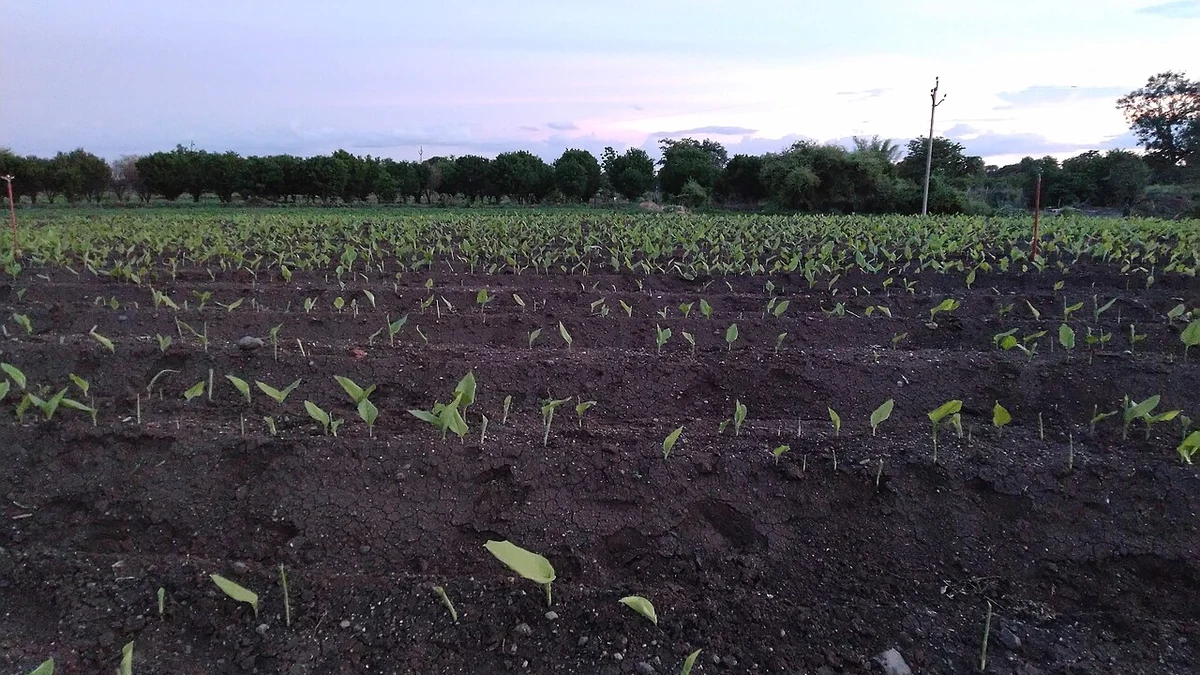
Planting occurs between late April and early June across most Indian plains. Farmers prepare 15–20 cm tall raised beds (1.0 m wide with 30–40 cm drainage furrows) using a tractor-mounted bed former or rotavator, incorporating 8 to 10 tonnes of well-decomposed farmyard manure or organic cow dung compost plus 200 kg neem cake per acre to deter soil nematodes and grubs. Disease-free mother or bold finger rhizome sets weighing 30–40 g each (with 2–3 sound sprouted buds) are planted at 30 × 25 cm or 45 × 15 cm spacing at a 5 cm soil depth, requiring 800 to 1,000 kg of seed rhizomes per acre.
- Mandatory Seed Rhizome Treatment: Before planting, dip seed rhizomes for 30 minutes in a tank mix of Mancozeb 75% WP (3 g/L) + Quinalphos or Imidacloprid systemic insecticide per CIB&RC label recommendations, then air-dry under shade for 24 hours (never direct sun).
- Green Mulching for Moisture: Cover beds immediately after planting with 4–5 tonnes per acre of green tree leaves (Pongamia, neem, or dried paddy straw) to suppress early weeds, conserve soil moisture, and moderate soil temperatures.
- Balanced Nutrient & Fertigation Schedule: Turmeric is a heavy potassium and nitrogen feeder. Beyond basal DAP and Muriate of Potash, top-dress nitrogen and potassium at 45, 90, and 120 days after planting, supplemented with foliar/drip feeds of water-soluble NPK 19:19:19 and chelated zinc/boron; customize exact doses using our Soil Health Card guide and fertilizer dosage calculator.
- Intercropping & Shade Tolerance: Because turmeric tolerates 30%–40% partial shade, it thrives profitably as an intercrop beneath young mango, coconut, arecanut plantations, or under 50% to 75% shade net houses in intense summer zones.
5. Protecting Raw Rhizomes from Soft Rot, Leaf Blotch & Scale Insects
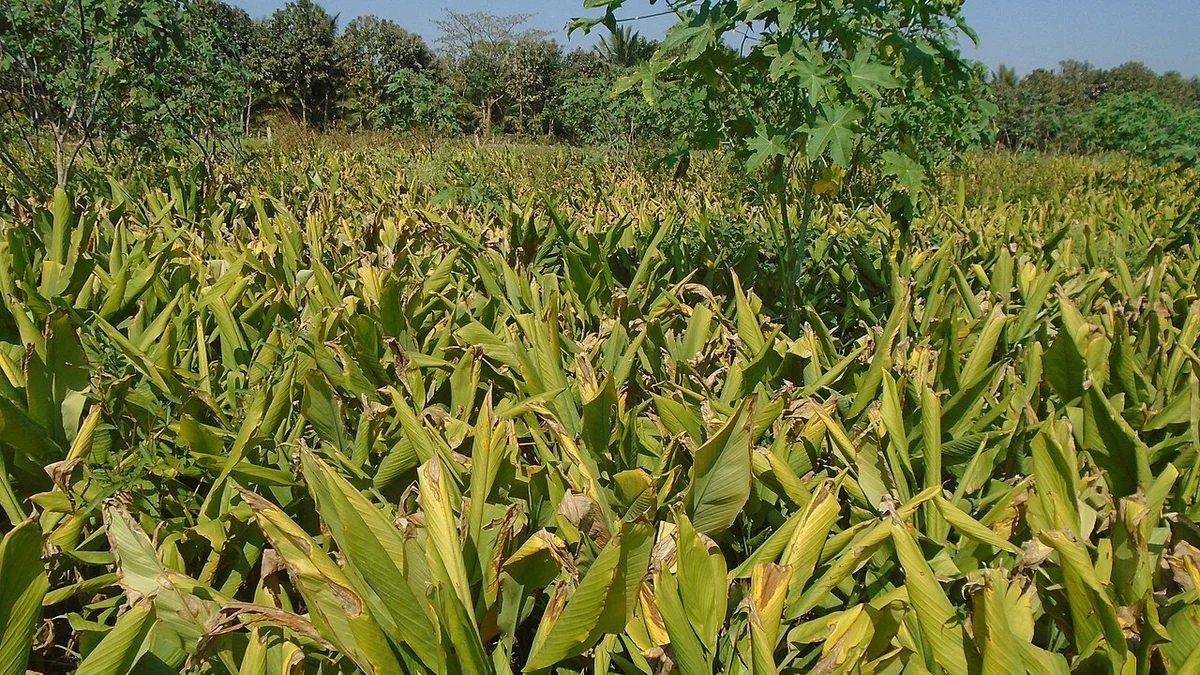
Even a high-curcumin cultivar loses 40% to 70% of marketable weight if waterborne fungi or chewing borers invade during the August–October monsoon phase. Preventive drainage, bio-agent enrichment with Trichoderma viride (2.5 kg mixed in 100 kg FYM per acre), and timely fungicidal intervention keep raw rhizomes firm, bright, and export-compliant.
- Rhizome Soft Rot (Pythium aphanidermatum): Water-soaked collar rot causes lower leaves to turn bright yellow and topple over while underground fingers liquefy. Ensure instant furrow drainage and drench affected beds immediately with 1% Bordeaux mixture or Metalaxyl + Mancozeb per CIB&RC label dosages.
- Leaf Blotch (Taphrina maculans) & Leaf Spot (Colletotrichum): Rusty brown elliptical spots coalesce across leaves, cutting photosynthesis during critical November bulking. Spray protective broad-spectrum fungicides or Carbendazim + Mancozeb at early lesion appearance.
- Shoot Borer (Conogethes punctiferalis): Larvae bore into central pseudostems causing "dead hearts" and frass extrusion. Scout fields weekly and apply targeted biological Bt or CIB&RC-approved formulations like lambda-cyhalothrin + thiamethoxam premixes when Economic Threshold Levels are exceeded.
- Rhizome Scale (Aspidiella hartii): Tiny white encrustations suck sap from stored raw seed rhizomes and field fingers, shrinking weight and ruining winter market gloss. Select scale-free mother stock and inspect storage heaps monthly.
6. Harvesting, Washing, Cold Storage & Market Channels
Raw turmeric reaches commercial maturity 7.5 to 9 months after planting when above-ground leaves turn pale yellow, dry down, and lodge naturally. Farmers cut dried foliage at ground level 7 days prior to digging, apply a light irrigation only if soil is rock-hard to prevent spade bruising, and lift intact clumps gently using specialized digging forks or tractor-mounted diggers.
Rhizomes earmarked for fresh kacchi haldi sale undergo careful separation of mother bulbs from slender fingers, trimming away fibrous rootlets, high-pressure clean water tumbling to strip adhering mud, and 24-hour shade air-drying to eliminate surface moisture without shriveling the tender outer skin. Packed in 20 kg breathable jute or mesh sacks, fresh raw turmeric maintains crispness for 15–20 days at ambient temperatures and up to 4 to 6 months in commercial cold storages maintained at 12°C–14°C and 70%–75% relative humidity (avoid freezing below 10°C, which causes chilling injury and dark internal browning).
7. Subsidies, ODOP Branding & Farmer Credit Support
Recognizing India’s global monopoly in turmeric exports, both central and state governments extend targeted support under the Mission for Integrated Development of Horticulture (MIDH), the Spices Board of India Spice Park infrastructure schemes, and One District One Product (ODOP) cluster programs across Nizamabad, Sangli, Erode, Kandhamal, and West Jaintia Hills. Registered FPOs and individual cultivators receive 40% to 50% subsidies on drip irrigation (PMKSY), 35% credit-linked capital support under PMFME for solar turmeric dryers, steam boilers, and curcumin-testing micro-units, and low-interest crop finance through Kisan Credit Card (KCC) loans.
Prospective growers can compute exact project returns with our crop income calculator, estimate government capital support via the subsidy calculator, review central scheme eligibility on our government schemes portal, and safeguard standing crops against hail or drought losses under PMFBY crop insurance, PMFBY claim status tracking, and AgriStack Farmer ID enrollment.
Frequently asked questions
- What is the price of 1 kg raw turmeric (kacchi haldi) in India right now?
- As of November 2026, indicative wholesale mandi rates for standard fresh raw turmeric (Salem/Erode/Rajapuri) range between Rs 28 and Rs 52 per kg (Rs 2,800 to Rs 5,200/quintal) on Agmarknet, while urban winter retail prices average Rs 60 to Rs 110 per kg. Premium GI-tagged Lakadong raw turmeric retails between Rs 140 and Rs 220/kg.
- How much dry turmeric is obtained from 100 kg of raw turmeric?
- Fresh raw turmeric contains 75% to 80% moisture. After boiling, curing, sun-drying, and polishing, 100 kg of raw turmeric yields roughly 20 to 25 kg of cured dry turmeric fingers (a 4:1 to 5:1 dry recovery ratio). Compare dry futures spreads in our NCDEX turmeric price guide.
- How many quintals of raw turmeric are harvested per acre?
- With improved high-yielding varieties like IISR Pratibha or IISR Pragati, raised-bed planting, drip irrigation, and balanced nutrition, farmers harvest 80 to 120 quintals (8 to 12 tonnes) of fresh raw turmeric per acre over an 8-to-9 month crop cycle. Estimate net profits via our crop income calculator.
- Which variety of raw turmeric has the highest curcumin percentage?
- Meghalaya’s GI-tagged Lakadong turmeric contains the highest natural curcumin concentration in the world at 7.0% to 9.2%, followed by Waigaon turmeric from Maharashtra (5.5%–6.8%) and ICAR-IISR Kozhikode bred IISR Pratibha (5.5%–6.2%), compared to 2.5%–3.5% in common local cultivars.
- What is the seed rate for planting raw turmeric per acre?
- Cultivating one acre requires 800 to 1,000 kg of healthy, disease-free mother or primary finger rhizomes (each 30–40 g piece with 2–3 viable eye buds) planted at 30 × 25 cm or 45 × 15 cm spacing on raised beds.
- Should farmers sell raw turmeric fresh or cure it into dry fingers?
- If winter mandi rates for clean fresh raw turmeric exceed Rs 38–Rs 45 per kg, selling fresh directly to metro markets often delivers superior cash flow because curing loses 75%–80% water weight and adds Rs 6–Rs 9/kg in boiling firewood, labor, and polishing charges.
- What is the best time to plant and harvest raw turmeric in India?
- Planting is done from late April to early June with pre-monsoon showers or drip irrigation. Harvest for fresh tender winter kacchi haldi begins partially from December onward, while full dry-matter peak maturity harvesting runs from January through March when foliage dries down completely.
- How can growers prevent rhizome soft rot in raw turmeric fields?
- Always plant on 15–20 cm raised beds with deep monsoon drainage furrows, treat seed rhizomes prior to sowing, enrich beds with Trichoderma viride, and drench emerging collar rot patches promptly with 1% Bordeaux mixture per agricultural extension norms.
- Can raw turmeric be grown under shade nets or as an intercrop?
- Yes. Turmeric thrives with 30% to 40% partial shade, making it an excellent intercrop under coconut, arecanut gardens, and young mango orchards, or inside 50%–75% agricultural shade net houses in intensely hot regions.
- How long can fresh raw turmeric rhizomes be stored without spoiling?
- Cleaned, shade-dried raw turmeric stays fresh for 15 to 20 days in cool, ventilated room conditions. In commercial cold storages held at 12°C to 14°C and 70%–75% relative humidity, raw seed and fresh market rhizomes keep cleanly for 4 to 6 months.
- Which government agencies support turmeric farmers with subsidies and exports?
- The Spices Board of India, National Horticulture Board (NHB), and MIDH state horticulture missions offer subsidies for improved seed rhizomes, micro-irrigation, solar boilers, organic certification, and export promotion under ODOP.
- Is raw turmeric more potent than dried turmeric powder?
- Fresh raw turmeric retains delicate volatile essential oils (such as ar-turmerone) and natural moisture that partially volatilize during high-temperature boiling and grinding, though dried cured powder concentrates non-volatile curcuminoids by weight due to water removal.
This article is for general information only and is not financial advice. Loan and scheme eligibility depends on partner and government criteria.