NECC Egg Rate Today: Zone-Wise Mandi Bhav & Trends
Key takeaways
- NECC egg rate today across major Indian production and consumption hubs trades within the wholesale range of Rs 4.90 to Rs 5.60 per piece, depending on regional logistics and seasonal demand.
- A standard commercial paper tray contains exactly 30 eggs, priced today between Rs 147 and Rs 168, while a commercial wholesale peti (box of 210 eggs or 7 trays) trades between Rs 1,029 and Rs 1,176.
- Barwala (Haryana) and Namakkal (Tamil Nadu) serve as India’s two primary poultry price engines, establishing daily benchmark rates for North India and South India respectively.
- The National Egg Coordination Committee (NECC) announces benchmark wholesale prices daily at e2necc.com through 27 zonal production and consumption committees to protect farmers from middlemen exploitation.
- Commercial layer farm break-even cost of production ranges between Rs 4.30 and Rs 4.80 per egg, heavily driven by poultry feed raw materials: maize (55% of diet) and soybean meal (25% of diet).
- Egg prices experience strong seasonality, surging by 15% to 25% during the winter peak (November to February) due to higher domestic protein consumption, and dipping during summer and religious fasting periods.
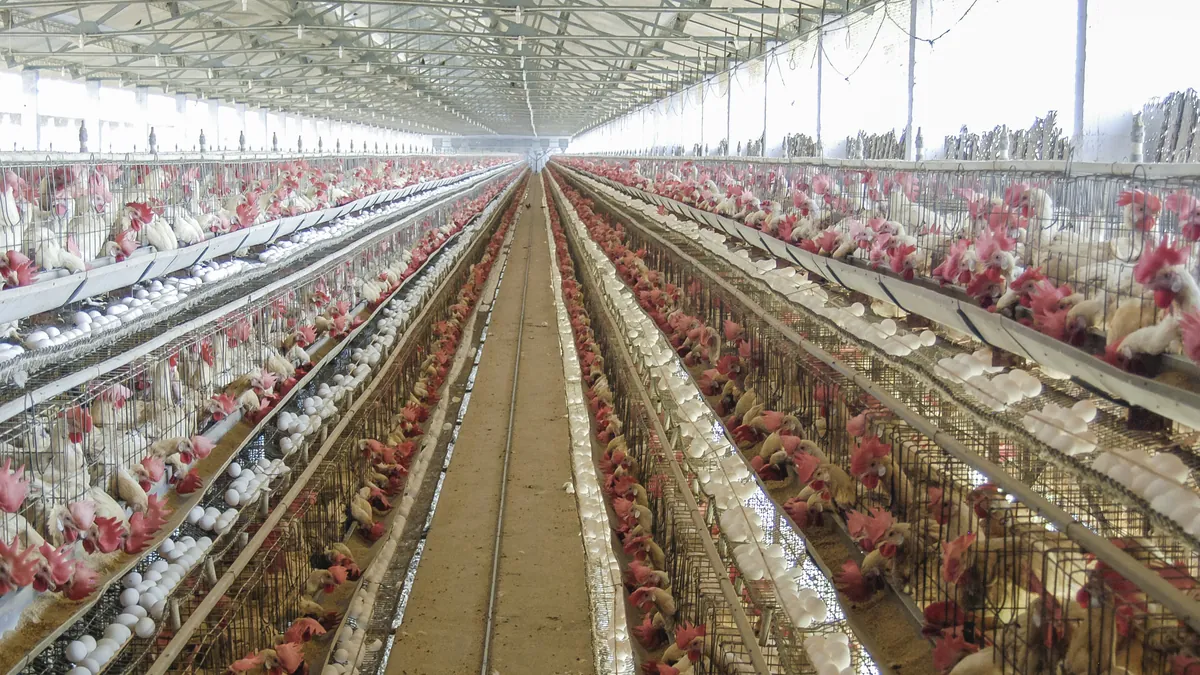
Eggs are one of India’s most affordable, nutrient-dense protein staples and the backbone of the domestic commercial poultry industry. India ranks as the world’s second-largest egg producer, manufacturing over 138 billion eggs annually. Unlike agricultural crops governed by government Minimum Support Prices (MSP), commercial poultry egg rates operate under a transparent, producer-managed price discovery mechanism spearheaded by the National Egg Coordination Committee (NECC). Poultry entrepreneurs can track related grain inputs and daily market quotations on our mandi rates platform and check wholesale agricultural rates across the national commodity price tracker.
For commercial layer farmers, wholesale poultry aggregators, retail grocers, and institutional food buyers, tracking the NECC egg rate today (एनईसीसी अंडा भाव आज का) is critical for managing daily procurement, egg tray packaging, cold storage dispatch, and operational farm cash flows. Prevailing rates fluctuate daily based on farm arrivals, inter-state transit freight, local weather conditions, religious fasting calendars, and volatile raw feed costs. Growers comparing layer revenues with allied agribusinesses can explore our commercial poultry farming guide, review parallel returns in our dairy farm setup guide, and study indigenous livestock yields in our Gir cow milk report.
NECC Egg Rate Today Across Indian Zones & Mandis
The National Egg Coordination Committee establishes daily wholesale prices across 27 distinct zones covering production belts and major urban consumption centers. Wholesale transactions occur in standard units of 100 eggs, 30-egg cardboard trays, and 210-egg corrugated master cartons (petis). Farmers monitoring regional spreads can examine specific northern rates in our Barwala egg rate report, check national benchmarks on our today egg rate guide, and review long-term industry margins in our egg rate overview.
The table below details prevailing indicative wholesale benchmark prices, tray conversions, and carton values across India’s primary poultry zones:
| Poultry Zone / Trading Center | Zone Role | Rate per Piece (Rs) | Rate per 100 Eggs (Rs) | 30-Egg Tray Cost (Rs) | 210-Egg Peti Value (Rs) |
|---|---|---|---|---|---|
| Barwala (Haryana) | North Production Hub | Rs 5.25 | Rs 525 | Rs 157.50 | Rs 1,102.50 |
| Namakkal (Tamil Nadu) | South Production Hub | Rs 5.00 | Rs 500 | Rs 150.00 | Rs 1,050.00 |
| Delhi (CC / Mandi) | North Consumption Center | Rs 5.45 | Rs 545 | Rs 163.50 | Rs 1,144.50 |
| Mumbai (CC) | West Consumption Center | Rs 5.50 | Rs 550 | Rs 165.00 | Rs 1,155.00 |
| Pune (Maharashtra) | West Production & Market | Rs 5.30 | Rs 530 | Rs 159.00 | Rs 1,113.00 |
| Hyderabad (Telangana) | South Production Engine | Rs 4.95 | Rs 495 | Rs 148.50 | Rs 1,039.50 |
| Kolkata (West Bengal) | East Consumption Center | Rs 5.60 | Rs 560 | Rs 168.00 | Rs 1,176.00 |
| Bengaluru (Karnataka) | South Metro Market | Rs 5.15 | Rs 515 | Rs 154.50 | Rs 1,081.50 |
| Ahmedabad (Gujarat) | West Commercial Zone | Rs 5.35 | Rs 535 | Rs 160.50 | Rs 1,123.50 |
| Kanpur / Lucknow (UP) | Central North Consumer | Rs 5.40 | Rs 540 | Rs 162.00 | Rs 1,134.00 |
| Ludhiana (Punjab) | North Production Belt | Rs 5.28 | Rs 528 | Rs 158.40 | Rs 1,108.80 |
| Vijayawada / East Godavari | Coastal AP Production | Rs 4.90 | Rs 490 | Rs 147.00 | Rs 1,029.00 |
Poultry farm operators balancing seasonal revenues often contrast layer returns against open market cash crops such as those covered in our sugar price today guide, the essential oil sector detailed in our mentha oil rate report, and plantation horticulture in our avocado price analysis. Producers can also plan their farm budget using our crop income calculator and estimate working capital borrowing costs via our Kisan Credit Card loan calculator.
The NECC Price Discovery Protocol: How Daily Rates Are Determined
Before the inception of the National Egg Coordination Committee in May 1982 by legendary poultry pioneer Dr. B.V. Rao, egg farmers across India were vulnerable to cartelization by wholesale traders and commission agents. Traders would artificially depress buying prices at the farm gate while maintaining exorbitant retail prices in urban cities, driving thousands of smallholder poultry farmers into bankruptcy. Today, NECC collaborates with statutory livestock departments under the Ministry of Fisheries, Animal Husbandry & Dairying (DAHD portal) to safeguard smallholder incomes.
NECC operates under the guiding motto "My Egg, My Price, My Life". To declare fair, remunerative benchmark prices, NECC established 27 local zonal production and marketing committees across India. Every evening between 5:00 PM and 6:30 PM, zonal committee members—comprising local commercial layer farmers, feed millers, and trade representatives—participate in telephonic and digital consultative conferences. Similar transparent auction systems are observed across major agricultural terminals like Bhawani Mandi and the major spice floor at Ramganj Mandi Kota.
The committees analyze three core variables: (1) Daily farm production and accumulated stock in farm holding rooms, (2) Inter-state movement and dispatches to major deficit metros like Delhi, Mumbai, and Kolkata, and (3) Prevailing retail clearance rates. Based on this consensus, NECC publishes recommended wholesale prices on its official portal (e2necc.com) and broadcasts them via SMS and digital channels to over 25,000 commercial poultry farms nationwide.
Packaging Math: Converting Piece, Tray, 100 Eggs & Peti Rates
In wholesale trade, price negotiations and invoices are handled in varied commercial units. Understanding standard packaging mathematics ensures farmers and retailers avoid calculation discrepancies during volume transactions. Farm logistics teams frequently utilize haulage tractors such as models from the Mahindra tractor range or reliable haulers from the Swaraj tractor lineup to transport crated petis from farm gates to regional mandi collection centers:
- Single Egg (Piece): The base retail pricing unit. When NECC quotes Rs 5.25 wholesale, neighborhood retail stores generally price eggs between Rs 6.50 and Rs 7.50 to cover transport breakages, paper bags, and retail margin.
- 100 Eggs: The primary accounting benchmark used in NECC declarations. A rate of Rs 525 per 100 eggs equals Rs 5.25 per egg.
- Egg Tray (30 Eggs): Standard molded paper pulp or plastic tray containing 5 rows of 6 eggs each. Tray Price = Per Egg Rate × 30. At Rs 5.25 per egg, a full tray costs exactly Rs 157.50.
- Wholesale Peti / Carton (210 Eggs): Standard corrugated transport box containing 7 nested trays (7 × 30 = 210 eggs). Peti Value = Per Egg Rate × 210. At Rs 5.25 per egg, one peti costs Rs 1,102.50. This is the primary unit used for inter-state refrigerated truck shipping.
- Truckload Lot (1,500 to 2,000 Petis): Commercial 10-wheeler trucks typically transport 3.15 lakh to 4.2 lakh eggs per shipment from Barwala or Namakkal to consumption markets.
Commercial Layer Farm Economics & Poultry Feed Linkage
The viability of commercial egg farming depends almost entirely on the spread between the NECC egg selling price and the cost of poultry feed. Feed expenses account for 70% to 75% of the total operating budget in a modern commercial layer poultry farm. Proper feed grain fertilization with balanced nutrients detailed in our DAP fertilizer manual and organic amendments from our humic acid soil conditioner guide directly supports the cultivation of high-yield feed crops like grain sorghum, soybeans, and paddy crop fields.

A high-yielding commercial layer hen (such as BV-300, Hy-Line Brown, or Lohmann) consumes approximately 110 grams of balanced compound mash feed daily. Over a commercial laying cycle of 72 to 80 weeks, each bird produces between 310 and 330 marketable eggs. If feed cost averages Rs 34 per kg, the direct daily feed cost per bird is Rs 3.74. With a standard hen-day egg production efficiency of 92%, the raw feed cost per egg equals approximately Rs 4.06.
| Cost / Feed Ingredient Component | Percentage in Diet (%) | Indicative Price (Rs/kg) | Cost Contribution per Egg (Rs) | Operational Role |
|---|---|---|---|---|
| Yellow Maize (Corn) | 55% – 60% | Rs 22 – Rs 26 | Rs 2.10 – Rs 2.35 | Primary carbohydrate energy source for bird metabolism |
| Soybean De-Oiled Cake (DOC) | 22% – 26% | Rs 42 – Rs 48 | Rs 1.25 – Rs 1.45 | Essential crude protein (46-48%) for egg albumen formation |
| De-Oiled Rice Bran (DORB) / DDGS | 8% – 12% | Rs 14 – Rs 18 | Rs 0.25 – Rs 0.35 | Fiber source and economic crude protein extender |
| Limestone Grit / Calcite / DCP | 7% – 9% | Rs 6 – Rs 12 | Rs 0.15 – Rs 0.22 | Calcium and phosphorus essential for rigid eggshell synthesis |
| Vitamins, Amino Acids & Minerals | 1% – 2% | Rs 150 – Rs 250 | Rs 0.12 – Rs 0.18 | Methionine, lysine, and trace vitamins for disease immunity |
| Day-Old Chick (DOC) Amortization | N/A | Rs 38 – Rs 45 per bird | Rs 0.25 – Rs 0.32 | Initial chick purchase amortized across 315 egg lifetime |
| Vaccines, Labor, Power & Packaging | N/A | Fixed Farm Overhead | Rs 0.40 – Rs 0.55 | Marek/ND vaccination, electricity, water, and farm wages |
| Total Production Cost per Egg | 100% | Cumulative Budget | Rs 4.30 – Rs 4.80 | Break-even farm-gate benchmark threshold for layer farmers |
When NECC wholesale quotes trade above Rs 5.20 per egg, a 10,000-bird layer farm generates Rs 1,50,000 to Rs 2,50,000 in monthly net operating profit. Energy-intensive poultry sheds are increasingly deploying off-grid solar panels under the PM Kusum solar scheme or adopting agricultural solar units reviewed in our solar water pump guide to cut shed cooling expenses. Farmers can also verify state agricultural welfare transfers through our DBT payment status guide and complete Aadhaar verification via the farmer e-KYC portal.
Seasonality & Demand Cycles: What Drives Egg Prices Throughout the Year
Egg consumption in India follows sharp, predictable seasonal curves influenced by climatic conditions and cultural festivities. Vegetable farmers selling in regional APMCs tracked in our sabji mandi wholesale guide also observe similar festive price shifts:
- Winter Consumption Surge (November to February): Cold weather drives high egg consumption across North and Eastern India. Schools, street food vendors, bakeries, and households increase egg consumption, pushing NECC wholesale prices to seasonal highs between Rs 5.50 and Rs 6.30 per piece.
- Summer Slump (April to June): Extreme summer temperatures (exceeding 42 deg C in the northern plains) reduce consumer egg demand due to traditional dietary beliefs that eggs produce "internal body heat". Simultaneously, high ambient temperatures accelerate spoilage, forcing poultry farmers to liquidate stocks rapidly at discounted rates (often dropping below Rs 4.20 per egg).
- Shravan (Sawan) & Navratri Fasting Dips: During the auspicious Hindu month of Shravan (July-August) and the 9-day Navratri festivals in spring and autumn, vegetarian dietary practices peak across Western, Northern, and Central India. NECC prices frequently drop by 50 to 80 paise per egg during these periods.
- Post-Diwali & New Year Rally: Immediately following Diwali and extending through Christmas and the New Year, confectionery and bakery demand for whole eggs and liquid egg yolk surges, revitalizing wholesale rates.
Frequently asked questions
- What is the NECC egg rate today in major Indian cities?
- NECC egg rate today ranges between Rs 4.90 and Rs 5.60 per piece wholesale across major Indian centers. Primary production hubs like Barwala (Haryana) and Namakkal (Tamil Nadu) quote around Rs 5.00 to Rs 5.25 per egg, while major consumption metros like Delhi, Mumbai, and Kolkata trade between Rs 5.40 and Rs 5.60 per egg. You can check daily rates on our mandi rates platform.
- How much does a 30-egg tray cost today based on NECC rates?
- At prevailing NECC wholesale rates of Rs 4.90 to Rs 5.60 per egg, a standard cardboard tray of 30 eggs costs between Rs 147 and Rs 168 at wholesale mandi points, with retail supermarket prices ranging from Rs 190 to Rs 220. See national price comparisons in our today egg rate guide.
- How many eggs are in one commercial wholesale peti (carton)?
- One commercial wholesale peti (carton) contains exactly 210 eggs, packaged as 7 stacked trays of 30 eggs each. At current rates, a peti trades between Rs 1,029 and Rs 1,176.
- What is the official website to check daily NECC egg rates?
- The official web portal of the National Egg Coordination Committee is e2necc.com, where zone-wise wholesale prices for all 27 regional committees are updated daily every evening.
- Why are egg prices in Barwala and Namakkal cheaper than Delhi and Mumbai?
- Barwala and Namakkal are massive rural production clusters hosting millions of layer hens. Consuming metros like Delhi, Mumbai, and Kolkata rely on inter-state truck transport, adding freight, transit breakage (1-2%), and local handling charges of 30 to 50 paise per egg. Detailed regional trends are analyzed in our Barwala egg rate report.
- What is the break-even cost of egg production for a commercial layer poultry farmer?
- According to poultry farm economic audits, the average cost of producing one egg in India is between Rs 4.30 and Rs 4.80, with feed (maize and soybean meal) accounting for approximately 75% of total expenses. Layer operators can benchmark overall livestock budgets using our farm income calculator.
- Why do egg rates drop significantly during the summer months?
- High summer temperatures reduce consumer egg consumption due to dietary preferences, while heat stress forces farmers to sell eggs quickly before room temperatures spoil egg freshness, creating temporary spot market supply gluts.
- How does the price of maize and soy meal impact egg prices?
- A commercial layer bird consumes 110 grams of feed daily, consisting of 55% maize and 25% soy meal. If maize or soy meal prices rise by Rs 5 per kg, the cost of egg production increases by roughly 25 to 30 paise per egg.
- Are NECC egg rates legally binding on private traders?
- NECC declared rates are recommended benchmark prices created by a voluntary association of poultry farmers. While not statutory laws, they serve as the universal industry benchmark across all major poultry mandis and wholesale supply contracts.
- When does the egg rate reach its annual highest price in India?
- Egg rates historically reach their annual peak between November and January during peak winter, when colder temperatures double household consumption and breakfast street food demand across North and Central India.
- What is the difference between brown eggs and white eggs in NECC pricing?
- NECC daily declarations reflect commercial white leghorn eggs. Brown eggs, produced by specific heavier layer breeds like Rhode Island Red, sell at a 20% to 40% retail premium due to perceived organic value and higher bird feed consumption.
- Can poultry farmers access institutional bank loans under the Kisan Credit Card (KCC)?
- Yes. The Government of India extends Kisan Credit Card (KCC) working capital facilities to poultry farmers at a subsidized interest rate of 4% per annum upon prompt repayment. You can calculate your scale of finance using our KCC loan calculator.
This article is for general information only and is not financial advice. Loan and scheme eligibility depends on partner and government criteria.