Soyabean Rate Today: Mandi Bhav, MSP & Price Forecast
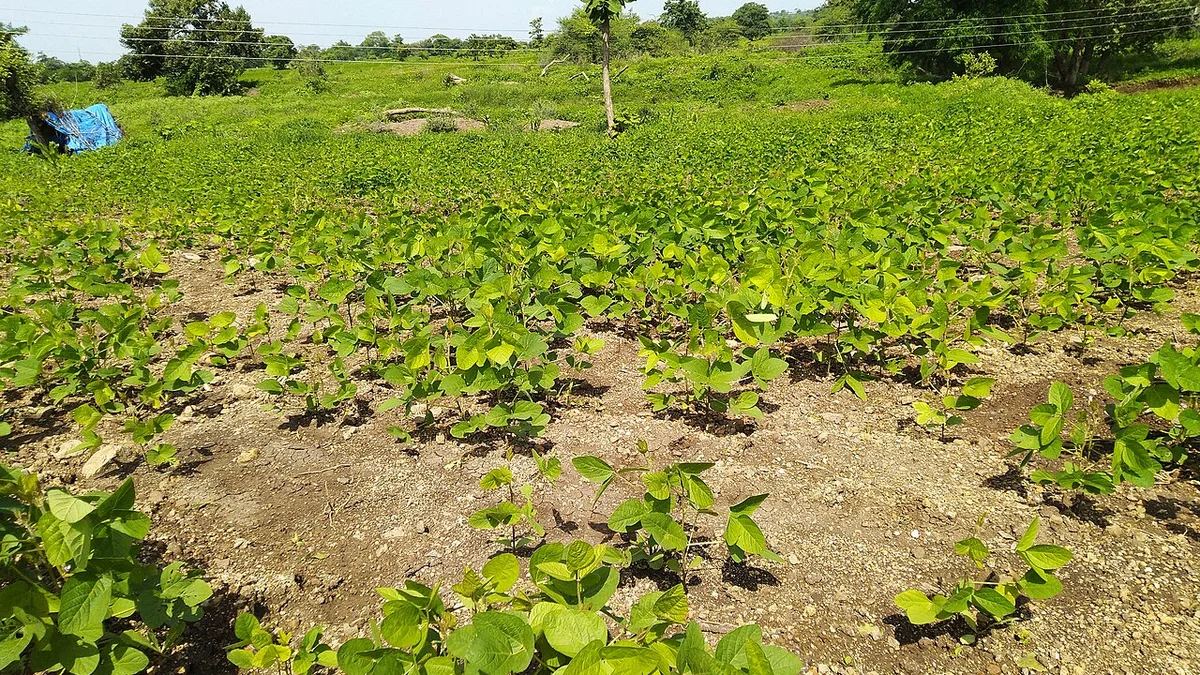
Soyabean (Yellow Soybean) is the premier kharif oilseed crop anchoring the agricultural economy of central and western India, particularly across Madhya Pradesh (the 'Soybean Bowl of India'), Maharashtra, and Rajasthan. Governed by quality benchmarks defined by the Commission for Agricultural Costs and Prices (CACP) and tracked systematically on the national agricultural market portal (Agmarknet), soyabean rates directly dictate the livelihood of millions of farming families and drive the raw material supply for India’s massive soy oil refining and de-oiled cake (DOC / soymeal) export processing industries.
1. Soyabean Rate Today: Mandi Bhav Across Major Indian States
Today, wholesale soyabean auction rates across primary APMC market yards range from ₹4,100 to ₹4,850 per quintal for standard Fair Average Quality (FAQ) yellow soybean, with premium dry lots (under 10% moisture) fetching up to ₹5,050 per quintal. For the current marketing season, the Government of India has fixed the Minimum Support Price (MSP) for soyabean (yellow) at ₹4,892 per quintal, providing a baseline price floor for official state procurement under the PM-AASHA price support scheme. Below is the comprehensive daily rate breakdown across prominent trading hubs in Maharashtra, Madhya Pradesh, and Rajasthan.
| State & Primary Mandi | Daily Arrival (Quintals) | Minimum Price (₹/Q) | Modal / Average Bhav (₹/Q) | Maximum Price (₹/Q) |
|---|---|---|---|---|
| Indore Mandi (Madhya Pradesh) | 15,000 - 28,000 Q | ₹4,250 | ₹4,680 - ₹4,820 | ₹5,020 / Quintal |
| Ujjain Mandi (Madhya Pradesh) | 10,000 - 18,000 Q | ₹4,200 | ₹4,640 - ₹4,780 | ₹4,950 / Quintal |
| Latur Mandi (Maharashtra) | 18,000 - 32,000 Q | ₹4,300 | ₹4,720 - ₹4,880 | ₹5,060 / Quintal |
| Akola Mandi (Maharashtra) | 12,000 - 22,000 Q | ₹4,220 | ₹4,650 - ₹4,810 | ₹4,980 / Quintal |
| Kota Mandi (Rajasthan) | 8,000 - 14,000 Q | ₹4,180 | ₹4,600 - ₹4,750 | ₹4,920 / Quintal |
| Nagpur Mandi (Maharashtra) | 6,500 - 11,000 Q | ₹4,240 | ₹4,670 - ₹4,800 | ₹4,970 / Quintal |
Source: Official benchmark data compiled from Ministry of Agriculture & Farmers Welfare, ICAR research bulletins, State Agricultural Marketing Boards, and Agmarknet official market records (Updated 2026).
2. Quality Grading Standards: Moisture, Oil Content & Foreign Matter
At mandi auction yards and solvent extraction plants, soyabean lots undergo rigorous quality testing. Top modal prices require compliance with standard FAQ parameters: 1. Moisture Content: Must remain strictly at or below 10.0% by weight. Lots with 12% to 15% moisture face price deductions of ₹100 to ₹300 per quintal. 2. Foreign Matter & Dust: Must not exceed 1.5% to 2.0%. 3. Damaged / Green Seeds: Immature green seeds from early harvesting must be below 2.0%, as green seeds impart high chlorophyll into refined soy oil, degrading oil clarity and shelf life.
3. Global Edible Oil Import Parity & NCDEX Futures Influence
Domestic soyabean prices are intrinsically linked to international commodity dynamics, notably the Chicago Board of Trade (CBOT) soybean futures, Brazilian harvest yields, and import tariffs on crude palm oil (CPO) and degummed soy oil imported from Malaysia, Indonesia, and Argentina. On the domestic National Commodity and Derivatives Exchange (NCDEX), soybean futures contracts reflect market sentiment regarding crush margins, monsoon coverage, and export demand for Indian non-GMO soymeal.
| Quality Parameter | FAQ Grade Benchmark | Permissible Limit | Rejection / Severe Dockage Threshold |
|---|---|---|---|
| Moisture Content (Max) | 10.0% by weight | 12.0% by weight | Above 14.0% (Risk of heating & mold) |
| Oil Content (Dry Basis) | Minimum 18.0% | 17.0% - 17.5% | Below 16.5% |
| Foreign Matter / Weeds | Under 1.5% | 2.5% maximum | Above 4.0% |
| Green / Immature Seeds | Under 2.0% | 3.5% maximum | Above 6.0% |
| Splits & Broken Grains | Under 5.0% | 10.0% maximum | Above 15.0% |
4. Solvent Extraction Crush Margins & De-Oiled Cake (DOC) Exports
The purchasing appetite of domestic solvent extraction plants is determined by the crush margin equation: 1 quintal (100 kg) of raw soyabean yields approximately 18 kg of crude degummed soy oil, 80 kg of high-protein de-oiled cake (DOC / soymeal), and 2 kg of refining loss. Because Indian soyabean is 100% certified non-GMO, Indian soymeal commands a premium in export markets across Southeast Asia, Europe, and the Middle East for poultry and livestock feed formulations.
5. Post-Harvest Storage & Strategic Selling Guide for Farmers
Historical market analysis reveals that soyabean prices typically hit seasonal lows during October and November when post-monsoon harvest arrivals flood mandis. Farmers who dry their harvest to 9% to 10% moisture and store it in clean gunny bags on wooden pallets routinely capture price increases of 15% to 25% by holding stock until February or April. Registered warehouse receipt financing allows cultivators to pledge stored soyabean and secure low-interest working capital loans.
6. Government Procurement Under PM-AASHA & Bhavantar Schemes
When open market auction rates dip below the official MSP of ₹4,892 per quintal, the central government activates the Pradhan Mantri Annadata Aay Sanraksan Abhiyan (PM-AASHA). Through state nodal agencies like NAFED and state cooperative marketing federations, farmers can sell up to 25% to 40% of their marketable surplus directly at the full MSP rate, ensuring comprehensive income protection against global commodity volatility.
7. Weather Impact, Sowing Acreage & Long-Term Price Outlook
The supply fundamentals of Indian soyabean are intensely sensitive to the spatial and temporal distribution of the Southwest Monsoon. Sowing across the central black soil belts of Malwa, Vidarbha, and Marathwada commences with the onset of monsoon rains in late June. Adequate vegetative soil moisture during July flowering and August pod formation is vital; prolonged dry spells or late-season waterlogging in September can reduce yields by 20% to 35% and trigger price rallies across physical mandis.
Looking ahead, growing domestic demand for poultry feed and expanding health-conscious consumption of refined soy oil provide strong structural support to market prices. Analysts advise agriculturalists to track weekly arrivals at bellwether mandis like Latur, Akola, and Indore, setting phased selling targets between ₹4,900 and ₹5,400 per quintal during the January-to-April off-peak supply window to maximize net farm revenue.
8. Agricultural Inputs, Mechanization & Allied Farm Operations
Maximizing farm gate returns in soyabean rate today begins with strong agronomic management, calibrated soil nutrition, clean irrigation, and efficient harvesting machinery. Growers systematically coordinate crop care through Triple Super Phosphate (TSP) root nutrition guide, Bayer Solomon broad-spectrum insect control, cumin seed (jeerige) pricing and grading, Single Super Phosphate (SSP) sulphur and phosphorus nutrition, melon seed (magaz) wholesale market trends, sesame seed (ellu) agronomy and market rates. Modern field execution and transport rely heavily on comparing specs and subsidies across hydraulic tipping and non-tipping tractor trolley prices, Agrimachinery DBT SMAM tractor and implement portal, John Deere 5310 4x4 55 HP CRDi tractor specs, Farmtrac 45 Classic Supermaxx tractor review, Swaraj 855 FE 4x4 heavy-duty 52 HP specs, dual-purpose tractor gadi haulage models, John Deere India tractor lineup and pricing, Swaraj 735 FE 39 HP utility tractor review, full Swaraj tractor HP lineup and pricing. For specialized tillage, haulage, and water distribution, cultivators also evaluate Swaraj 744 FE and XT torque and fuel economy, Mahindra 575 DI 45 HP workhorse mileage guide, Mahindra 575 DI XP Plus 47 HP torque and review, New Holland 3630 TX Plus 4x4 55 HP tractor specs, Powertrac Euro diesel-saver tractor models and prices, VST Shakti and Kubota 12-15 HP power tiller prices, Farmtrac heavy tractor series and diesel saver specs, Solis 4515 E Yanmar-tech tractor specifications, field tractor power testing and safety buying checks, sprinkler irrigation layout and PMKSY subsidy.
9. Regional Mandi Networks, Credit Schemes & Official Data Sources
Across India's regulated market ecosystem, farmers compare live realizations across state trading yards and tap formal welfare and institutional financing. Growers benchmark regional supply arrivals and MSP procurement across Jakhal Mandi Fatehabad grain auction rates, Mangoli & Sangli regional fruit mandi bhav, Dhamnod Mandi cotton and soyabean arrivals, Kalapipal Mandi onion and garlic auction rates, wheat (gehu) cultivation varieties and grain nomenclature, moong dal wholesale and split green gram rates, daily Neemuch Krishi Upaj Mandi garlic and herb prices, live APMC Krishi Upaj mandi auction trends, chana dal procurement and wholesale market rates, wheat (gehu) mandi auction and FCI procurement rates, Mandsaur APMC lahsun and soybean market rates, Neemuch Mandi medicinal spice and grain rates. Key grain, oilseed, and pulse realization corridors additionally track Piplia Mandi wholesale garlic auctions, Narela Anaj Mandi paddy and wheat arrivals, daily UP and Maharashtra sugar mill chini bhav, guar seed APMC & NCDEX prices, arhar (tur) dal wholesale and MSP realizations.
Agricultural diversification and specialty value chains spanning spices, plantation crops, dairy, and poultry offer steady cash flow—tracked via Byadgi red chilli oleoresin grading and APMC rates, Sangli and Nashik golden kismis (raisin) rates, copra milling and coconut oil wholesale rates, Arunachal Pradesh organic kiwi and Azadpur rates, dairy butter fat economics and Amul retail prices, Barabanki mint wholesale mandi and MCX benchmarks, wholesale mushroom prices across urban mandis, NCDEX Turmeric Price Today, Rashi, Bette, and Chali arecanut grade pricing, Bangalore wholesale egg tray prices and retail spreads, all-India NECC egg rate directory. Operational working capital, DBT cash transfers, and subsidized farm solar or e-KYC infrastructure can be accessed via Haryana Meri Fasal Mera Byora MSP procurement registration, Madhya Pradesh e-Uparjan and Kisan Kalyan portal, CSC Aadhaar biometric e-KYC verification workflow. Primary regulatory notifications, technical bulletins, and statutory benchmark portals are published by Ministry of Agriculture & Farmers Welfare, Agmarknet Mandi Price Portal, Ministry of Consumer Affairs, Food & Public Distribution, Central Farm Machinery Training & Testing Institute (CFMTTI), CACP, and NCDEX.
Frequently asked questions
- What is the today soyabean rate in Maharashtra and MP?
- Wholesale modal prices range from ₹4,650 to ₹4,880 per quintal across major mandis like Latur, Akola, Indore, and Ujjain. Official regulatory guidelines can also be verified on the Ministry of Agriculture & Farmers Welfare.
- What is the official government MSP for soyabean in 2025-26?
- The Government of India has declared the Minimum Support Price (MSP) for yellow soyabean at ₹4,892 per quintal. Official regulatory guidelines can also be verified on the Agmarknet Mandi Price Portal.
- What is the ideal moisture content for selling soyabean in mandi?
- The optimal moisture content is 10.0% or below; lots exceeding 12% moisture face price deductions from mandi buyers. Explore related mandi benchmarks and farmer support guides in our Byadgi red chilli oleoresin grading and APMC rates.
- Which state in India produces the most soyabean?
- Madhya Pradesh and Maharashtra together account for over 85% of total national soyabean production. Explore related mandi benchmarks and farmer support guides in our Haryana Meri Fasal Mera Byora MSP procurement registration.
- How much edible oil is extracted from 1 quintal of soyabean?
- One quintal (100 kg) of soyabean yields approximately 18 kg of crude soy oil and 80 kg of high-protein de-oiled cake (DOC). Explore related mandi benchmarks and farmer support guides in our Sangli and Nashik golden kismis (raisin) rates.
- Why is Indian soyabean preferred for export?
- Indian soyabean is 100% non-GMO, making Indian soymeal highly prized in European and Asian poultry and livestock feed markets. Explore related mandi benchmarks and farmer support guides in our Jakhal Mandi Fatehabad grain auction rates.
- What is PM-AASHA procurement for soyabean?
- PM-AASHA is a central government price support scheme that purchases oilseeds at full MSP when open market prices dip below benchmark levels.
- What causes green seeds in harvested soyabean?
- Harvesting prematurely before vegetative maturity or sudden cessation of monsoon rains causes green seeds, which lower oil quality.
- How does NCDEX impact daily physical soyabean prices?
- NCDEX futures reflect future supply, international CBOT rates, and crusher demand, serving as a pricing benchmark for physical mandis.
- What is the best month to sell stored soyabean for maximum profit?
- Prices historically appreciate between January and April when harvest supply gluts subside, offering higher realization.
- Can stored soyabean be pledged for bank loans?
- Yes, farmers can deposit grain in WDRA-accredited warehouses, obtain electronic Negotiable Warehouse Receipts (e-NWR), and secure 7% crop pledge loans.
- What are the key pest threats affecting soyabean yields in India?
- Major threats include the girdle beetle, semilooper caterpillars, and stem fly, which are managed through crop rotation and registered insecticides.
This article is for general information only and is not financial advice. Loan and scheme eligibility depends on partner and government criteria.